

California Could Give Formerly Incarcerated Parents a Chance to Get Their Kids Back
People who lost parental rights helped pass a bill to reform California's law blocking people with past convictions for violent felonies from reuniting with their children.
| September 1, 2026
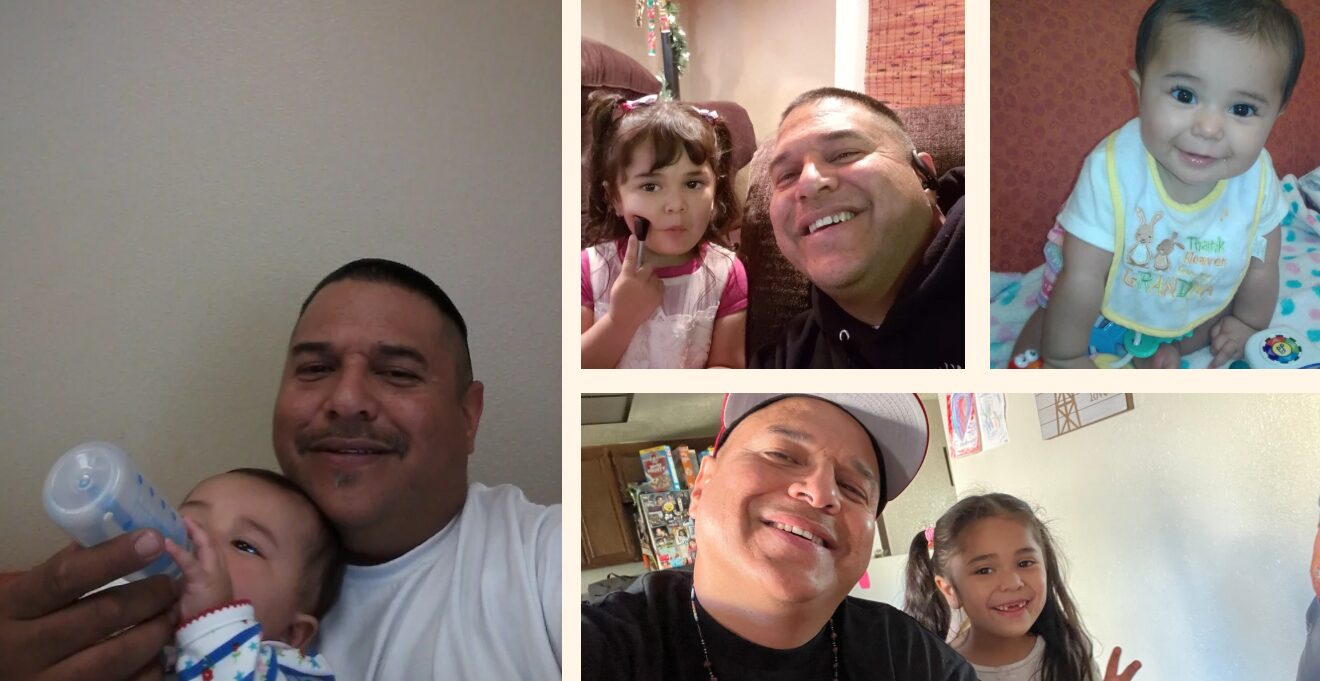
Fidel Chagolla’s daughter was just six weeks old when California child protective services took her, after the girl’s mother tested positive for opioids when giving birth to her, which he says was from taking tylenol with codeine that had been prescribed by a dentist. Chagolla wasn’t allowed to take custody because of his previous conviction for a violent felony, even though it was unrelated to children and he had been out of prison for six years.
In the two years that followed, Chagolla could only see his daughter during visits to a child welfare office. During those supervised visits, Chagolla remembers bringing his baby a stroller, a car seat, diapers, clothes, and formula. As she grew into a toddler, he would feed her, play with her, and make her laugh by making funny faces during those visits to the office. She was little, but he wanted to make sure she knew he was there.
“That’s all I could do,” Chagolla said. “I would always try to make sure I brought stuff for her every visit, every chance I got. The impact is very emotional. It’s draining, unfair.”
People who lose custody of children are typically offered child welfare services to attempt to reunite families—such as a social worker who helps parents develop a case plan to resolve whatever issues led to their child being taken away. Those services could also include parenting and domestic violence classes, transportation to visits, therapy, housing assistance and more.
But under California state law, people with previous convictions for violent felonies are denied those services. As a result, formerly incarcerated people often have their parental rights permanently terminated, even if they’ve already served their time and worked to turn their lives around since their conviction.
Sign up for more news on the criminal legal system
Subscribe to our newsletter
Chagolla didn’t get meetings with a child welfare social worker to discuss how to get his daughter back, or referrals to classes that could have helped him during the two years he went to court to fight for his parental rights, which he says were ultimately terminated in 2018.
The last visit after his parental rights were terminated was emotional. As time ran out, he tried not to think about losing his toddler, not knowing if he’d ever see her again. Before he had to hand her back to the woman taking custody of her and leave the office, he made his daughter a promise that he’d never stop fighting to get her back.
“I didn’t know how, but I told her that I’ll never stop trying to get her back, and I’ll figure out something so I can get her back, because I’m not giving up,” Chagolla said.
Now, nearly a decade since losing his daughter, Chagolla is still trying to keep that promise.
When Chagolla was a student at the University of California, Riverside, he met and started to share his story with community organizations led by formerly incarcerated people like Starting Over Inc., a nonprofit that provides assistance with reentry and family reunification. Upon hearing his efforts to get his daughter back, some of the organizers explained how he could change the policy through passing a new law. They began meeting regularly to draft a bill that would give people with violent felony convictions a better chance of reuniting with their children. Instead of summarily denying reunification services for people with past violent felonies, the reform Chagolla helped write would require judges to individually assess people’s cases before determining whether the state can withhold those services.
“I never had a clue you could change the law,” Chagolla said. “But from being a part of all these different organizations … I’ve learned that yes, you can change them, and the way they get changed is by people that have been directly impacted to talk about what those experiences have been.”
The first version of the bill, filed in 2023, failed to advance. Then last summer, the most recent version of the legislation, Assembly Bill 1201, cleared the state Assembly, after lawmakers amended it so that people whose felony convictions that included child abuse would still be excluded from those services, as well as people with convictions for which “the victim was someone with whom the parent or guardian had a child in common at the time of the commission of the offense.” The amendment erased the only public opposition the legislation had faced from some individual counties and California County Welfare Directors Association.
The state Senate passed the bill in August during the final days of the state’s two-year legislative session, and it is now on Governor Gavin Newsom’s desk awaiting his final approval.
Chagolla says the reform “doesn’t mean it’s going to automatically give your children back to you, it just means that you’re going to be able to work towards getting your children back.”
He added, “I was never given an opportunity to work towards getting my daughter back.”
Assemblymember Corey Jackson, who carried this year’s version of the legislation, said the reform sends the message “that we can’t give up on each other, and there is always the possibility of redemption.”
“At the end of the day, everyone is stronger, including the community and including California, when we can keep families together, and the fact that we took out the ability for judges to look at each case individually, I think has been a disservice to everybody,” Jackson told Bolts. “And so we are righting a wrong, and I think we’ll have stronger families because of it.”
California’s current law denying child welfare services to people with violent felony convictions who are seeking custody of their children, known as automatic bypass, is one of the harshest in the country, according to legislative analysis that accompanied this year’s bill; Illinois is the only other state that summarily denies reunification services to parents who have previous convictions for a violent felony. Montana and New Mexico have no restriction on the provision of reunification services to parents based upon their past criminal history, while the rest of states have restrictions that are somewhere in between the two extremes.
According to the legislative analysis, people of color in California are disproportionately impacted by the state’s restrictions on reunification services, as 11.4 percent of Black children and 3.5 percent of Latino children in the state have an incarcerated parent, compared to 1.8 percent of white children.
Chagolla says his work with Starting Over and other groups advocating for formerly incarcerated people underscored how his case was far from uncommon. He also recalled how, in his efforts to get his daughter back, the current system reduced him to an old felony charge.
“Right away [the social worker] looked at my background record. She saw my charges that were old, and she right away was like, ‘Oh no, we’re gonna remove your child. You got to go to court,’” Chagolla said.
He said the experience reflects how formerly incarcerated people, even when they’ve sought redemption and turned their lives around, “are constantly looked at as the worst of the worst.” In Chagolla’s case, he’s received three degrees since he was incarcerated, including a master’s in clinical mental health counseling, more than 20 certificates, and a court order declaring that he’s been rehabilitated, which makes him eligible for a pardon by the governor.
Yet he’s still unable to regain custody of his daughter, who’s now 10 years old.
Chagolla says that he never even got to see his daughter for the two years that followed the termination of his parental rights, but eventually, the family that adopted her allowed him to be a part of her life. “The only thing is, it’s not on my terms,” he said. “The people never even told her that I’m her dad, they tell her that I’m her tío, because they said that they don’t want to confuse her, and that those are the terms.”
He says it’s like serving time never ends.
Jackson, the lawmaker championing the reform to reunification services, said, “There are great stories of people who have completely rehabilitated themselves, who are an asset in their community, leaders in the community, leaders in the state, but because of their past records, they are still being denied the ability to be reunified with their children.”
Amethyst Yates, who has also worked with Starting Over to advocate for changes to the reunification law, explained how devastating the process can be for formerly incarcerated parents.
“You have a parent that has already been through a lot, whatever got them in the situation to begin with for them to commit a crime, and then they get out, and then they lose their baby to the system,” Yates said. “They feel very defeated and very depressed.”
Yates said that when people have to fight to regain custody of their children, the threat of losing access to their children indefinitely impacts them mentally, and can even cause financial stress if they’re paying on their own for any parenting and domestic violence classes or substance abuse treatment that might interfere with their job hours. She called it “nearly impossible” to reunite with children if they are turned over to the foster system when the parent has a violent felony.
Yates knows the feeling personally. It took her 11 years to find her children after she got out of prison, but even then she was denied reunification services and could never regain custody.
“Now my children are in my life in some capacity, but [the system] was no help,” Yates said.
As someone who was in foster care herself when she was younger, she also understands the impacts that separation could have on children. Every time her mom would get close to regaining custody, Yates would be moved to another foster home, which she said affected her mental health.
By the time her mother regained custody, Yates said they “gave her back a very broken child” with no resources to help. She said she felt unworthy and like she did not belong anywhere, and later sought validation from people who didn’t have her best interests in mind because she internalized being “bad” and acted accordingly.
“If the system is telling [children] that their parents are bad, even if it’s indirectly, the children will internalize that as they are part of their parents, so therefore they are bad, and it leads to a bunch of trauma for the children,” Yates said.
Sign up and stay up-to-date
Get timely updates about pressing stories and elections.
Support us
Bolts is a non-profit newsroom that relies on donations, and it takes resources to produce this work. If you appreciate our value, become a monthly donor or make a contribution.