
In a Final Act, New Jersey Governor Opens Jury Service to Thousands with Convictions
New Jersey has been one of the harshest states in banning people with records from juries. Murphy’s order restores eligibility to over 300,000, but stops short of permanent change.
| January 14, 2026

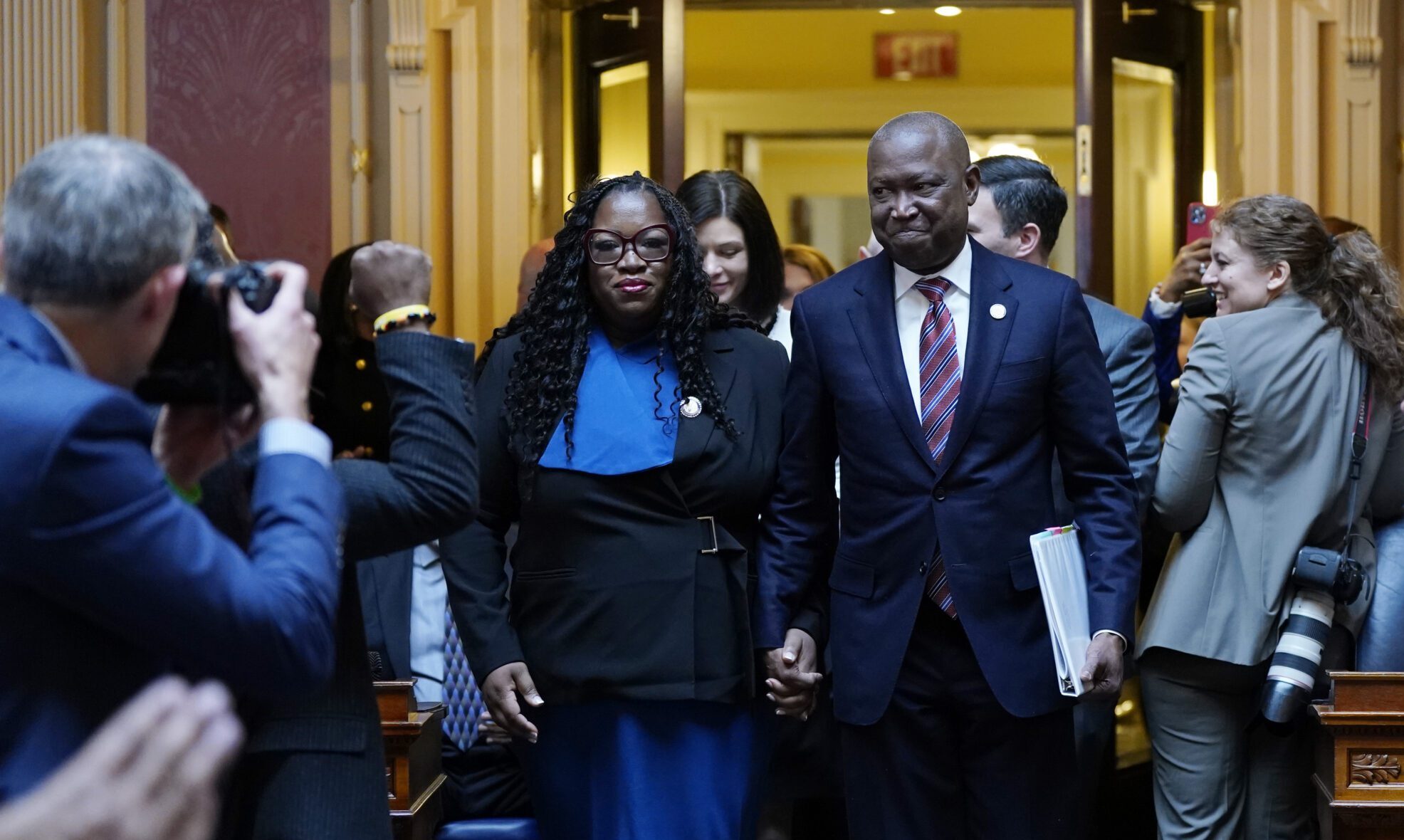
On Sunday, coming up on his last full week in office, New Jersey Governor Phil Murphy stood at the lectern of the New Hope Baptist Church in East Orange to announce one of his final executive actions: restoring the eligibility to serve on juries for some 350,000 people who’d been blocked due to prior criminal convictions.
“As we observe Martin Luther King Jr. week, we are reminded that, in his words, ‘Justice too long delayed is justice denied,’” Murphy, a Democrat elected in 2017 who will reach his term limit next week, told congregants at New Hope, a Black church with a tradition of social justice advocacy. “Today, literally hundreds of thousands of New Jerseyans will finally be able to once again participate in our justice system and help us build a state where the rule of law is secure, and the dignity and worth of every person is protected.”
He signed the executive order from the lectern and gifted his pen to Dameon Stackhouse, a formerly incarcerated man who has spent years trying to convince state policymakers to take this very step. Stackhouse and various colleagues had recently leaned on Murphy to issue the order before he steps away next week and is replaced by Governor-elect Mikie Sherrill, also a Democrat.
“It’s monumental,” Stackhouse told Bolts on Monday. “If I am sent a letter saying I should come in for a jury, I am excited to go through the process. I’ve been telling family and friends that when they get a letter and they try to get out of jury duty—no, you should be excited to be involved. I am.”
For more stories about rights restoration
subscribe to our newsletter.
Murphy’s order, which went into immediate effect, marks a significant shift for New Jersey, which, as Bolts previously reported, has been unusually harsh in its exclusions from jury pools.
Though every single state excludes at least some people with criminal convictions from juries, New Jersey’s rules go further than most. The state imposes a lifetime ban on jury service for anyone convicted of any “indictable offense”—a category inclusive of felonies and lower-level crimes that would be considered misdemeanors in other states. Only four other states—Maryland, Pennsylvania, South Carolina, and Texas—are that restrictive.
The executive order will now enable people with past convictions who have already completed a sentence, including any post-incarceration period of parole or probation, to serve on a jury. The change means that the pool of eligible jurors in New Jersey will instantly become much more reflective of its demographics.
New Jersey’s restrictive policy has had the effect of severely distorting its jury pools, warping what it means to be tried before a jury of one’s peers: Because New Jersey’s criminal legal system, like all others around the country, disproportionately targets people by race, more Black New Jerseyans end up with criminal convictions on their record. As a result, about 25 percent of Black adults have been banned from serving on a jury in the state, according to estimates by the New Jersey Institute for Social Justice, where Stackhouse works as a policy fellow. Murphy on Sunday said that, overall, four percent of New Jersey adults were affected by the state’s lifetime ban on jury service.
“All of us have been denied the promise of being judged by a jury that truly reflects our communities,” Murphy said at New Hope. “A justice system that does not look like the people it serves is not built to serve, frankly, any of us.”
The order is a fitting bookend for Murphy, who in 2019, during his first term, signed a bill to restore voting rights to some 80,000 people previously blocked from the ballot because they were still on parole or probation.
Research shows that more diverse juries are less quick to convict, and that they deliberate longer and more carefully. One study done in the Houston area found that proportionate representation on juries could reduce median sentence terms by 50 percent.
Stackhouse, who is Black, remembers well how New Jersey’s jury distortion hit him when he was tried for armed robbery two decades ago. He’d felt confident in his case, but then jury selection began and he noticed no Black men in the room. He spent 12 years in prison, and his scarring personal experience with jury selection helped motivate him to push for reform after his release.
That push does not end with Murphy’s order, however. The governor only has the power to restore jury service retroactively, to people convicted on or before Jan. 10 of this year. It cannot change the rules going forward, so anyone convicted after Jan. 10 will still face a lifetime ban. Lasting reform would have to come from a permanent law change.
The state legislature has since 2018 considered various bills to reform jury service eligibility, but none has passed. The most recent iteration of the bill, introduced in the 2024-2025 session, fizzled in the state Senate after having cleared the state Assembly.
Stackhouse said of the prolonged stall in this Democrat-controlled state, “The stigma behind individuals with a criminal background, them not deserving an opportunity to be fully restored to society—that’s a stigma that has always prevailed in America. Most times, we are considered less than citizens.”
Murphy’s order helps melt some of that stigma, Stackhouse said, but he added that it’s only “a first step.” Without permanent reform, New Jersey’s juries will in time revert back to being distorted. The state holds some 13,000 prisoners at any one time, and has one of the nation’s highest racial disparities in prisons.
New Hope’s pastor, Thurselle Williams, encouraged lawmakers to “keep going until justice” is cemented on this front. “We’re all supposed to be with our peers,” she told Bolts. “If you’re not being judged, if you will, by people from your communities, your walk of life, your age, then there’s a whole population of people that are missing.
“They have paid their debt to society. Why should they be excluded from this right when they’ve come out and are sharing in all the other burdens of society? Shouldn’t they share in the benefits, too?”
Sign up and stay up-to-date
Support us
Bolts is a non-profit newsroom that relies on donations, and it takes resources to produce this work. If you appreciate our value, become a monthly donor or make a contribution.