

Maryland, New Mexico Become Latest Blue States to Ban Local Contracts with ICE
Governors Lujan Grisham and Moore signed laws barring local sheriffs and police from partnering with ICE’s 287(g) program, joining eight other states with similar prohibitions.
| February 19, 2026

Jordy Diaz and many other immigrant rights advocates in Maryland were crushed last spring when the legislature, in the final hours of its 2025 session, declined to pass a landmark bill to ban local law enforcement agencies in the state from partnering with ICE. The Trump administration’s assault on immigrants was just a few months underway, and these advocates told Bolts at the time that they felt betrayed when Democrats, who control every level of state government, failed to pass the ban.
ICE has grown, and grown more deadly, in the months since. That failed 2025 bill returned in January, and this time it swiftly passed both chambers. On Tuesday morning Governor Wes Moore signed it into law, amid thunderous chants of “Si se puede!” from a grateful audience of supporters.
“They’ve corrected a wrong that should have been taken care of last year,” Diaz told Bolts. Diaz is a citizen but has many friends and family members vulnerable to deportation. “This alleviates some concerns,” he said.
The bill Moore signed bans law enforcement agencies from partnering with ICE through the federal 287(g) program, which deputizes local and state officers to act on ICE’s behalf, including by detaining people in jails past their scheduled release dates, then transferring those people to ICE custody. This program is a crucial force multiplier for ICE, largely because it expands ICE’s access to jails and prisons, where it can intercept people in greater numbers, and with greater ease, than in the field.
For more on local impact immigration enforcement
Subscribe to our newsletter
The 287(g) program has been a tool for federal immigration authorities for decades and has been used at varying, relatively low levels under previous administrations. But the program has exploded in popularity since Donald Trump returned to office: About 130 state and local agencies around the country had 287(g) contracts in January of 2025, and today more than 1,300 do. Maryland was home to nine of those agreements as of Moore’s bill signing; all nine come from sheriff’s offices, which must terminate their agreements as a result of the new law.
One of those sheriffs, Republican Chuck Jenkins of Frederick County, is a longtime 287(g) participant connected to far-right networks. He is also notable for being one of very few sheriffs anywhere in the country participating in the program in a county Kamala Harris carried in 2024. Jenkins is up for re-election this year, alongside every other county sheriff office in Maryland.
The Maryland reform immediately follows a similar law adopted this month in New Mexico, which will, among other things, ban 287(g) agreements in that state. And in January, Maine also adopted a law that bars local and state agencies from joining the program.
Maryland, Maine, and New Mexico join six other blue states—California, Connecticut, Delaware, Illinois, Oregon, and Washington—in adopting laws to ban local and state agencies from partnering with ICE’s 287(g) program. New Jersey has a ban in place through an executive directive, though the state’s outgoing governor vetoed a bill that would have codified it into law in January.
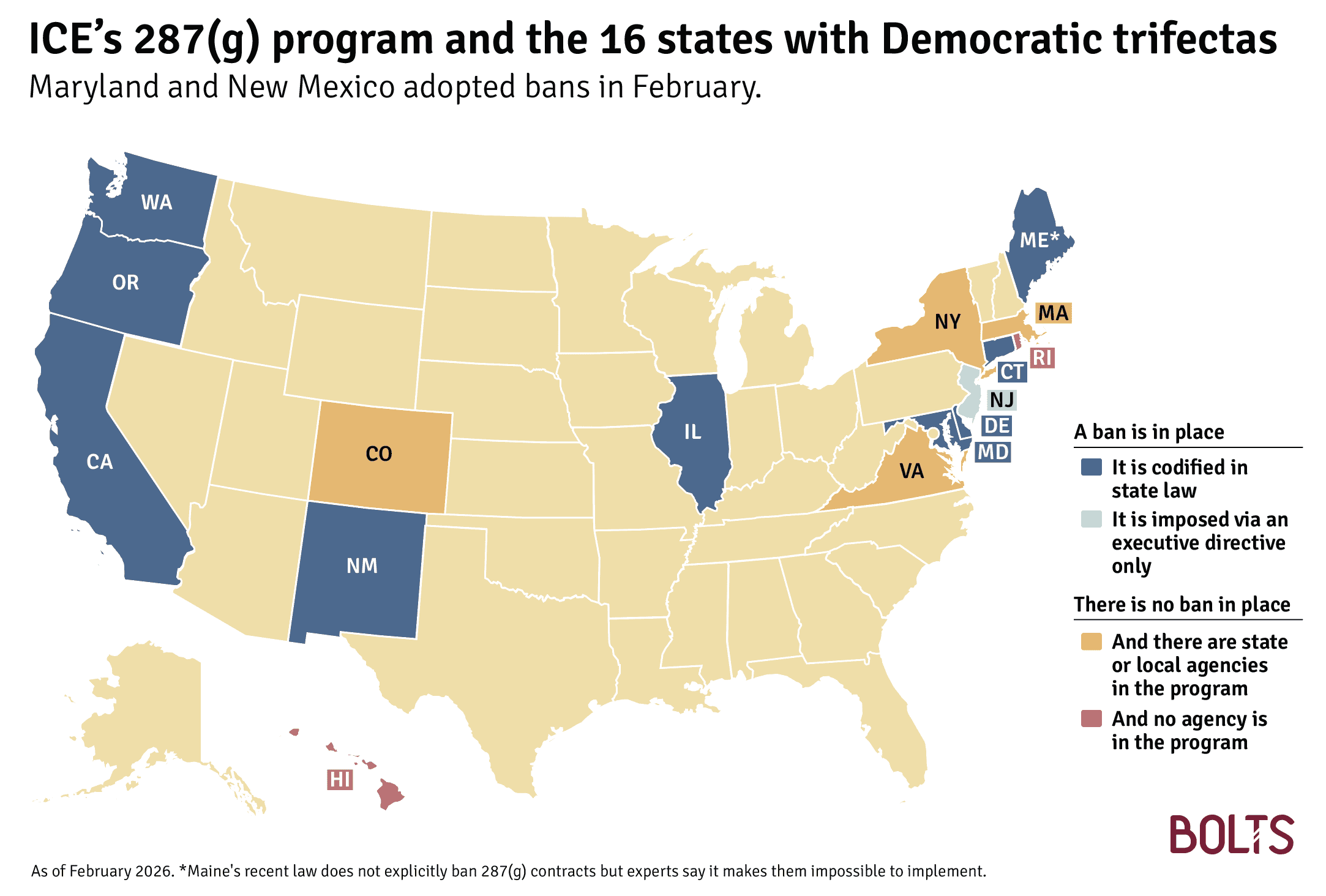
Four states under full Democratic control—Colorado, Massachusetts, New York, and Virginia—still have local or state agencies that have joined the 287(g) program, though there is currently active legislation in at least three of those states to limit or end these contracts.
Democratic state Representative Angelica Rubio, who sponsored New Mexico’s reform, joined the legislature in 2017 and has been trying ever since to pass a bill to ban local ICE cooperation. “I was getting a lot of pushback from my own party,” she said.
Rubio believes this year’s bill was finally viable because the Trump administration and Congress have ballooned ICE into an $85 billion behemoth inflicting violence on non-citizens and citizens alike.
“What we’re seeing across the country is what we’ve been seeing on our border for decades,” said Rubio, whose district is just north of the Mexico border. “Now, it’s reaching a point where it’s so much more visible, so much more violent, and that’s why I think we were able to get it over the finish line this time: Legislators who didn’t support it before are seeing how rapidly the machine has moved, and I think that’s put a lot of fear into them.”
In addition to banning 287(g) contracts, the New Mexico law also prohibits state entities from contracting with the federal government to warehouse immigrant detainees. These arrangements, through ICE’s Intergovernmental Service Agreement program (IGSA), currently exist in three parts of New Mexico: Cibola, Otero, and Torrance counties.
The new state law will effectively shut down those three counties’ detention programs, and prevent any future ones.
New Mexico currently has just one 287(g) contract, in Curry County, which is rural and borders the Texas panhandle. The local sheriff there, Republican Michael Brockett, had defended the program, telling Source New Mexico that “keeping our communities safe is a team effort.” But under the newly adopted law, Curry County must notify ICE that it’s terminating the contract no later than May 20.

Becca Sheff, a senior attorney with the ACLU of New Mexico, told Bolts that advocates in the state worried other counties would soon join Curry County if the legislature did not act. “The political climate made it really clear that there is an acute risk of our state law enforcement being co-opted by ICE to do their dirty work,” Sheff said.
Those fears had already been realized in Maryland, where six of the nine sheriffs who joined the 287(g) program did so since Trump’s second inauguration. According to data shared with Bolts by the state public defender office, 287(g) counties in Maryland combined to transfer at least 218 people into ICE custody between January and October of last year, with two-thirds of those people having not been convicted of whatever alleged offense had landed them in jail to begin with.
Opponents of Maryland’s bill, which passed the overwhelmingly Democratic legislature on party-line votes in both the House and the Senate, argued that banning 287(g) would promote violent crime in Maryland. Ahead of the final votes on the legislation in both chambers, several Republican lawmakers focused on various sexual offenses committed by immigrants in the state over the years, suggesting that banning 287(g) would facilitate more of those crimes in the future.
But data shared by the public defender’s office highlight that the majority of people ensnared by 287(g) have not, in fact, been convicted of any crime—much less a serious one. And the new law does not stop law enforcement agencies from contacting ICE to coordinate the transfer of any particular individual into federal custody.
Immigrant rights advocates see that as a loophole. “Outside of 287(g) partnerships, which obligate local officials to act as deputized ICE agents in every case and to follow ICE’s orders 100 percent of the time, there’s still a wide range of policies with less formal types of collaboration,” said Stephanie Wolf, director of immigrant services at the state public defender office.
“What’s legal right now, generally and statewide, is that police officers may communicate with ICE,” Wolf continued. “Without 287(g), they’re not allowed to interrogate someone about their immigration status or prolong a detention based on a suspicion, but there’s no prohibition on police officers calling ICE and providing them with information. The same is true of jails. So, that problem will remain.”
Moore, the governor, nodded to this when he signed Maryland’s reform, saying that Maryland will keep working with federal authorities in cases involving “the worst of the worst” crimes. “We do not take violent offenders lightly. We are going to make sure our communities are safe from people doing violent harm to them,” he said.
Like New Mexico lawmakers, those in Maryland have also lately focused on immigrant detention, in addition to 287(g) contracts. While Maryland already banned IGSA contracts in a 2021 law, lawmakers this year are now scrambling to try to thwart federal immigrant detention camps from being built in the state with two bills that would create new standards and oversight for immigrant detention in the state and require local approval for private prison companies to create new detention centers. The Department of Homeland Security earlier this month purchased a warehouse in Hagerstown, Maryland, for $102 million with the intention of using it as a detention facility.
When Maryland’s 2025 reform was being debated last session, some Democratic leaders in the state openly questioned whether it was unwise to ban 287(g) and, in so doing, attract the attention and ire of a retributive president known to target political opponents. The proposed Hagerstown warehouse changed that conversation and helped this year’s reform pass, Democratic House Majority Leader David Moon told Bolts.
“We’re all very well aware of the risks of the administration lawlessly directing resources at political retaliation,” Moon said. “But nevertheless, we’ve got to do the right thing. And, in fact, a lot of the things people learned about last year, as reasons not to stand up to Trump, they’re doing anyway. They’re building an immigrant internment camp in western Maryland. If that’s the kind of thing we were trying to avoid, well, it’s coming.”
Rubio, the New Mexico lawmaker, says she’s happy to see the reforms in Maryland and Maine, but that she also wants Democrats to remain vigilant about ICE beyond the current administration.
She says that what she opposes about local 287(g) agreements existed long before Trump retook office, including under the Obama and Biden administrations: ICE, she says, has long trampled due process and constitutional rights while making people scared to report crime or otherwise interact with government, out of fear they or someone they know will get deported.
“I’m glad this is becoming more mainstream,” Rubio told Bolts. “But these are issues that a lot of us organizers have been talking about for decades.”
Sign up and stay up-to-date
Get timely updates about pressing stories and elections.
Support us
Bolts is a non-profit newsroom that relies on donations, and it takes resources to produce this work. If you appreciate our value, become a monthly donor or make a contribution.
Related Posts