
This Wisconsin City Ditched AI Surveillance Cameras. Now Activists Want to Keep Going.
Some cities are opting out of camera networks like Flock’s, concerned about abuse by police and immigration authorities. Organizers hope Dane County is the “next big domino” to fall.
| March 18, 2026
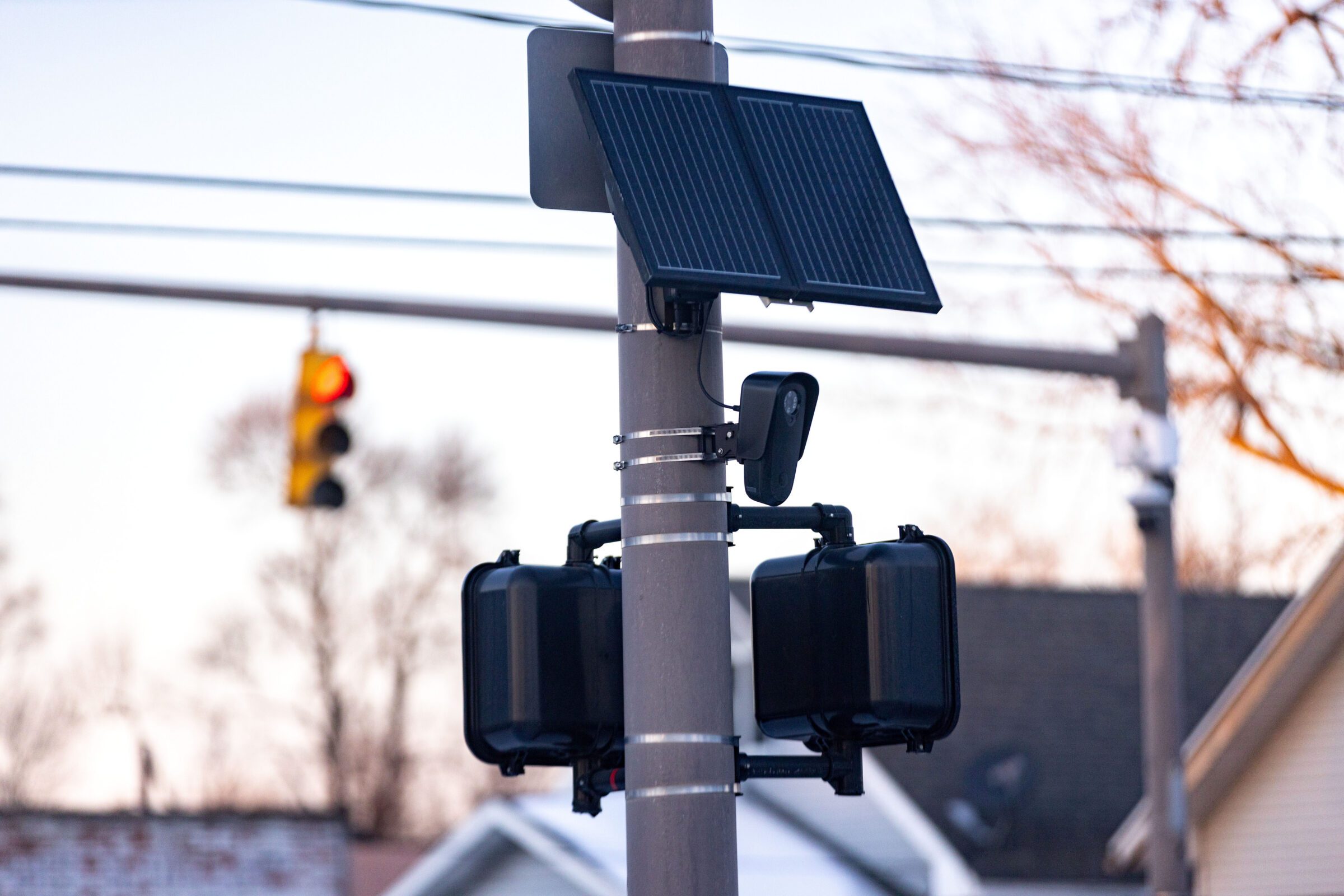
Last November, the city of Verona, Wisconsin, voted to pull out of the sprawling surveillance network run by tech company Flock Safety in hopes of protecting residents’ privacy and preventing the cameras installed around the city from being abused by police.
At the meeting where the Verona Common Council voted on the city’s contract with Flock Safety to operate the cameras, community members testified that the safety benefits of the cameras were not worth the risk.
But in the months after the city chose to end its agreement with Flock, Mayor Luke Diaz noticed that the cameras were still up.
City officials reached out to Flock to demand they take down the three cameras placed around the small town, a suburb of the state capital of Madison. But, Diaz told Bolts, the company effectively ignored their request, while at the same time a sales team contacted them to try and sell them a new contract. “They didn’t have enough time to send a technician out here for the cameras, but they did have sales people reaching back out to us,” Diaz said.
Flock has insisted the cameras were not operating for the months they remained up after Verona ended its contract, but Diaz says there is no way to be sure, especially given the company’s record of privacy breaches.
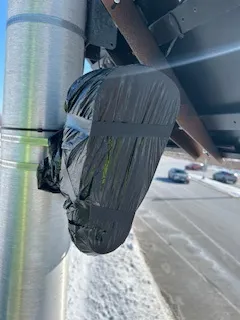
So, concerned that the cameras may still have been spying on residents, Diaz had the city cover them with black plastic bags in January. Only then did the company agree to take down the cameras.
“I imagine having cameras in their network with plastic bags over them kind of messes things up on their end,” Diaz said. “Having garbage data going to their network, I imagine they want to clean it up.”
Subscribe to our newsletter
for more stories about policing
Diaz suspects the company was so slow to pull out of Verona because their priority isn’t just selling the cameras to police officials, who often enter into contracts with Flock without the approval or even knowledge of local elected leaders, but rather growing the massive surveillance network its customers can access nationwide.
“The fact that they didn’t take the cameras down shows that we are the product,” Diaz said. “They were never really selling to us in the first place. What they are doing is selling to much bigger agencies the ability to spy on a ton of people.”
Since its founding in 2017, the Atlanta-based Flock Safety has seen a massive growth in its network of surveillance cameras in Wisconsin and across the country. According to the company’s own estimates, more than 5,000 law enforcement agencies nationwide now contract with Flock for its searchable camera network, which uses AI technology to read license plates and identify other vehicle features—such as make, model, color, and even minor details like dents and bumper stickers.
But this proliferation has been met with widespread outcry by residents and advocates fearful of how the footage and precise geolocation capabilities could be used—especially by the federal government. Verona’s success in ending its contract with Flock coincided with a larger push by activists to retire the cameras to ensure federal immigration authorities cannot access its data to track people amid President Donald Trump’s escalation of immigration raids—something they fear is already happening. Cities from Denver to Evanston, Illinois, have ended their contracts in the last year, while continued revelations about how police use the company’s network has ignited heated debates in other cities that are reconsidering the surveillance technology.
And in the wake of Verona’s effort, other local governments in the region are now facing similar pressure from residents to cut their ties with Flock, including heavily Democratic Dane County, which is home to Verona and Madison.
Diaz, the Verona mayor, points to Dane County’s contract as “the next big domino locally” to fall as surveillance has emerged as a key issue at demonstrations against ICE.
“You are giving ordinary law enforcement the power to track and know an entire city’s movements,” said Jon McCray Jones, a policy analyst with the ACLU of Wisconsin. “Surveillance can be weaponized. It leaves us ripe for abuse.”
Flock’s surveillance of the broader region has continued even after the company finally agreed to remove Verona’s cameras. The company still operates roughly 25 others that were installed along most major highways in the region by the sheriff of Dane County and those installed by other towns in the county. Advocates have warned that the expansiveness of Flock’s camera system has made it exceptionally difficult to completely unplug from the network, leaving communities to be surveilled with little oversight and without the consent of their elected leaders.
Many residents in Verona were unaware of Flock’s cameras in the city until shortly before the contract was set to automatically renew, which came after numerous other cities pulled out of the network after their data was misused. Officials were never initially asked to greenlight them, since the camera system was purchased by the police department using its usual technology budget.
“The ability to spy on us is being sold to much bigger players, and to me, that’s another indication of the cameras need to come down,” Diaz said. “The whole point of Flock is that it’s a network, and the more people you have in the network, the more people you have accessing and using it, the stronger it gets.”
Like in Verona, other Flock cameras in the region weren’t approved by the Dane County Board of Supervisors before the local sheriff’s office installed them. When Jade, a longtime Madison resident, learned that the county had joined the surveillance network, they created DeFlock Dane County, a project to map the cameras in the region and uncover how data gathered by them is shared. (For privacy reasons, Jade preferred to use only their first name.) The project builds on the work of DeFlock.me, a larger crowdsourcing website that has mapped thousands of Flock’s cameras around the country, and which is managed by a Denver resident who has faced legal threats from the company over it.
Jade told Bolts that in the absence of much public debate about the cameras, the project is meant to give residents an opportunity to voice their misgivings and convince their leaders to pull the plug on Flock. They said Dane County is one of the more progressive areas of Wisconsin, where officials are generally responsive to issues raised by their constituents, but few residents were even aware of how they were being watched due to the “secretive and undemocratic” way in which the Dane County Sheriff’s Office set up the surveillance system.
“People did not have a consensual, popular agreement to work with these tech companies, and the police were collecting this data without our knowledge,” Jade said.
“Getting things into the light is the first step, and that is part of why we are starting to see this pushback,” they continued. “People just don’t trust the surveillance state, and that’s something that’s going to keep growing as people realize that there’s nothing really holding back all this technology from growing in a way that just takes our data and uses it for horrible purposes.”
Flock has a transparency portal that shares a limited amount of information about its cameras across Dane County, including how many have been installed and a list of agencies that can access them. But it doesn’t disclose the location of its cameras in the area, or which agency operates them, and has been hostile to activists’ efforts to map where they are. Last year in an interview with Forbes, the company’s CEO called DeFlock.me, the broader grassroots effort, a “terroristic” project. The company declined to answer questions Bolts sent for this story.
In response to a public records request for the locations of the cameras, Dane County Sheriff’s Office told Bolts the department “does not maintain an existing record of a list of the locations of the Flock cameras.”
To cut through the secrecy around Flock surveillance, DeFlock Dane began crowdsourcing information to create its own map of the cameras, though its map is incomplete and there is often no way of knowing what agency installed the equipment, Jade told Bolts. Locals have reported dozens of Flock cameras across the area and added them to the DeFlock map, which shows the location and direction of the cameras.
DeFlock Dane has also begun releasing contract documents between Flock and local governments, including an agreement with the sheriff that shows the Flock subscription was initially purchased for $68,750 using a grant funded by a separate surveillance company, Axon Enterprise. A spokesperson for the sheriff told Bolts in an email that “the board did not have to approve it because there was no cost to the county.”
The sheer breadth of Flock’s network also amplifies the risk of leaks, breaches and sensitive data being used for immigration enforcement or abused in other ways. Officers have repeatedly been caught using the camera network to stalk romantic partners, including in Milwaukee. Flock cameras have also been used to spy on No Kings Day protesters and to track at least one person who’d gotten an abortion. Flock has said it does not partner with ICE for data sharing, but that doesn’t mean federal agencies can’t still access parts of its nationwide network.
Wisconsin has few privacy restrictions that limit surveillance and data sharing: Flock’s cameras record any passing cars regardless of any suspicion of a crime, and police don’t need a warrant to access or share the footage they capture. There are no state laws limiting when federal agencies can access local surveillance networks. Even when local governments try to establish their own restrictions, there have been breaches; for instance, even though Verona’s police chief had told city officials that his department had disabled data-sharing with federal agencies, access log data presented at the November council meeting and reviewed by Bolts showed that this was not the case.
The data show that Verona’s camera networks were accessed in nearly 3,200 searches by Border Patrol as part of broad sweeps that also included thousands of other cameras in towns and cities around the country.
This is not a unique occurrence: 404 Media uncovered last year how even in states like Illinois and California, where sharing data with ICE is illegal, federal officers still get backdoor access to data from Flock cameras with the assistance of out-of-state police departments that were in the Flock network and had no data-sharing restrictions. According to McCray Jones, the ACLU analyst, these kinds of leaks are inevitable when data is shared across a sprawling web of agencies that all have different privacy rules.
Police leaders are often the “sole decider of what surveillance technologies are being used,” McCray Jones said. The costs of relatively small surveillance contracts are often not included in public safety budgets for lawmakers to review, and cameras purchased using grants can “skirt around the power of the purse,” he said.
Elsewhere, Flock has offered cameras for free to police departments, another way to maneuver around a vote by city council. Denver lawmakers voted down a $666,000 renewal of the city’s contract with Flock last year after reports surfaced that its cameras had been accessed thousands of times by ICE, despite the state’s ban on sharing data with federal immigration agencies. But the cameras remained in place after the mayor secured a no-cost extension deal to keep the cameras up that didn’t need approval by the whole council.

Advocates have pointed to the porous information sharing networks between law enforcement agencies to call for guardrails around the use of surveillance technology. A coalition of groups including the national ACLU have pushed for local governments to enact laws that require explicit approval by lawmakers before police use any new surveillance equipment. Advocates have endorsed a model policy called the Community Control Over Police Surveillance ordinance (or CCOPS) that has already been adopted in cities like San Francisco, Detroit and New York City, that requires local police to disclose the tools they already use and follow a public approval process before rolling out new technologies.
“When elected officials have to vote and pass to allow law enforcement to use this technology, they need to become more responsive to their constituents,” McCray Jones said. “It democratizes the conversation around privacy and surveillance.”
Wisconsin’s capital, Madison, does not have its own Flock camera system, and it already has a CCOPS ordinance on the books that would require a public approval process before adopting any new surveillance tech. But there are still Flock cameras in and around the city, including the ones the Dane County Sheriff installed, as well as those set up by Wisconsin State Capitol Police and by police on the UW-Madison campus. A spokesperson for the UW police told Isthmus, a local news outlet, that their department automatically shares flock data with other law enforcement agencies within Wisconsin, but that federal requests are looked at on a “case-by-case basis.”
“The city can have these restrictions but every other jurisdiction can do its own thing. You can outsource the cameras to less progressive jurisdictions,” Jade, who created DeFlock Dane County, told Bolts.
Verona’s decision to remove Flock’s cameras has prompted other towns in the county to reconsider their agreements with the company. In Middleton, another Madison suburb, some residents who’d heard about Verona’s troubles with Flock questioned whether the technology is worth the risk at a February council meeting, though the city has not taken a vote on the issue.
This action may also have moved the needle in Dane County government—the Board of Supervisors on March 19 announced a resolution that would remove funding for the Dane County Sheriff’s Office’s 24 Flock cameras, which account for a large portion of the network in the area. In a press release announcing the resolution, Chad Kemp, the supervisor of District 32, which includes Verona, said, “Public safety tools must not come at the expense of privacy, data protection, or fundamental human rights.”
Diaz says other towns in the area with relatively few cameras would be far more likely to drop out of the surveillance network if the Dane County Sheriff’s Office first unplugged its cameras.
“Once they’re out in Dane County, they become less useful for other law enforcement agencies. It makes it easier for them to say, ‘Maybe we don’t need this tool.’” Diaz said.
Update (March 20): This story was updated to include the announcement of a Dane County Board of Supervisors resolution to end the sheriff department’s funding for Flock cameras.
Sign up and stay up-to-date
Get timely updates about pressing stories and elections.
Support us
Bolts is a non-profit newsroom that relies on donations, and it takes resources to produce this work. If you appreciate our value, become a monthly donor or make a contribution.