

Conservatives Play Musical Chairs to “Cement” Majority on Arkansas High Court
How seat-switching, plus a new state law, is helping gubernatorial appointees reap the benefits of incumbency before they’ve earned it from voters.
| February 11, 2026
In Arkansas next month, two supreme court justices are seeking re-election, sort of—neither is running for the seat they currently hold, but rather for each other’s seat on the bench.
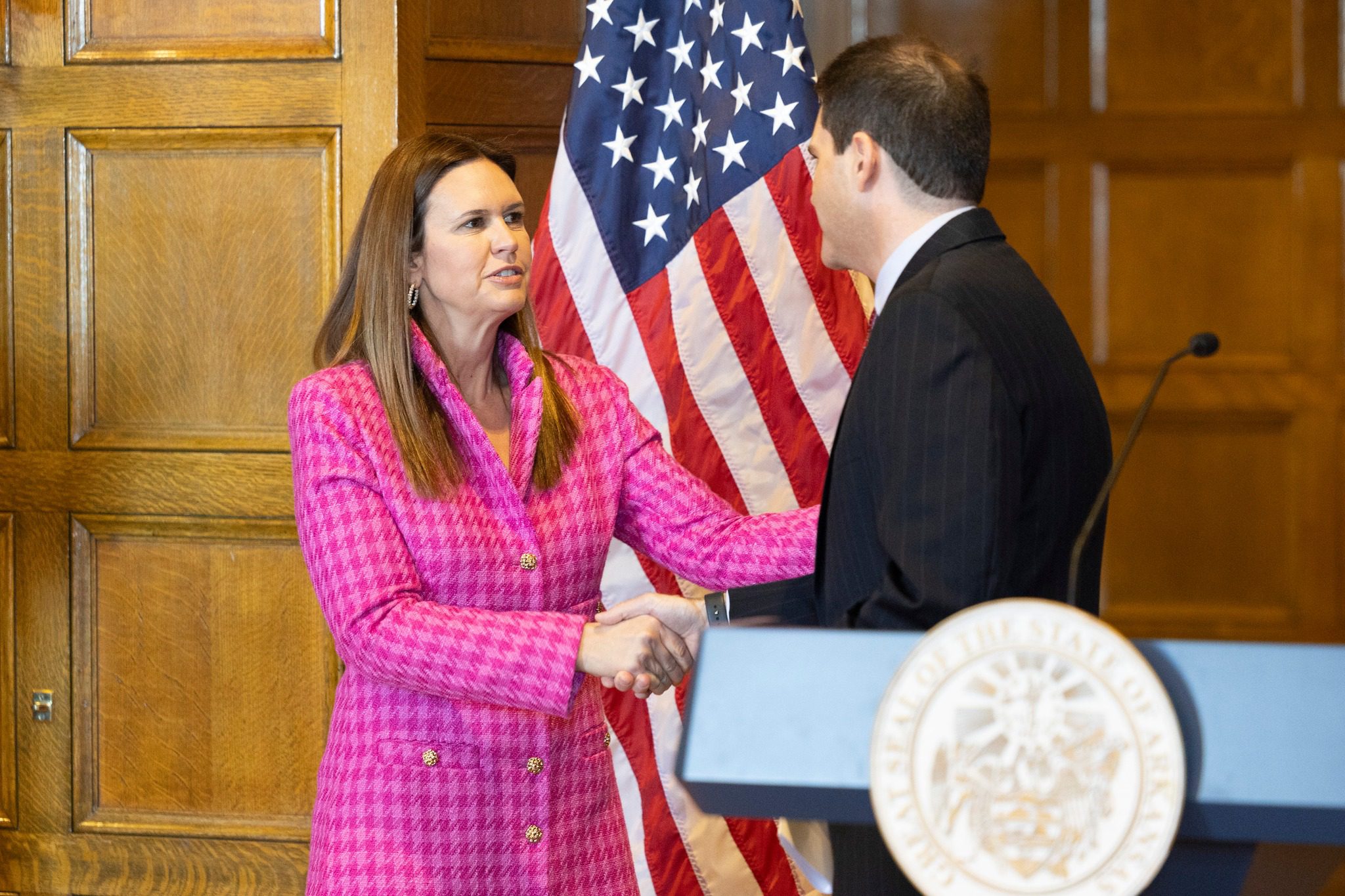
Nick Bronni and Cody Hiland were both appointed to the state supreme court in late 2024 by Governor Sarah Huckabee Sanders. Technically, both were barred from running to keep their place on the court this year since the Arkansas constitution forbids officials who were appointed to fill a vacancy to then run for that position when it next appears on the ballot. But luckily for them, the timing of their appointments offered Bronni and Hiland a solution: Since they each faced this same predicament at the same time this year, they could just trade spots.
This game of musical chairs, while legal, has the effect of circumventing the constitution’s ban, which typically prevents gubernatorial appointees from reaping the benefits of incumbency before they’ve earned it from voters.
That provision was part of a constitutional amendment ratified by Arkansas voters in 1938. Known as Amendment 29, the measure followed several governors’ controversial appointments—including then-Governor Junius Marion Futrell’s 1933 appointment of a close political ally who rankled the legal establishment and then ran to keep his seat as chief justice.
Subscribe to our newsletter
for more coverage of state supreme courts
Jay Barth, a professor emeritus at Hendrix College who studied the legal history of judicial elections in Arkansas, says the 1938 ban on appointed judges running for full terms was “a device to lessen the power of the governor.” The original drafters of Arkansas’ state constitution were intent on constraining the executive branch, he says, and Amendment 29 built on that legacy. He told Bolts, “It is certainly reflective of the populist sentiments found in the Constitution of 1874 that wanted to limit gubernatorial power.”
To Barth, appointees running for another seat on the court “does undermine that constitutional goal” by offering “something of a workaround” to these limits on a governor’s influence.
In 1938, in a newspaper column about the Amendment 29 referendum campaign, prominent legal scholar Robert Leflar summed up the ban’s core promise, even as he worried that it may keep a governor from appointing the best people to a job, writing, “The proposal will prevent the governor from building a political machine by means of appointments.”
But Huckabee Sanders, a Republican who became governor in 2023, has made it clear she intends to leave a durable imprint on the court. The Arkansas supreme court was no liberal body even before her tenure, but conservatives still denounced some of its rulings as evidence that it wasn’t sufficiently reliable for right-wing causes from abortion to the death penalty.
When she selected Bronni and Hiland in 2024, Huckabee Sanders said they would “cement our conservative Supreme Court majority.”
Two months later, in February 2025, she signed into law a bill that made it more likely that her two appointees would succeed at staying on the bench over the long term. House Bill 1223 allowed interim judges to use their new title on the ballot when they face voters for the first time. As a result, voters next month will see the word “justice” next to Bronni and Hiland’s names, marking them as the incumbents.
Incumbency typically brings important advantages. In Arkansas, no sitting justice has lost a reelection bid since at least the 1930s, including just recently when a conservative challenger lost to a justice known for her moderate politics.
Only two lawmakers, Republican Representative Richard Womack and Democratic Senator Jamie Scott, voted against HB 1223 last year.
“I just don’t think it was really solving a problem, and it looked like it was more maybe doing favors for people,” Womack told Bolts this month, recalling why he opposed the bill in 2025. “That was my gut reaction looking at it: This just looks somewhat likely anyway that we’re trying to help certain people on the ballot.”
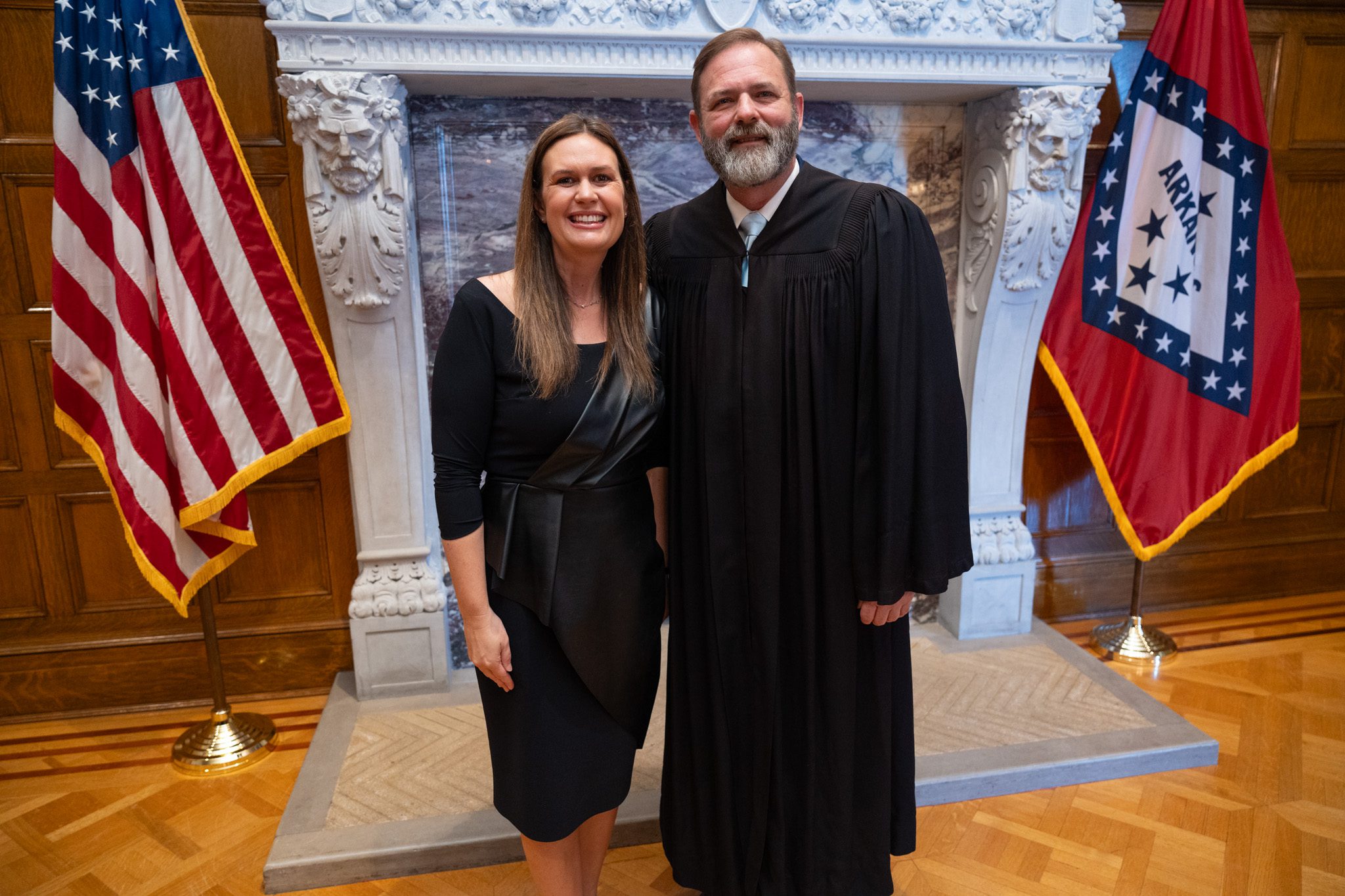
Now, Hiland faces no hurdles as he runs for Bronni’s current ‘Position 6’ seat. He drew no challenger by the state’s filing deadline, so he is all but certain to win; that would allow him to stay on the court until that seat comes up again in 2030.
Bronni, meanwhile, faces attorney John Adams on March 3. The winner will take over Hiland’s ‘Position 3’ seat and serve until 2034. And due to the passage of HB 1223, Bronni is listed as “Associate Supreme Court Justice Nick Bronni.”
Adams takes issue with the change. “The political branches are working to facilitate the placement of their allies on the court right now,” he told Bolts.
He demurred when asked for his thoughts on Bronni and Hiland’s decision to run for each other’s spots. “I’ll let the voters decide if they think that the appointee-Round-Robin is within the norms that the voters care about,” he said.
Bronni and Hiland’s campaigns and offices didn’t respond to requests for comment for this article, nor did the governor’s office.
Arkansas is one of 22 states that holds contested judicial elections. In some of these states, it’s very common for justices to resign before their term is over, allowing the governor to pick a replacement who then stays on the court, boosted by their incumbency. Minnesota, for instance, has regular judicial elections but all current supreme court justices first took office through an appointment. In Georgia, a controversial legal loophole has led some elections to be altogether canceled when a justice has resigned.
But the political culture around this varies greatly across the country. In Michigan, Ohio, and Wisconsin, all of which hold supreme court elections but also allow governors to appoint members when there is a vacancy, most current justices have first joined the court through an election.
Gubernatorial appointments have not been a major force shaping the Arkansas supreme court until recently—largely because of Amendment 29’s ban on appointees running for their seat, but also because other appointed justices haven’t opted to work around that rule when they had the option.
In fact, this kind of seat-hopping by appointees to Arkansas’ high court seems rare: Until Hiland and Bronni, no other appointed justice has opted to run for a seat other than their own throughout the 21st century.
A Bolts analysis found that, since 2000, there have been five justices in the same position as Bronni and Hiland: appointed to the court by a governor, and presented with the opportunity to run for another seat without having to face a sitting justice. None chose to file for that other seat as a path to staying on the court.
The setup for the 2010 election was the same as this year: two seats up for grabs, each occupied by a justice selected by Governor Mike Beebe to fill a vacancy. Elana Wills and Ronald Lee Sheffield, Beebe’s appointees to those seats, both left the court when their interim terms ended, rather than run for each other’s position.
The other appointed justices who chose not to run in this circumstance were in 2004, 2014, and 2016, though the latter two were old enough that they would’ve forfeited retirement benefits if they had run for other seats. (Arkansas has no mandatory retirement but strips benefits if a judge runs past age 70.)
The game of musical chairs playing out in Arkansas’ supreme court races this year has been more common for local judgeships, where vacancies and appointments are even more plentiful. In 2002, a lawsuit tried to block appointed local judges from running for another seat than their own on the bench, making the case that this violates Amendment 29’s “apparent purpose…to deny the appointed judge the advantage of incumbency in a following election.” The Arkansas supreme court rejected the lawsuit and affirmed the practice as constitutional.
Joshua Silverstein, a professor of law at University of Arkansas, Little Rock, who frequently comments on the Arkansas supreme court, says he sees nothing objectionable in judges deciding to run for another position on the bench they’ve been appointed to.
“It’s just a triviaility—obviously they’re running for each other’s seat because they can’t run for their own seats,” he told Bolts. “You’re not going to get politicians, judicial or otherwise, to not take advantage of an opportunity to stay in office… It’s not a big deal.”

For Barth, it remains to be seen whether Bronni and Hiland’s decisions change the culture around supreme court appointments in Arkansas—whether the maneuver ”becomes normalized,” or “if it’s an exceptional case moving forward,” he said. He stressed that the ability of appointed justices to “work around” Amendment 29 will always be limited by whether there’s another open seat they can jump to that cycle.
Arkansas justices have previously run to swap seats on the bench, though it’s been for other reasons. In 2024, several sitting supreme court justices ran for an open chief justice seat, which is akin to a promotion since the chief justice has broad purview over the state’s judicial system.
As Bolts reported at the time, more unusually, another sitting member of the court, Associate Justice Courtney Hudson, also ran for another associate justice position as a way of circumventing the state’s mandatory retirement age and prolonging her maximum stay on the court by a few years.
Bolts reported at the time that the situation virtually guaranteed there would be multiple vacancies following the 2024 elections, and that this would give Huckabee Sanders the opportunity to shift the court to the right. Indeed, Hudson and Justice Karen Baker’s wins in those two races prompted them to resign from their own seats, and the governor then added Bronni and Hiland to the court.
Coupled with the death of Justice Robin Wynne in 2023, these events have pushed to the right a court that, before Huckabee Sanders’ tenure, had a somewhat moderate streak. Wynne, a former Democratic lawmaker, had just months earlier defeated the former executive director of the state Republican Party to secure reelection and a new eight-year term through 2030. Huckabee Sanders chose Hiland, who at the time was the chair of the Republican Party, to replace Wynne. (In 2024, Hiland did not run but Huckabee Sanders appointed him to fill another vacancy, this time for Hudson’s seat, so he stayed on the court.)
Recent conservative wins on the court include a decision in the summer of 2024 that knocked an abortion rights measure off the ballot; another ruling, authored in late 2025 by Hiland, that weakened direct democracy in the state.
Adams, Bronni’s opponent in the March election, told Bolts he’s worried about where the current court is taking Arkansas law, pointing for instance to a pending case in which he fears justices may weaken protections against pretextual arrests by law enforcement.
Supreme court elections are nonpartisan in Arkansas, but Adams, a former assistant attorney general who now works in private practice, unsuccessfully ran for office as a Democrat in the early 2010s, including an unsuccessful bid for Congress in 2010.
Meanwhile, the state Republican Party has endorsed Bronni, who served as the state’s solicitor general under two GOP attorneys general before the governor appointed him to the court. In a typically red state, that puts Adams at a disadvantage against Bronni, though he is quick to point out that Arkansans have rejected GOP-endorsed supreme court candidates in elections held in both 2022 and 2024.
Adams is highlighting his advocacy for civil rights, including when he helped challenge a 2023 state law that made it easier to restrict books in libraries and bookstores. “It just shows my experience defending the constitutional rights of Arkansans when they’re at risk,” he says.
And he says he’s concerned about the proximity between the sitting justices and the governor, and whether that may mean they don’t sufficiently question the state and its actions. “It’s important that we have a legislative and executive branches that function in their spheres, and that we likewise have a judicial branch that functions independently,” he said. “Freedom requires that we limit and separate power.”
Sign up and stay up-to-date
Support us
Bolts is a non-profit newsroom that relies on donations, and it takes resources to produce this work. If you appreciate our value, become a monthly donor or make a contribution.
Related Posts

The Prison Next Door