
Bid to Renew Federal Grant Sparks Concern Boston May Help Trump’s DHS on Immigration
The grant helps fund a law enforcement center that’s drawn criticism over privacy and over data-sharing with ICE. It would also come with new strings to spend money on border control.
| September 29, 2025
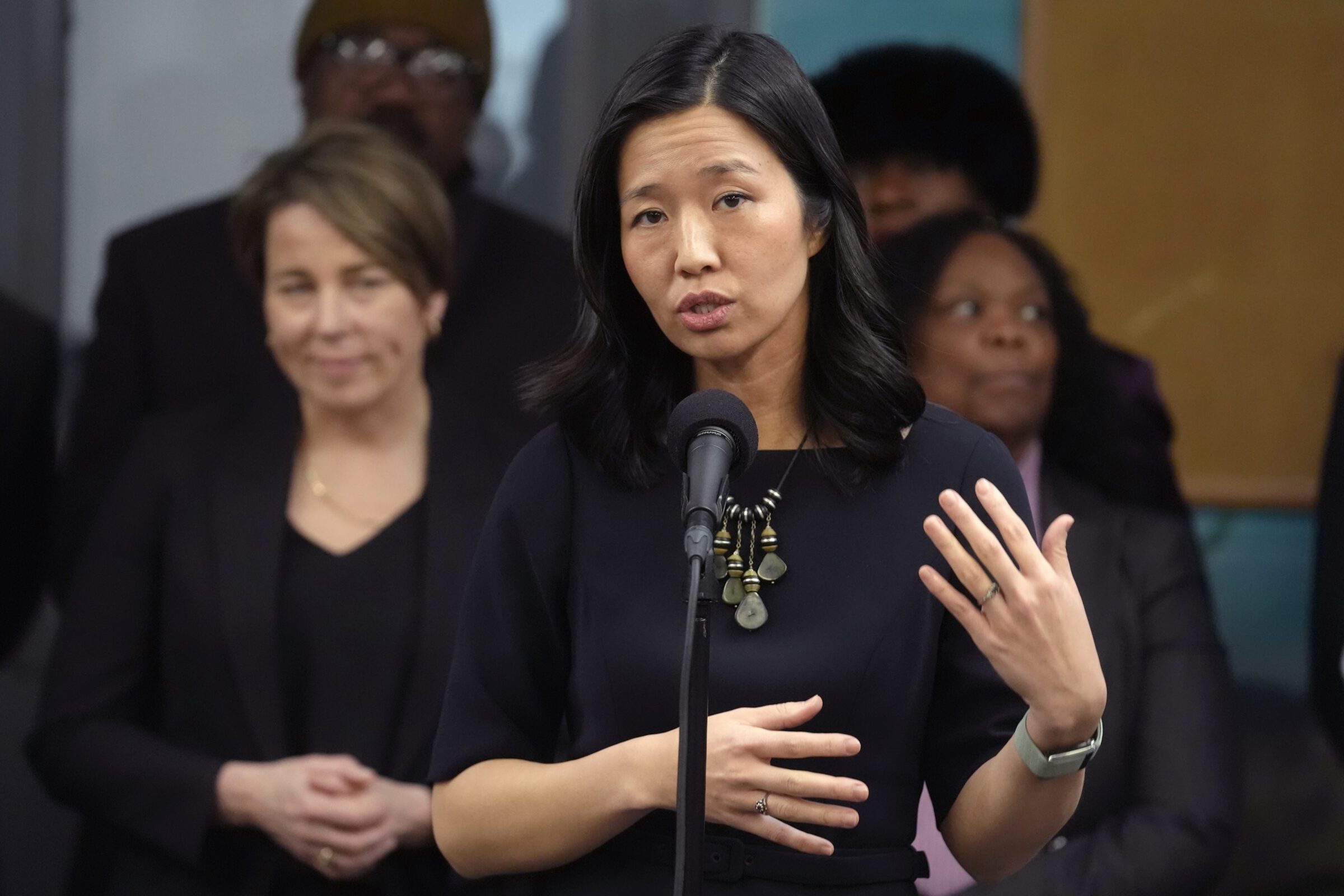
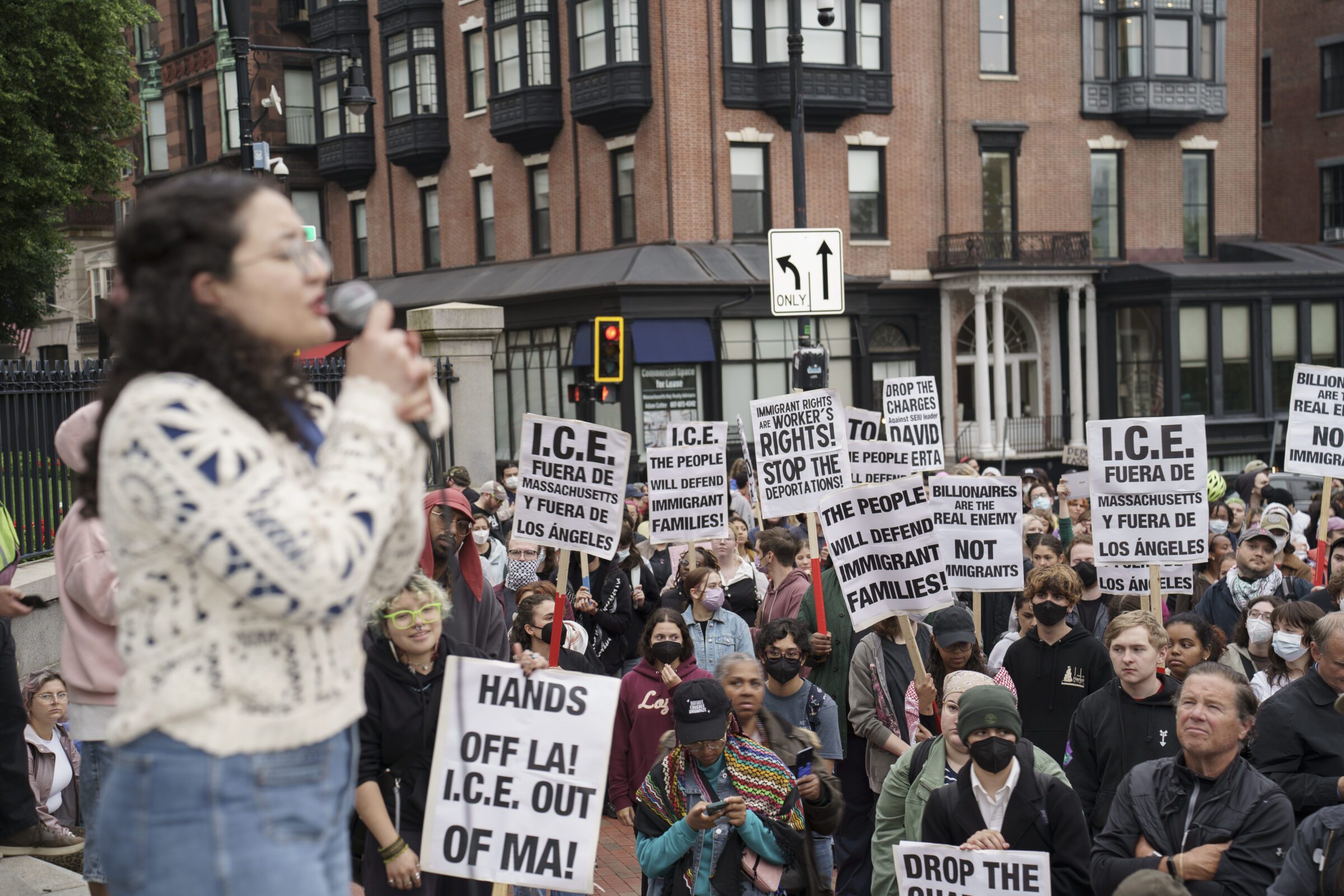
Boston Mayor Michelle Wu has been scrapping with the Trump administration over immigration enforcement all year, a battle replete with threatening letters, lawsuits, congressional testimony, and multiple ICE deployments. After Attorney General Pam Bondi ordered the leaders of Democratic cities and states to participate in mass deportation efforts or else face criminal and financial consequences, Wu sent a defiant response, vowing that “Boston will never back down from being a beacon of freedom, and a home for everyone.”
Soon after their exchange, ICE initiated a new round of operations in Boston and its surrounding cities. On Sept. 4, the Department of Justice sued the city over the TRUST Act, the landmark local policy that limits local law enforcement’s ability to cooperate with ICE. “The City of Boston and its mayor have been among the worst sanctuary offenders in America,” Bondi said in a statement. Meanwhile, Wu, a popular mayor who is sure to win a second term in November, has drawn praise from Democrats desperate for leaders willing to stand up to Trump.
But Wu is also pursuing funding this year that would entrench the bonds between the city’s local police and federal immigration enforcement. In August, as the fight with the DOJ played out, the Boston mayor said that the city would reapply for a $12 million-dollar federal grant that’s meant to fund emergency response—but because it’s routed through a controversial center that channels information from local police to the federal government, civil liberties watchdogs have called it a “Trojan horse” that will facilitate data-sharing with ICE and usher in more raids, immigrant detention, and deportations.
The grant, managed by the Department of Homeland Security, is a major source of funding for the Boston Regional Intelligence Center (BRIC), a so-called fusion center. Like DHS itself, these centers are a post-9/11 innovation meant to strengthen and streamline intelligence gathering and sharing between local, state, and federal law enforcement, with the stated aim of combatting terrorism.
Since its inception, BRIC has presided over precisely the sort of monitoring and data collection that activists worry the Trump administration will exploit in its quest to round up and deport undocumented immigrants and target politically active non-citizens. The center, which has consistently drawn concerns about surveillance and privacy rights, manages Boston’s controversial gang database, keeps tabs on politics-related social media activity, and routinely surveils protesters.
In particular, activists and immigration attorneys have long warned that BRIC creates both formal and informal pathways for the Boston Police Department to pass data along to ICE—from networks of surveillance technology, to various taskforces, to a host of databases containing sensitive information. Through BRIC and Massachusetts’ state fusion center, ICE has access to fingerprints and other personal data like license plate information and alleged gang membership. “The whole purpose of it is federal and local law enforcement collaboration,” said Fatema Ahmad, executive director of the Muslim Justice League and one of the center’s fiercest critics. With Trump back in office, she said, her longstanding concerns about how ICE may use the information that BRIC is collecting and sharing are greater than ever: “Exactly what we predicted is happening.”
Subscribe to our newsletter for more stories on immigration enforcement.
Under the current administration, the DHS money comes with even more strings attached. In August, the federal government altered the grant to include new requirements that localities spend 10 percent of the disbursed funds on “border crisis response and enforcement.”
Wu has argued that the city can comply with the new federal requirements without working directly with ICE. In fact, she says, Boston already meets the spending requirements through its existing harbor security work. “We do not & cannot comply with their coercion [because] of city ordinance & state law,” Wu, whose office did not respond to multiple requests for an interview, wrote in an August Bluesky post.
Still, DHS specifies that the state agencies that apply for these grants “must coordinate with ICE on all projects and related matters” that fall within this 10 percent. The agency in charge of this process in Massachusetts also did not reply to Bolts’ request for comment.
And despite Wu’s assurances, BRIC’s critics warn that the center is already funneling data to the federal government, and some local officials are nervous that doubling down on the grant means collaboration could escalate further.
“What I’m worried about is the climate that we’re in right now is very different,” Boston City Councilor Julia Mejia told Bolts. “Who’s to say that we will enter with one set of beliefs and end up with unintended consequences?”
The Boston debate has largely focused on the city’s TRUST Act, the 2014 law at the center of the DOJ lawsuit. The ordinance prohibits local police from acting as immigration officers or actively helping ICE out on civil immigration matters. It disallows things like asking people about their immigration status, sending their personal information to ICE, and complying with “detainers,” administrative requests from ICE to hold a person in jail or prison after they are legally free to go in order for immigration enforcement to pick them up.
Wu’s original response to Bondi cited the TRUST Act as a lawful protection against the incursions Bondi has threatened. Wu has also defended her decision to reapply for the federal grant by arguing that the city can spend the funds without running afoul of it.
“Nothing in the 2025 new documents can compel the City of Boston to violate our own city laws or state laws in using this grant money,” she told reporters last month, adding that the city had run an independent legal analysis and feels “on solid ground on solid ground applying for these grants.”
At a March 2025 criminal justice committee hearing on the grant, Boston City Councilor Benjamin Weber inquired, with evident concern, about the possibility of BRIC facilitating data sharing with ICE at a time when “people are being detained for their speech.” BRIC director Ryan Walsh reassured him, saying, “we stringently adhere to the TRUST Act.” Later on, Councilor Ed Flynn seemingly made reference to the protections provided by the TRUST Act, saying: “Why would we not want to accept federal funds that would go to the Boston Police, knowing that we have the most progressive city administration maybe in the country, including the police department?”
He continued: “Isn’t that enough…to accept the funds, knowing that there’s protections built in?” (The Boston Police Department, Flynn, Weber, and an additional councilor on the committee, Erin Murphy, also did not respond to requests for interviews.)
But even after the city council strengthened the TRUST Act in 2019, civil rights advocates have warned that its protections remain limited. “The TRUST Act is a really small barrier to very specific types of collaboration,” Ahmad told Bolts. “There’s just so many other ways that collaboration is happening.” For instance, the law prevents local law enforcement from taking active steps to share information with ICE, but when someone is booked into jail, their fingerprints are still automatically uploaded to a database that ICE can access, under the Obama-era “Secure Communities” program. And a number of police departments in the Boston area upload sensitive information to COPLINK, a database maintained by the state fusion center that an investigative arm of ICE, Homeland Security Investigations (HSI), has direct access to.
Today, the TRUST Act continues to allow Boston police to share information with HSI, as long as the primary reason for doing so isn’t simply civil immigration enforcement. The ACLU of Massachusetts has warned that there’s nothing in the revised TRUST Act preventing officers from using low-level crimes as a pretext for contacting ICE.
Heather Perez Arroyo, a senior immigration attorney at the Massachusetts Law Reform Institute, says BRIC allows for “passive information sharing” between the police and federal agents. The center counts among its ranks at least two federal employees, who work at the FBI and DHS. It also governs federal-local partnerships like the Joint Terrorism Task Force and HSI’s task force.
This arrangement has sparked major controversies in the past. In 2019, a WBUR investigation revealed that an officer with the Boston Police Department had been deputized as a federal law enforcement agent through the HSI task force. The BPD officer and ICE’s field office regularly exchanged emails scanning misdemeanor arrest data to see if they could find undocumented people. In one email discovered by WBUR, ICE sent the officer an immigration detainer—a request to local law enforcement to hold a person in custody so that ICE can pick them up. “Happy hunting,” the sender wrote.
After the arrangement was uncovered, the officer was removed from the task force position. It’s unclear who replaced him; the city council put in a formal request for any current MOUs governing the task force in August, but Mejia’s office told Bolts that Boston mayor’s office has not replied or produced anything.
BRIC also oversees a number of databases that can serve as key sources of information for ICE. Though fusion centers’ initial focus was combatting terrorism, their remit has expanded to include a major focus on ordinary street crime and gang violence—which is why, for instance, BRIC manages the Boston police department’s database of local residents it considers gang members.
The database has repeatedly come under fire for racial profiling: as of 2021, more than 97 percent of those on it were either Black or Latino.To end up on the list, you don’t need to have a criminal conviction, or technically even an arrest. You might just have the wrong apparel or tattoo. But simply being added—even if you’re not a gang member and are later taken off the list—can have devastating and far-reaching consequences.
In 2015, Boston school police mistakenly labeled a Salvadoran teenager, who’d never been arrested before, as a MS-13 associate after reviewing footage of a high school cafeteria argument. They forwarded the report to BRIC, where investigators from ICE’s HSI arm got ahold of it and performed social media surveillance that led them to conclude the young man was a gang member. Relying on this information, an immigration judge chose to deport him.
Perez Arroyo, the immigration attorney, says she has encountered similar situations with her clients because of the BRIC database. After one of her clients was detained shortly after his 18th birthday, ICE lawyers produced a report from HSI labeling him a gang member, based on information from BRIC’s gang database. Even though she was able to prove that the allegations were false and get the man taken off the gang database, the damage was done: “Every immigration judge that he saw from that point had taken that into evidence and used that against him.” Her client was denied bond and held in detention, then deported back to his home country where, she says, “he was afraid of the very gang members that they were alleging him to be.”
As the new administration invokes the Alien Enemies Act to deport people it deems gang members without due process, it has been using similar criteria to the BRIC database to determine gang membership—especially tattoos. “No one would be surprised by the Trump administration doing whatever it takes to get every single name that is on the BRIC gang database to deprive those individuals of due process and to deport them,” Perez Arroyo told city councilors in March.
In her interview with Bolts, Perez Arroyo said the Trump administration’s policies mean that any involvement with law enforcement can put someone on ICE’s radar. “It really puts a red flag up for the people that have any type of interaction with the police, even if it’s something in the past that would not have raised any cause for concern.”
At the March hearing, Walsh tried to assuage the criminal justice committee’s doubts by saying that federal law enforcement employees don’t have “direct access” to Boston’s gang database. He stressed that BRIC shares information with HSI, the investigative arm of ICE, but not with Enforcement and Removal Operations, the part of ICE that carries out deportations.
But the Trump administration has been pressuring federal agencies to share information with each other, dismantling the usual walls and privacy shields that traditionally protected some information from deportation officials. Later on in the hearing, the ACLU’s Kade Crockford said that those traditional distinctions no longer apply, within the agency or beyond it. “It is no longer simply the enforcement and removal wing of ICE, ERO, that is focused on detaining and removing immigrants,” Crockford told the committee. “Under President Trump, the FBI, the DEA, ATF, ICE’s homeland security investigations, and even the state department are now working on civil immigration enforcement matters.”
The GOP megabill, which Trump signed into law in July, juiced immigration enforcement spending by an astonishing $171 billion, which experts predict will also increase the pressure for local law enforcement to get on board with the administration’s draconian immigration agenda.
Mejia, perhaps BRIC’s most vocal critic on the city council, told Bolts that she is in talks to strengthen the TRUST Act. “I do not think that the Boston TRUST Act is at the place that it needs to be for the type of drama that we are experiencing with the federal government,” she said. “I don’t believe we’re ready to meet the moment.” Mejia says she’s in talks with local civil rights organizations to determine how to establish better protections, and she hopes to advance a new ordinance further strengthening protections.
Mejia and the rest of Boston’s city council are on the ballot in November, alongside Wu, though the election seems unlikely to produce much change. The preliminary round in September signaled that incumbent councilors, including BRIC defender Flynn and BRIC critic Mejia, are strongly favored to win reelection.
Growing up, Mejia told Bolts, her mom was undocumented, so the issue is personal to her. “People are living in fear right now. So everything and anything that compromises the safety of the people that we deeply care about is a concern for me.”
That said, Ahmad warns that even well-intentioned TRUST Act reforms probably wouldn’t touch most of the existing avenues of collaboration that occur through BRIC. “There’s so much more that Mayor Wu could do, and other local mayors and cities could do, to protect folks from federal law enforcement,” she said, noting that it’s not just about ICE—“all of these agencies are working together now in immigration enforcement.”
For Ahmad, there are three main changes that could have real impact: pulling out of the Joint Terrorism task force, out of the HSI task force, and abolishing BRIC altogether.
It may sound fanciful, but not so long ago, it was on the table. Wu’s position on BRIC has changed notably from 2021, when she first ran for mayor. At that time, she supported eliminating not only the gang database but BRIC as well. But by 2023, she switched course to support an increase in funds for the BRIC, justifying her move by citing a number of recent reforms to the gang database and police oversight.
BRIC has continued to draw controversy under Wu’s tenure. In 2023, it disseminated regular reports on demonstrations related to Israel’s war on Gaza, according to documents obtained via FOIA by the Muslim Justice League and reviewed by Bolts. BRIC says that it “only reports on First Amendment protected activities for operational planning.”
Still, Wu’s change of heart on BRIC, as well as her strong opposition to the council’s proposed cuts to the Boston Police Department and support for a contract that included raises for officers, has won her the endorsement of the city’s largest police union, the first time in 30 years that it has backed a sitting mayor for reelection. She’s been able to forestall the sort of retaliation campaigns by rank and file officers that have threatened and undermined progressive leaders like Chicago Mayor Brandon Johnson or former New York Mayor Bill de Blasio.
But her shift toward supporting BRIC has also increased the city’s dependency on the federal government, given that funding for the fusion center relies in large part on the DHS grant.
Given Wu’s public defiance of the Trump administration and Bondi’s threats around pulling funding, it’s not clear if Boston will receive its grant this year. DHS has already projected an allocation of nearly $17 million dollars to the Boston area, but the agency hasn’t yet made a final decision. If the money comes through, it will still have to go through the city council—Mejia said she’ll be voting no, but doesn’t know where her colleagues stand. Wu’s position, in any case, is clear. On Aug. 19, she posted on Bluesky that even if the grant were rejected, Boston wouldn’t let up trying to get the money—the city would “go to court as we have on other funds.”
Sign up and stay up-to-date
Support us
Bolts is a non-profit newsroom that relies on donations, and it takes resources to produce this work. If you appreciate our value, become a monthly donor or make a contribution.