
One Step Forward, Two Steps Back for Solitary Reforms in California
California officials dial back the minor reforms they've made to isolation in prison, four years after Governor Gavin Newsom vetoed legislation to rein in solitary confinement.
| July 15, 2026

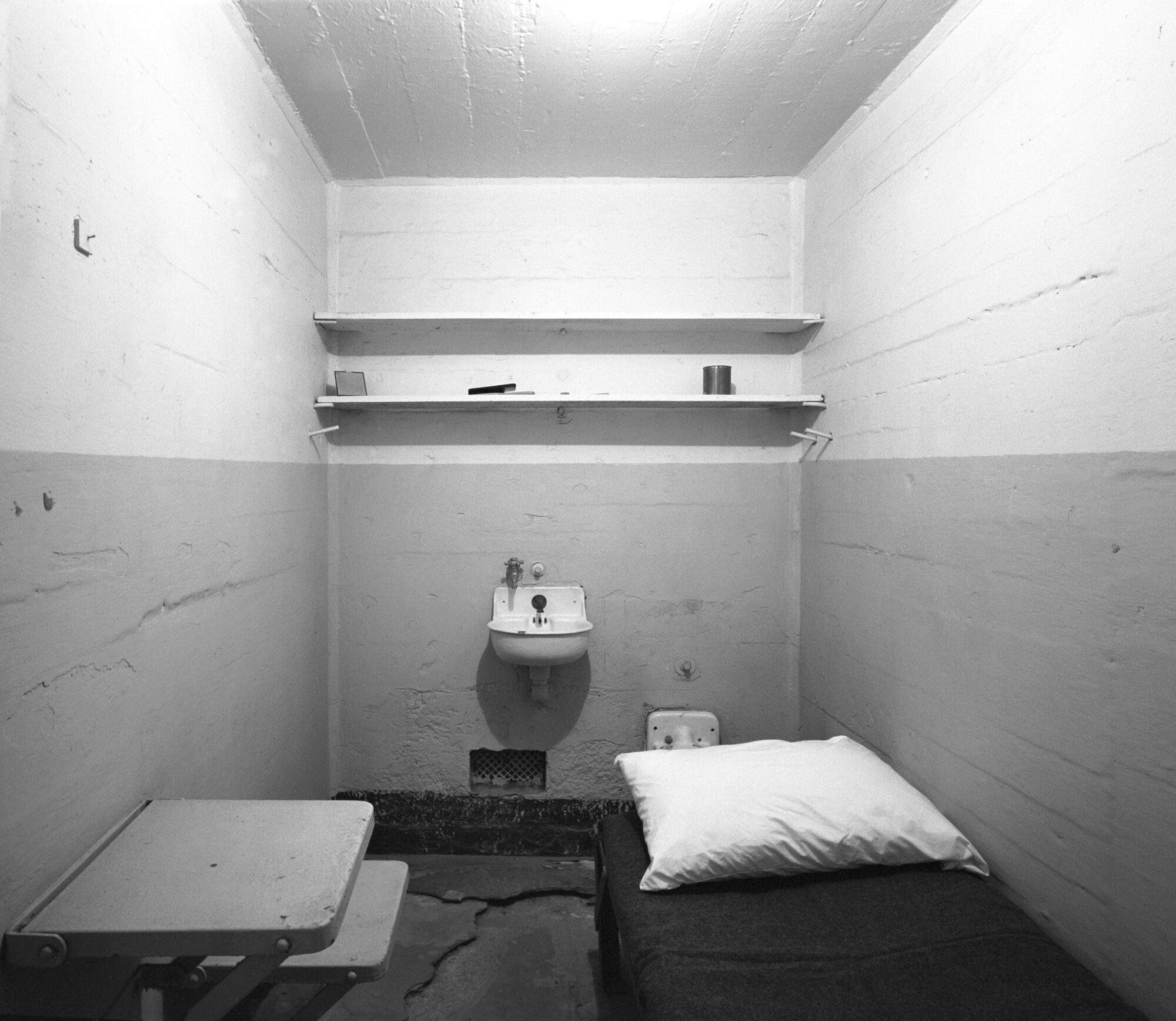
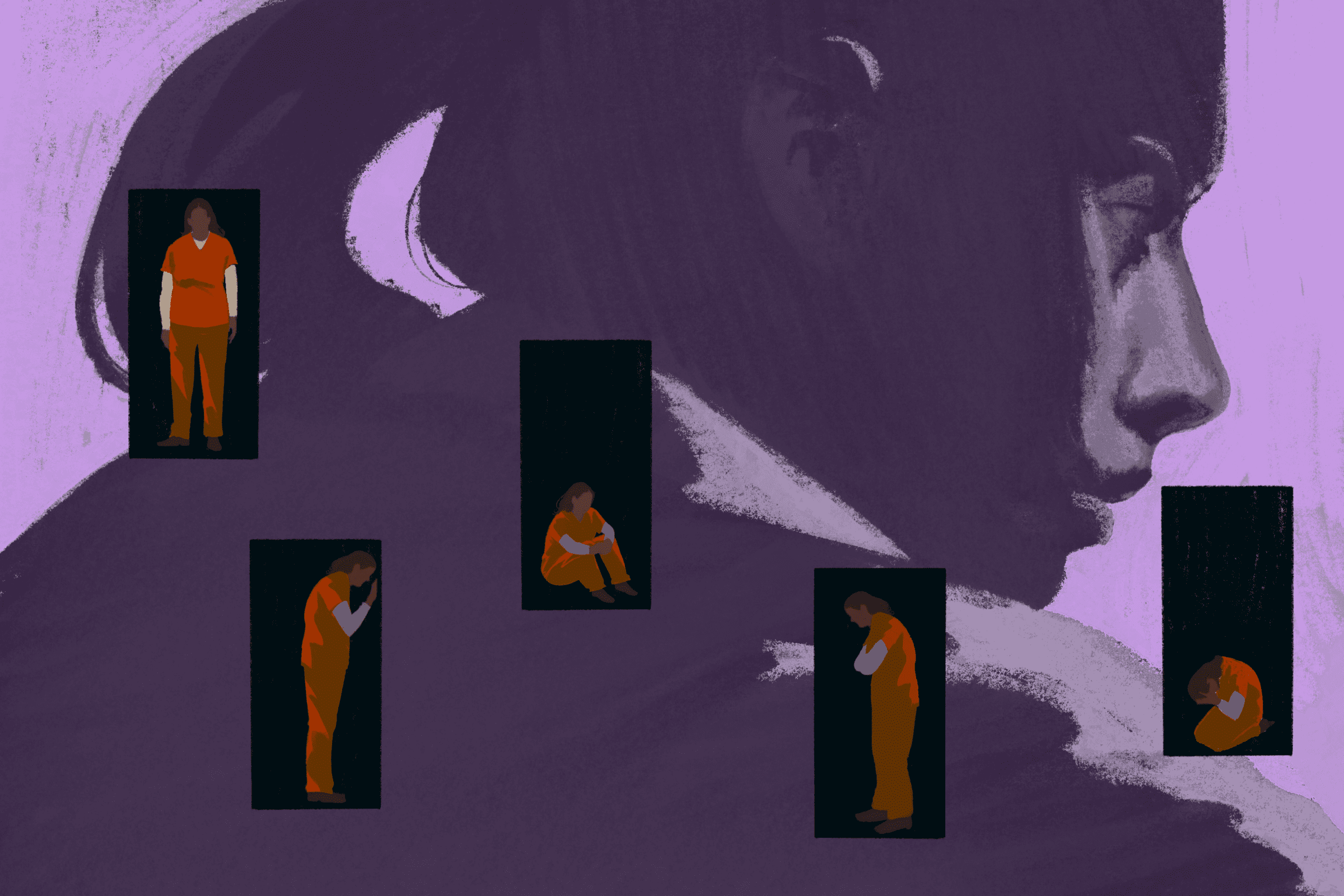
In California, survivors of solitary confinement who have spent years trying to seriously limit the practice are facing yet another setback as state prison officials unwind the minor reforms made in recent years.
Those reforms, which had reduced the number of rule violations that could make someone eligible for isolation and increased out-of-cell time for people in solitary, were part of a compromise Governor Gavin Newsom proposed after his 2022 veto of the Mandela Act, which state lawmakers had passed to bring solitary practices within international humanitarian guidelines. In his veto message, Newsom acknowledged the issue was “ripe for reform” and directed the California Department of Corrections and Rehabilitation (CDCR) to change its policies around isolation.
The changes, which went into effect in November 2023, already fell short of what advocates hoped to accomplish—for one, they only applied to the state’s prisons, carving out jails and detention centers, which had been included in the oversight bill that Newsom vetoed. And now, citing an increase in violence and overdoses within the prison system, CDCR says it must “dial back reforms”
Prison officials implemented this “dial back” as emergency regulations in May, and are now seeking to make them permanent. Their new rules expand the circumstances that render a person eligible for punitive isolation in a key way: California prisoners can now be put in solitary confinement and cut off from any form of communication with family members for up to six months following an accusation of simple battery of another incarcerated person without serious injury, though advocates argue that this sort of behavior is often triggered by psychiatric episodes rather than being an act of intentional violence. For many more serious violations, solitary terms have doubled. Access to food and communication has also been further restricted for people accused of rule violations.
Get more coverage of prison and jail conditions
Subscribe to our newsletter
The changes have the potential to seriously affect the over 3,000 California prisoners who, according to CDCR’s most recent public count late last year, are in Restrictive Housing Units at any given time.
Michael Bien, who represents prisoners with mental health issues under a class-action case that governs provision of mental healthcare within CDCR, argues that the changes will exacerbate a vicious cycle at a time when over 40 percent of California prisoners now experience some form of mental health issue. “How does cutting off access to writing paper and stamps and food reduce violence?” he asked. “It’s going to cause tremendous harm.”
The reversals have validated advocates’ earlier fears about Newsom’s decision to let the prison system handle its own reforms, rather than imposing legislative guardrails. They come at a time of reduced judicial oversight, too: A landmark 2015 settlement restricting solitary confinement in California, which came after some 30,000 prisoners went on extended hunger strike, ended in January 2024.
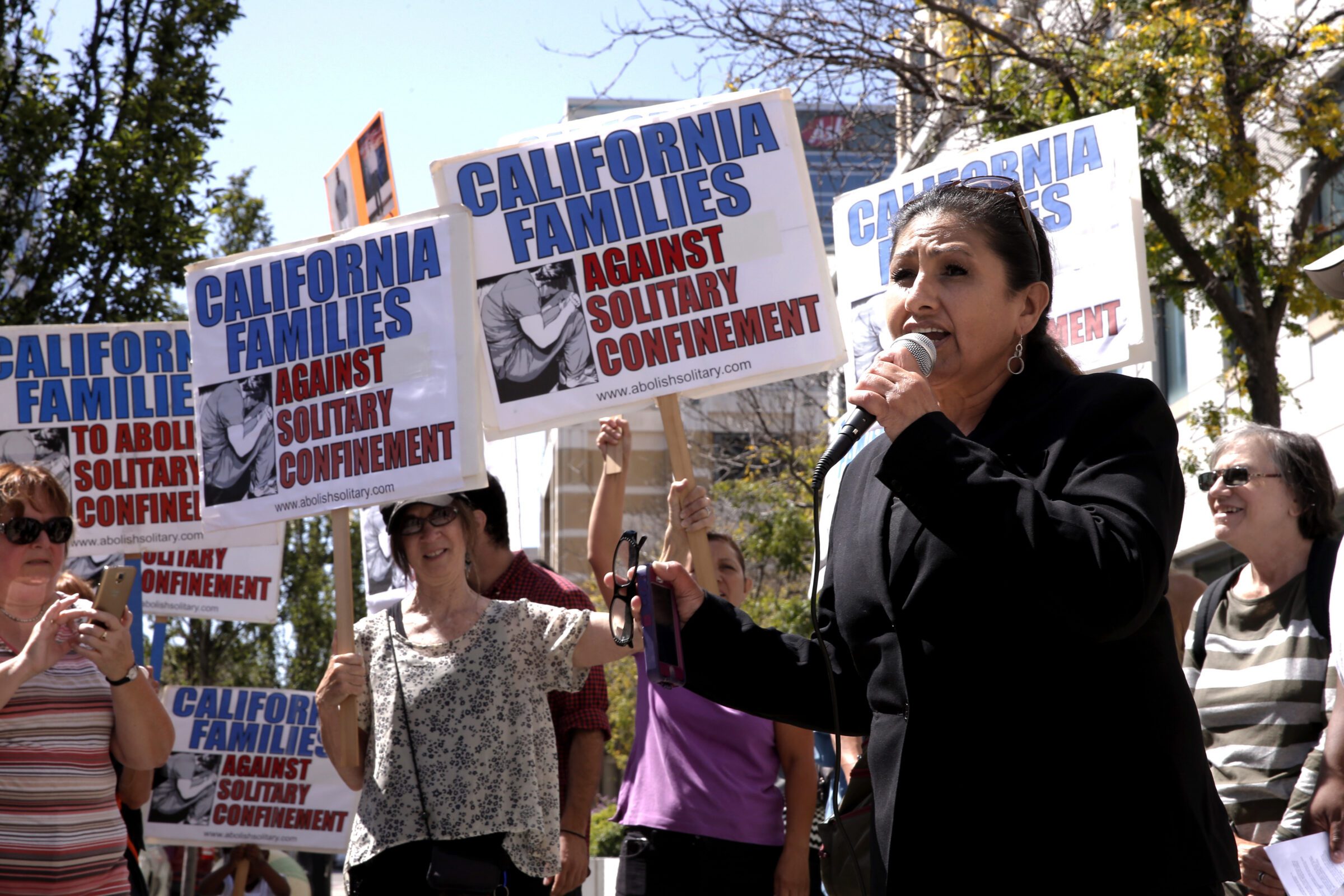
“To strip you now of all of these things takes you right back to that sensory deprivation, takes you right back to that isolated housing before the hunger strike,” Dolores Canales, a survivor of solitary confinement and leader of the group California Families Against Solitary Confinement, told Bolts.
Before 2013, California prisoners accused of being in a gang could be sent to solitary confinement for decades on end with little to no due process. Phone access came only when a family member died. “When they came to your cell to pull you out for a phone call, you knew that person was going to the death call,” Canales said.
James Nelson, who spent over twenty years in prison before being paroled in 2014, is now the senior campaign and advocacy manager at the Los Angeles-based grassroots organization Dignity & Power Now. While CDCR argues that it mainly uses solitary confinement as punishment for violence, Nelson says he saw it used as a tool to control the incarcerated population. He also witnessed its effects. “You know that saying, ‘You can’t get well in a cell’? I’ve seen it firsthand,” he said. “A lot of people develop mental health [problems] because of the isolation.”
Litigation and the historic 2013 hunger strike led to the 2015 Ashker settlement, which notably stopped the practice of indefinite confinement. But CDCR continued to make use of punitive isolation in other ways and has also failed to comply fully with the settlement, including by denying prisoners due process to challenge determinations that could land them in solitary.
In recent years, spurred on by these lapses and inspired by the success of landmark solitary legislation in New York, advocates have tried to restrict the practice further and outlaw it entirely for vulnerable groups like pregnant women, young people, and the elderly. Despite widespread support from legislators, and a broad “Mandela coalition” comprising immigrant justice, disability rights, and prisoners’ rights organizations, the Mandela Act has been stalled for several sessions now. Newsom vetoed it in 2022, tried to whittle it down significantly in 2023, and made clear the following year that he would not negotiate further.
Newsom’s compromise back in 2022—directing CDCR to implement reforms—fit with the governor’s broader penchant for allowing the prison system to dictate the terms of its self-improvement. To the advocates and attorneys interviewed for this piece, the results were mixed.
“They don’t solve all the problems, but there were steps in the right direction,” Bien said. Crucially, the prison system reduced the number of violations that land someone in solitary confinement. The new rules also increased out-of-cell time for people in solitary to 20 hours per week—but that still meant that people in solitary confinement would be confined for 21 hours per day.
Trancita Ponce, the San Francisco ambassador for the Sister Warriors Freedom Coalition, who was incarcerated for 25 years before being paroled in late 2024, told Bolts that in her experience, frequent lockdowns prevented this change from being fully implemented in practice.
To Canales, CDCR’s changes still “preserved the fundamental structure of isolation.”
CDCR, on the other hand, has argued that the reforms have had a direct and significant impact on violence within the prisons. “Since the codification of RHU regulations on November 1, 2023, the department has observed a significant surge in violent incidents and overdoses, including murder, assaults on staff, and assaults among incarcerated individuals,” CDCR wrote in its notice of the emergency changes.
The notice includes CDCR’s comparison of overdoses and various types of violence during the two 18-month periods before and after the solitary reforms took effect in November 2023. While the analysis broadly shows that violations were higher during the year-and-a-half period following the reforms, CDCR didn’t disaggregate the data to show month-by-month trends.
Still, Bolts’ analysis of the monthly incident reports that CDCR already makes public demonstrates that violence and drug use were increasing even before the policy changes in 2023, and further shows that both have plateaued during the past year. Those reports also indicate that documented use-of-force incidents by corrections officers increased by more than 40 percent during the 18 months following the policy changes, on par or higher than the increases in reported violence and drug use by the incarcerated population. Statistical reports the agency is required to file publicly also show large increases in the number of grievances filed by incarcerated people as well as the use of facility lockdowns.
“Lockdowns are extremely stressful,” Ponce told Bolts. “People aren’t sleeping. Not enough food, sunlight, not enough contact with other human beings, can definitely cause your anxiety and all these other things to flare.”
Bien told Bolts that the prison system’s numbers don’t prove that the solitary reforms caused the increase in violence. “We’re not saying that there isn’t a violence problem, we’re just saying that this is not a solution to the violence problem,” he said.
“I one hundred percent strongly dispute that the efforts to treat people more humanely are the main underlying driver of any increase in violence in the prisons,” Danica Rodarmel, a criminal justice reform lobbyist who is coordinating the statewide response to the emergency regulations, told Bolts.
CDCR declined an interview request for this story. A spokesperson wrote in response, “CDCR is proposing targeted, evidence-based regulatory adjustments to its restricted housing policy to address a significant increase in violence and overdoses inside our institutions. These changes are narrow refinements, intended to balance rehabilitative goals with institutional safety and operational integrity.”
Bolts reached out to Newsom’s office to ask whether CDCR’s rollback had caused the governor to reconsider his earlier decision to forego outside oversight and allow the prison system to govern how and when it implemented reforms. In response, the office echoed CDCR’s justification for the changes, writing, “These are targeted, evidence-based adjustments to address a significant increase in serious violence and overdoses inside our institutions while preserving the core reforms that expanded programming, rehabilitation, and out-of-cell opportunities.”
CDCR’s official notice of the rule changes back in May stated that “the department must dial back reforms made in the previous regulations to maintain the safety and security of incarcerated persons and staff,” but two months later the prison system and Newsom’s office both deny that the changes constitute rollbacks. CDCR now insists on its website that the changes “are not a rollback of prior reforms.”
“This is simply false. CDCR is not rolling back its 2023 restricted housing reforms,” Diana Crofts-Pelayo, a spokesperson for the governor, told Bolts in an email.
Advocates told Bolts that the regulations CDCR announced in May have sparked widespread concern and anxiety amongst California’s incarcerated population and their loved ones. The reduced access to supplemental food from the commissary has left people hungry—“The regular food is just simply not enough to live on in CDCR,” Canales said. And cutting off phone, tablet, electronic messaging services—and even access to pens and paper—can now be done before a formal finding that prisoners have committed a violation, only further isolating prisoners from their relatives.
Right now, Canales said, “their family members are going through it just as much.”
One of the open secrets of mass incarceration is that solitary confinement is the system’s blunt instrument to deal with mental illness—and that it remains so even as social understanding of psychiatric disorders has progressed significantly. Back when he was incarcerated, Nelson watched the system fail to provide care to men suffering from mental health issues. Instead, whenever someone experienced a crisis, “first thing they want to do is pepper spray you, jump on you, and send you off to the hole,” he said. In 2025, CDCR considered nearly two-thirds of the people it held in restrictive housing to have sufficient mental health issues to warrant enrollment in a treatment program.
While punitive isolation can be psychologically destructive even for the most mentally resilient individuals, for those with mental illness it is often deadly. CDCR data shows that suicide rates within restrictive housing are significantly higher than for the rest of the prison population. “Segregation is so dangerous that even with all these [protective] measures, people still commit suicide at tremendously high rates,” Bien told Bolts.
In 1990, prisoners represented by Bien and colleagues at his San Francisco law firm, alongside the Prison Law Office, filed a class action suit, Coleman, challenging California’s treatment of incarcerated people with mental illness, and they won at trial, forcing CDCR to improve its provision of mental healthcare. But as with the Ashker settlement that aimed to greatly limit solitary confinement, CDCR has repeatedly failed to comply with the terms dictated by Coleman, racking up over $100 million in fines and being declared in contempt of court in the process. In 2023 the federal judge assigned to the case noted that prisoners have “waited far too long for constitutionally adequate mental health care.”
Three years later, they are still waiting. One of the main stumbling blocks is the prison system’s reliance on solitary confinement to handle people in mental health crisis. At a status conference for Coleman in late June, Bien warned the judge that CDCR’s emergency regulations would make it much more difficult for the system to come into compliance. “This is contrary to everything we’ve been doing,” he told Bolts.
CDCR allowed the public to submit comment and speak at a hearing last Wednesday as it seeks to make the emergency regulations permanent. For just over an hour, person after person spoke against the changes, including one man who had done 33 years in solitary confinement. Ponce told Bolts that the CDCR representatives present appeared affected by the testimony; at moments, some of them appeared to open their mouths in shock at what they were hearing.
“I do hope that they change their minds,” she said. “I do hope that they provide opportunities instead of just putting people in a cage.”
Still, advocates can’t be sure that this feedback will affect the final outcome. “From everything that I’ve seen in the past, they give no heed, no consideration to the voices that are speaking up,” Canales told Bolts. The deadline for a decision regarding permanent regulation changes is next May.
The Mandela Coalition had given up hope of passing the Mandela Act as long as Newsom remained in office, but the governor is termed out this year. Xavier Becerra, a former California attorney general, is the frontrunner to replace him.
Canales told Bolts that the coalition hopes to reintroduce the Mandela Act once Newsom leaves office in January 2027. The emergency rollbacks have “really opened everyone’s eyes to see that this is just the beginning,” she said. “It’s rolling back so much of what we fought for, and that if we don’t have some kind of legislation, this is just going to continue.”
Sign up and stay up-to-date
Get timely updates about pressing stories and elections.
Support us
Bolts is a non-profit newsroom that relies on donations, and it takes resources to produce this work. If you appreciate our value, become a monthly donor or make a contribution.