
How Immigrant Organizing Flipped Nixon’s Hometown
The California city of Whittier swung to Democrats this spring, spurred by ICE raids and by anger toward election rules that long dampened turnout among Latinos and kept them out of city government.
| May 7, 2026
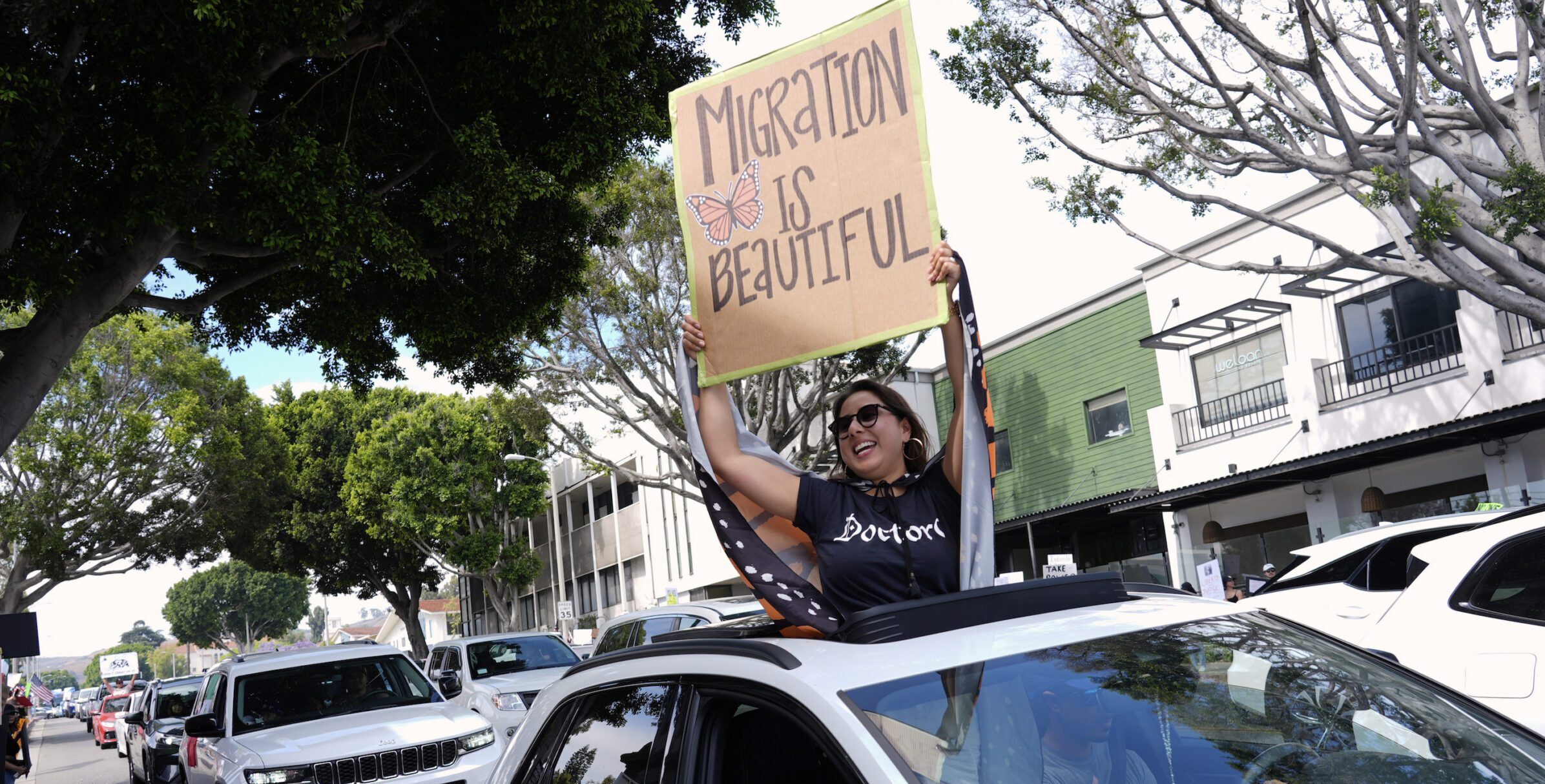
When residents of Whittier, a majority-Latino suburb of Los Angeles, came out in large numbers last summer to protest a rush of ICE operations, the city’s Republican leaders remained unfazed. Masked federal agents were rounding up people at the Home Depot and hauling workers away from local car washes, a jarring disruption to the usual quiet charm of a city where a lush canopy of ficus trees and Canary Island pines line the streets.
To the protesters who saw ICE vans stationed at City Hall and the public library, the city was complicit. They demanded that Whittier officials take action and ban ICE agents from covering their faces and using public land to make arrests. A council meeting to discuss the raids had to be moved out of city hall and into a larger auditorium to fit the crowd that attended.
But their pleas did not convince the council; its conservative majority rebuffed a proposed ordinance to restrict ICE activities. “We expected the city council to do something to make us safer, and we did not receive that response,” says Renee Lorenzo, a member of Organize Whittier, an advocacy coalition that emerged after the raids to channel residents’ anger over the council’s inaction.
Once a conservative stronghold known as Richard Nixon’s hometown, Whittier has grown and transformed into a predominantly Latino city that votes reliably Democratic in state and national elections, including voting against Trump by double-digits in 2024. But for decades, GOP politicians kept winning local contests, while Latino residents struggled for influence in city government.
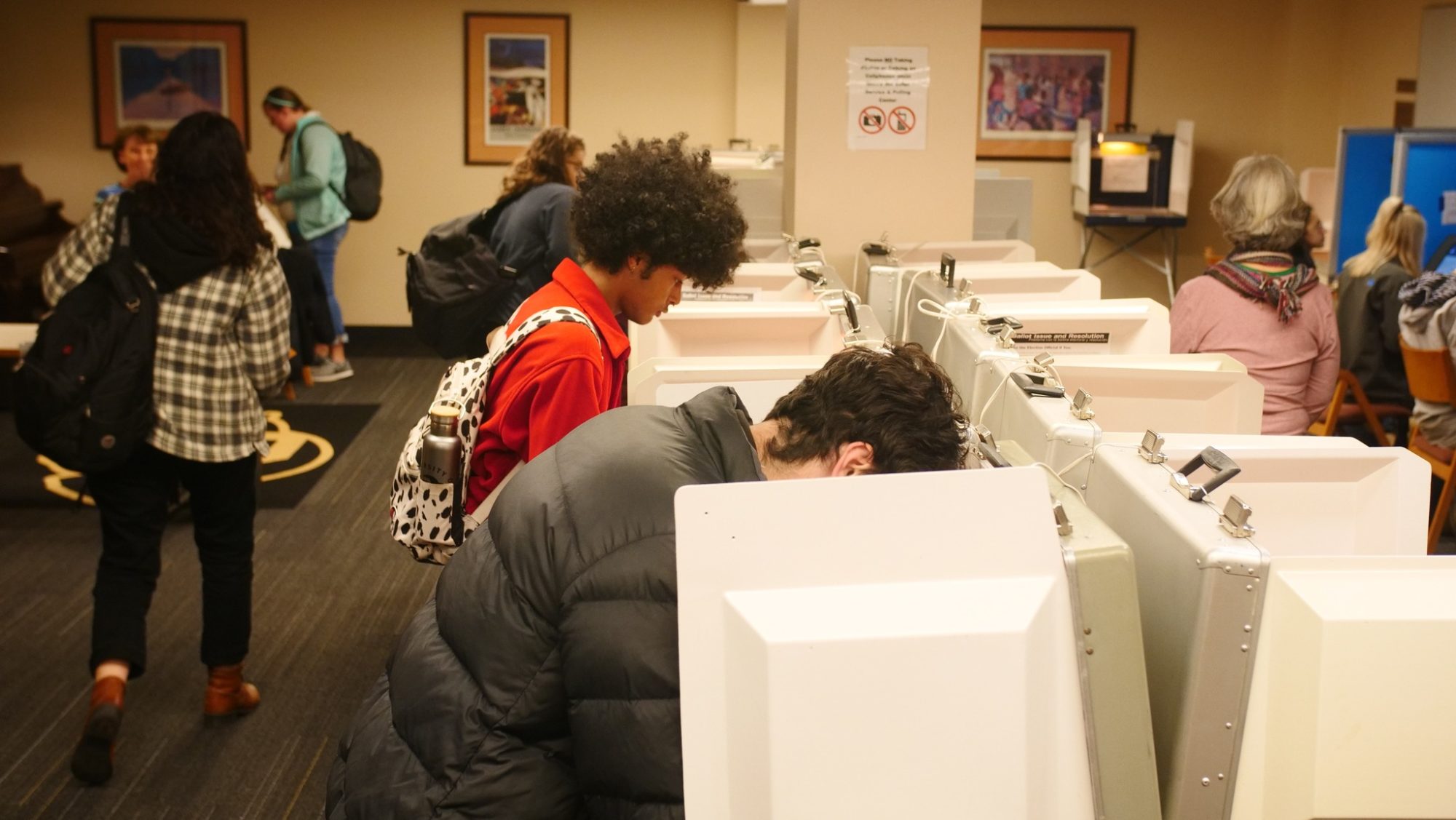
Whittier schedules its municipal elections in April, separate from big-ticket items like the races for governor or Congress, and this typically makes turnout crater. Studies have shown that lower engagement in off-cycle elections favors older and white voters, and many Whittier residents think that this is why the GOP has coasted to victory in local elections here. “Off-cycle elections are a form of voter suppression,” says James Becerra, an urban planner who ran for mayor this spring.
But this year ended up different. As Whittier prepared for a new round of mid-April contests for voters to choose their mayor and two city council seats, masked agents remained an ominous presence, bringing residents’ frustration to a boil. “It has galvanized our community in a way I have not before seen,” said Angie Medina, who leads the Whittier Latino Coalition.
Her organization worked with other civic groups within the Organize Whittier coalition to keep people engaged. They hosted community meetings and trained people to run for office themselves or join city boards or commissions, and Medina was heartened to see hundreds of people attend a candidate forum in January, telling Bolts, “It was like we were slapped awake.”
They also threw their support behind Becerra in the mayor’s race and behind candidates Aida Macedo and Vicky Santana for the two council seats. The contests were officially nonpartisan but Becerra, Macedo, and Santana were all endorsed by the county Democratic Party.
On April 14, turnout soared to double that of recent city contests. Boosted by the unusually high engagement, this slate of challengers swept all three contests in a landslide and flipped Whittier’s five-member city council to a liberal majority.
Becerra ousted a longtime Republican mayor with 67 percent of the vote; Santana and Macedo secured similarly huge victories against incumbent city councilors.
Subscribe to our newsletter
for more stories on local politics
Their wins also produced the first Latino-majority city council in Whittier’s history.
“This is historic for a city like Whittier, people that hold policymaking positions should reflect the community,” Medina said. “The whole thing came together like a perfect storm, where people really got it. This time, they said, what is going on is important enough for me.”
The results were the latest in a series of huge swings toward Democratic-backed candidates in heavily Latino districts and precincts elsewhere in the country this year.
“This past year has been a big wake up call for a lot of people,” Lorenzo says. “A lot of issues are rising now that people want answers to, and the raids have escalated everything. That is fueling people to the polls.”
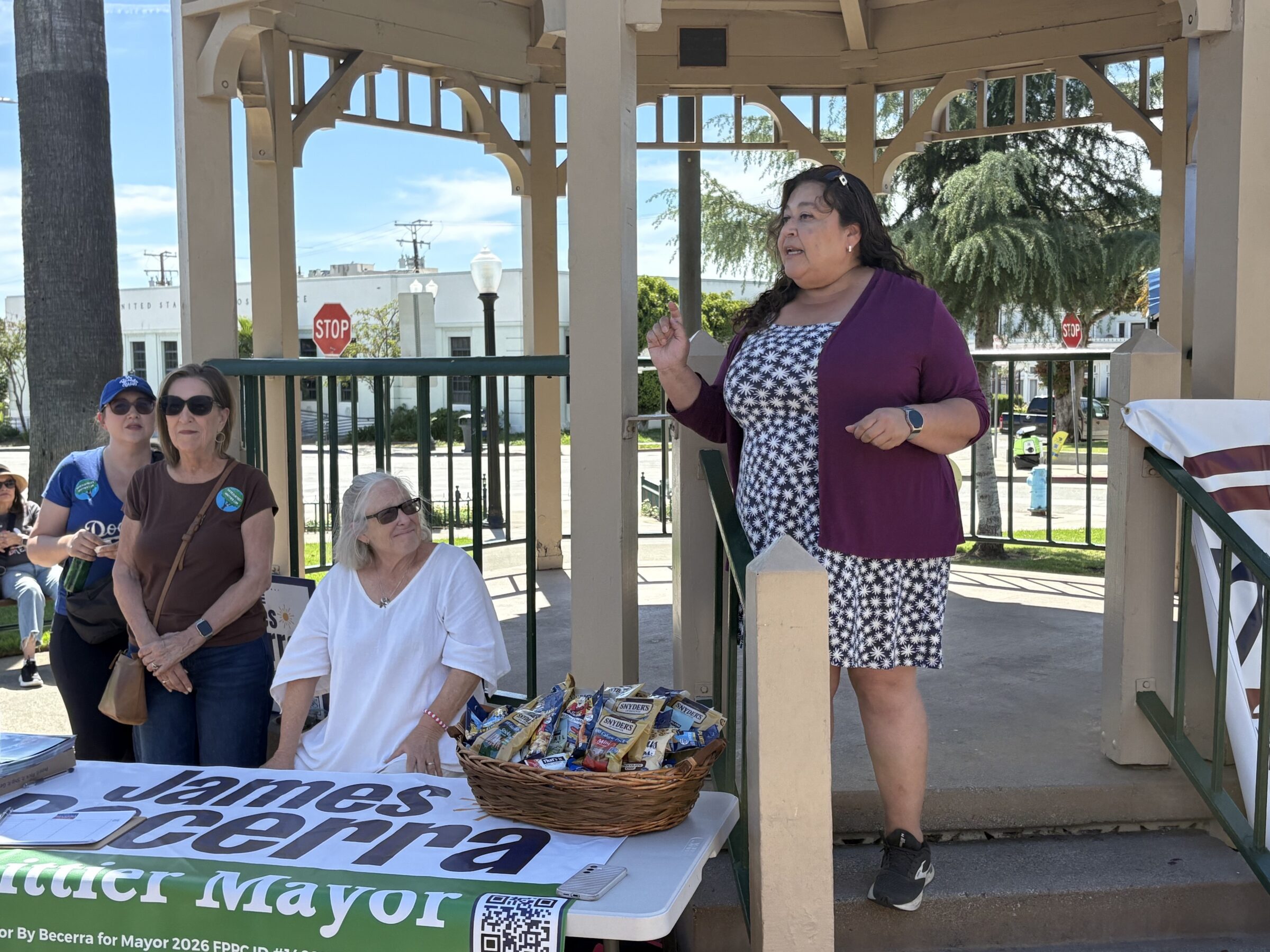
The incoming officials plan to dramatically reorient the outlook of Whittier’s government. Becerra told Bolts he wants the city to adopt the ICE ordinance that conservatives rejected last year.
He also plans a push to align local elections with the state and federal cycles and help pull the city out of its “entrenched power structure.”
The upsets are already rippling through local politics. A member of Whittier’s planning commission, Richard Quirk, resigned shortly after the election. Some residents had been demanding his removal since last summer, when photographs circulated of Quirk and his partner dressed as an ICE agent and an undocumented immigrant at a costume party. Council Member Mary Ann Pacheco, who for years has been the council’s lone liberal member, celebrated the resignation as a sign of what is to come.
“Whittier residents … felt unheard, disrespected and concerned about his radical social media hatred against immigrants,” Pacheco wrote in a statement. “At that time, the previous Council majority chose not to act. Today, this resignation represents a step in the right direction.”
While Whittier became a majority-Latino city in the 1990s, after a swell of families left the city of Los Angeles for the suburbs, few Latinos served in city government until recently. As of 2013, the city was two-thirds Latino but the city council was all-white, and only one Latino had been elected previously.
A group of voters sued Whittier that year for discriminating against Latino residents. Their complaint argued that the odd election date had the effect of suppressing Latino voters; it also took issue with the city’s at-large voting scheme, saying that it allowed a few wealthy and predominantly white neighborhoods to control every council seat rather than giving Latino voters a chance to elect their preferred candidate.
Whittier agreed in 2014 to end the at-large voting system and create four districts, which helped a Latino candidate win a seat on the council the following year, and the court dismissed the lawsuit. The following year, a statewide reform also provided a remedy to the election timing issue. The California Voter Participation Rights Act required that local races share a ballot with a state-level contest to boost participation.
The change was short-lived in Whittier, but it boosted turnout in the first and only mayoral race in which it was implemented. In 2020, with the election synced up with the presidential primary, 44 percent of Whittier’s registered voters took part in choosing their mayor that year—nearly three times the number of ballots cast in the 2018 mayoral race.
But the Court of Appeals ruled that same year that the California Voter Participation Act could not apply to cities like Whittier that defined their election rules in their own city charter. Whittier officials voted in 2021 to move their local elections back to their traditional, standalone date.
Turnout plummeted once more. Only 16 percent of registered voters participated in the following mayoral election, in 2022, little more than a third of the turnout of the previous race.
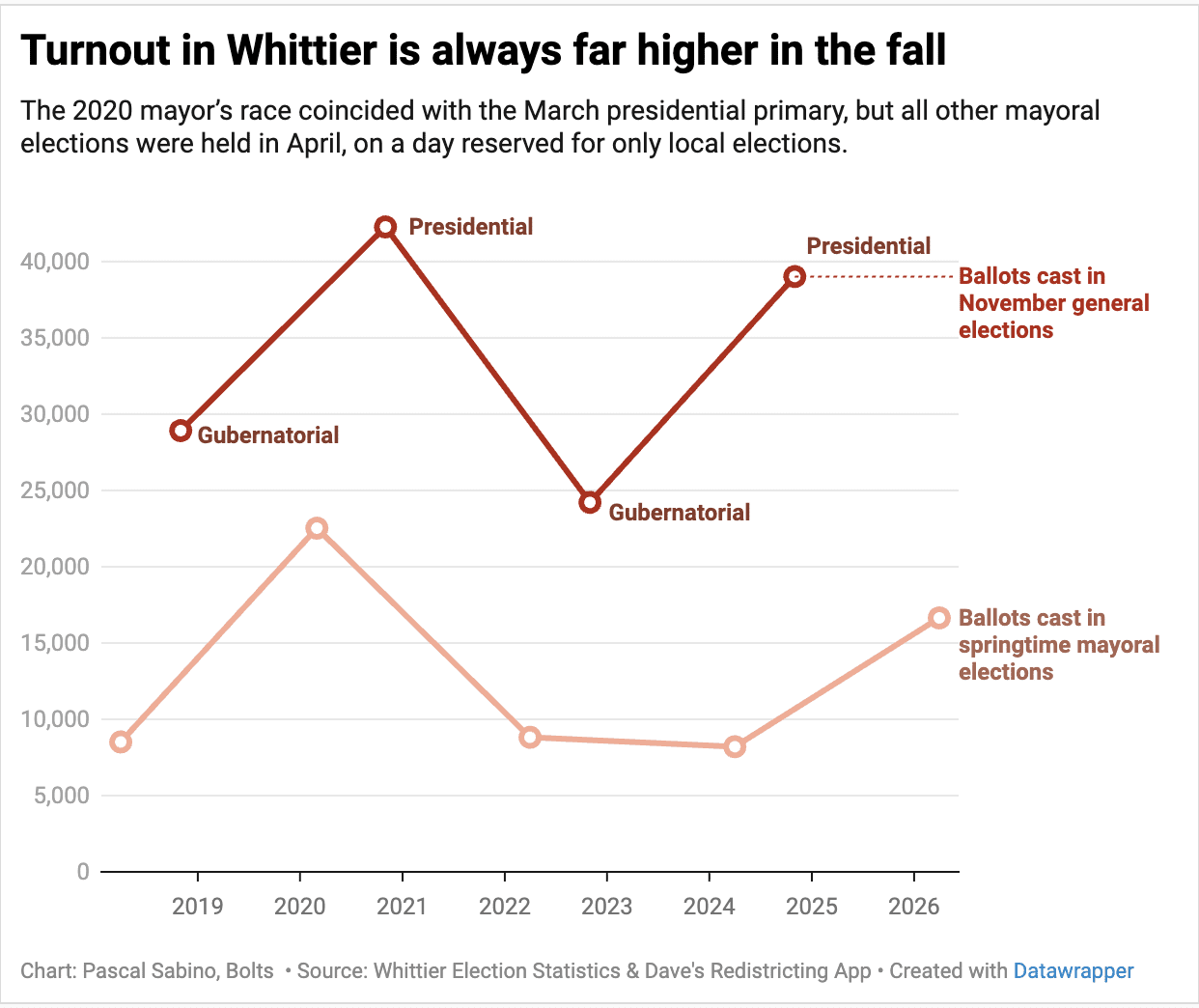
“This is a way that local politicians have built something that only works for them,” Lorenzo told Bolts. “People want to vote when everybody else is voting.”
A recent study by University of California researchers shows that Southern California cities that rescheduled their local contests to match presidential elections saw huge gains in participation among groups that tend to be under-represented at the polls, including renters, young people, and voters of color. The study found that issues that matter to these communities, including housing affordability and immigrant services, played a larger role where local elections were synced with state races.
Ricardo Robles, a co-author of the study, told Bolts, “Cities do this because they don’t want to be responsive to the types of interests that would have been represented in on-cycle elections.”
Whittier organizers have long been frustrated by this dynamic. “We’ve been talking about this for years,” Medina said. “People in power don’t want to lose their power.”
Martha Escutia, a former state senator who retired in 2006 but has remained a fixture in local politics, was awed last summer witnessing the actions of residents who were previously unengaged. In the wake of the ICE raids, neighbors began to patrol the streets to check in on local vendors who sold fruit and flowers, she recounts, and mutual aid groups dropped off snacks to day laborers at the Home Depot. A group gathered outside a DoubleTree Hotel in June to protest against federal agents believed to be staying there.
Days later, during the nationwide No Kings Day protests, so many people came to Whittier’s demonstration that it became clear to Escutia that change was on the horizon.
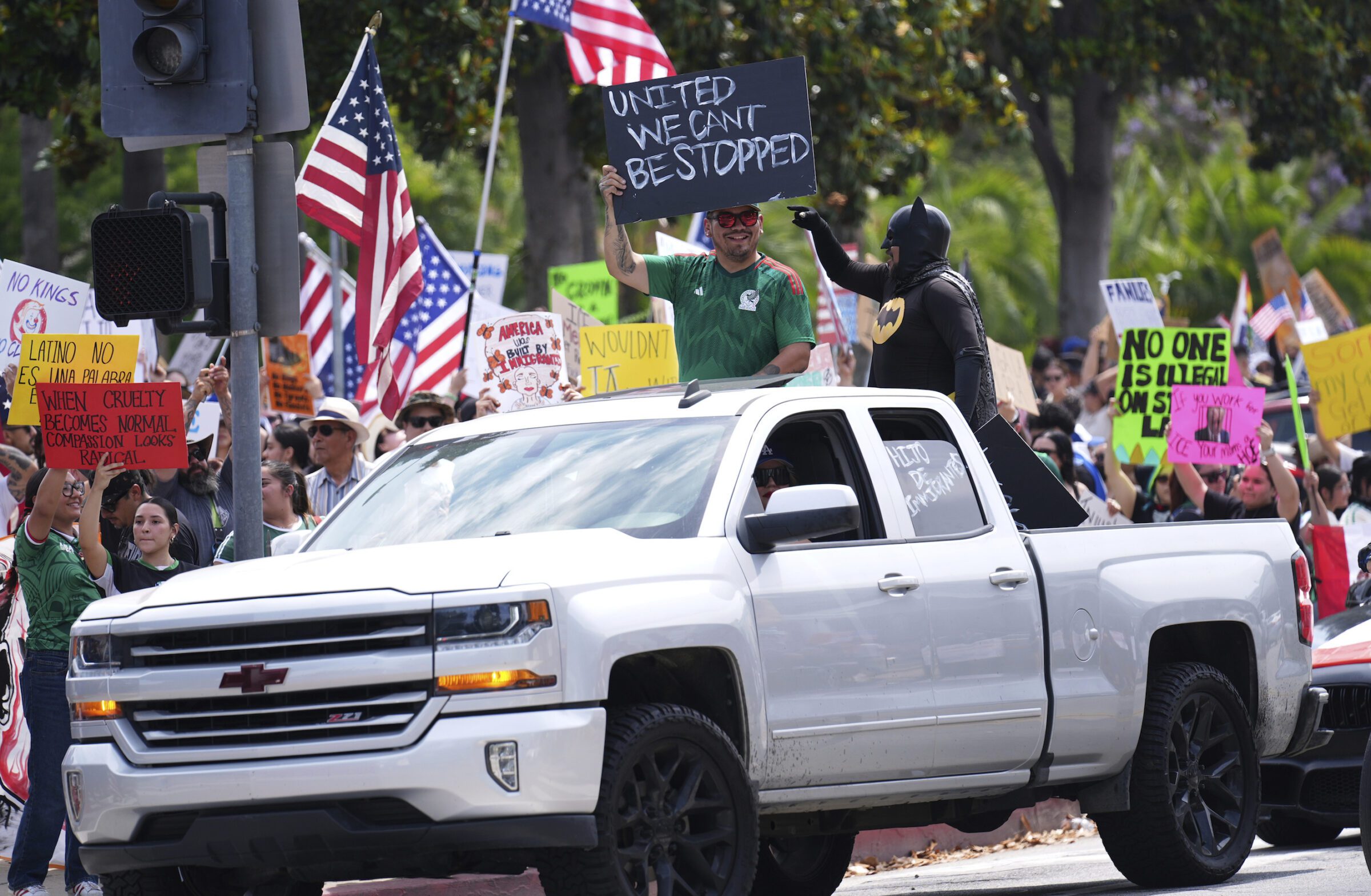
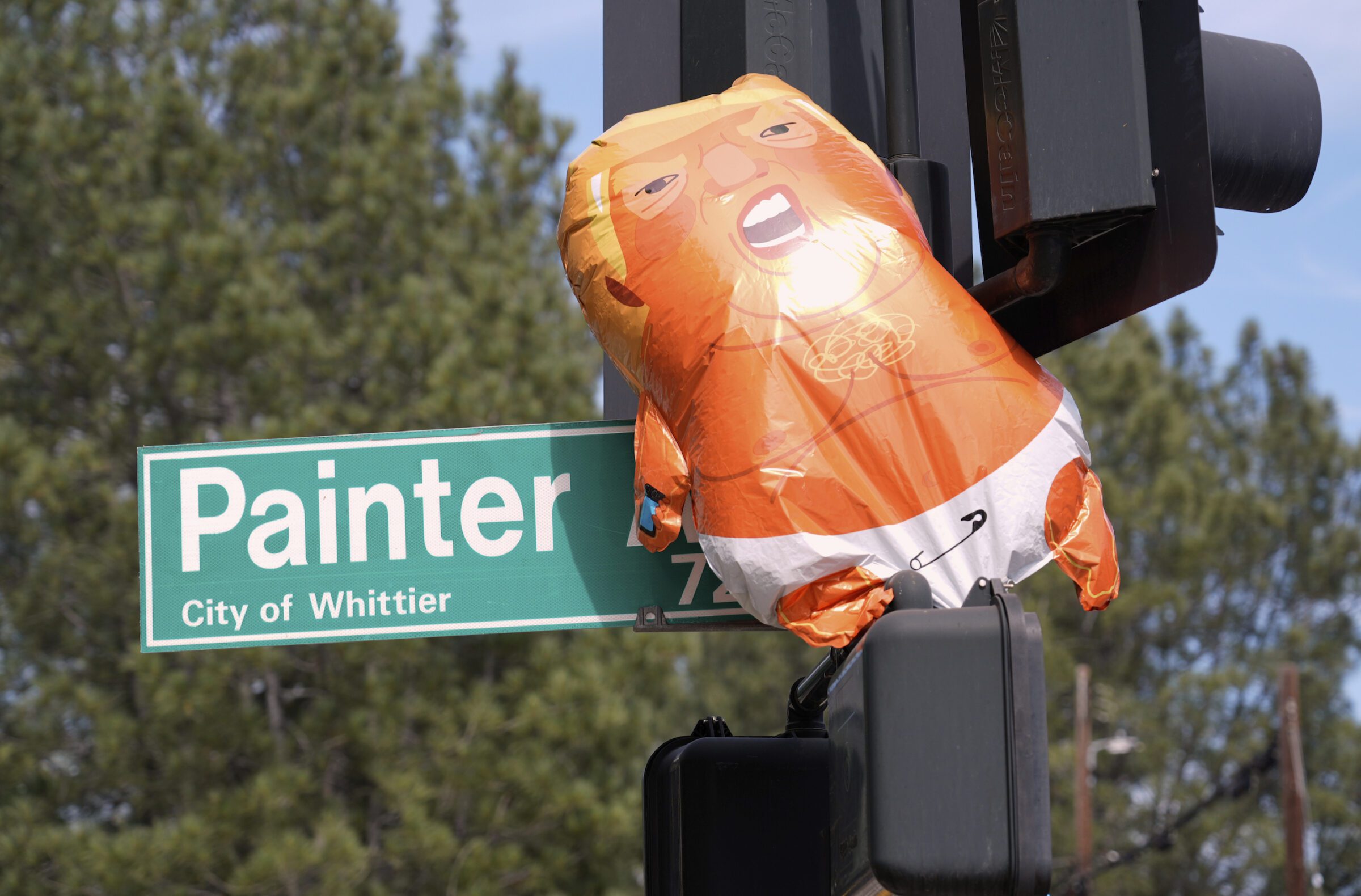
“It was unbelievable. I have lived in Whittier for 30-something years, and I have never ever seen that type of civic engagement,” she said. “I don’t want to be sarcastic or jaundiced, but we cannot allow a crisis to go to waste, and we are in a crisis here in Whittier.”
Grassroots volunteers who spent hours phone-banking and door-knocking for the challengers this spring told Bolts during the campaign that they were spurred into action by the ICE raids.
They also said the city was unresponsive to their concerns long before federal officers descended upon it. Many have fought local officials’ plan to cut down over 80 of Whittier’s hallmark ficus trees to make way for new development in the Uptown neighborhood. Many residents felt disregarded when Mayor Joe Vinatieri brushed off a petition with over 8,000 signatures opposing the plan, said Conny McCormack, founder of the Save Our Trees campaign.
“The average city election here only has around 8,000 voters, so it’s not fake outrage,” McCormack told Bolts. The trees became a rallying point for many voters, and many of the election signs on people’s lawns and carried at rallies read: “Chainsaw Joe has got to go.”
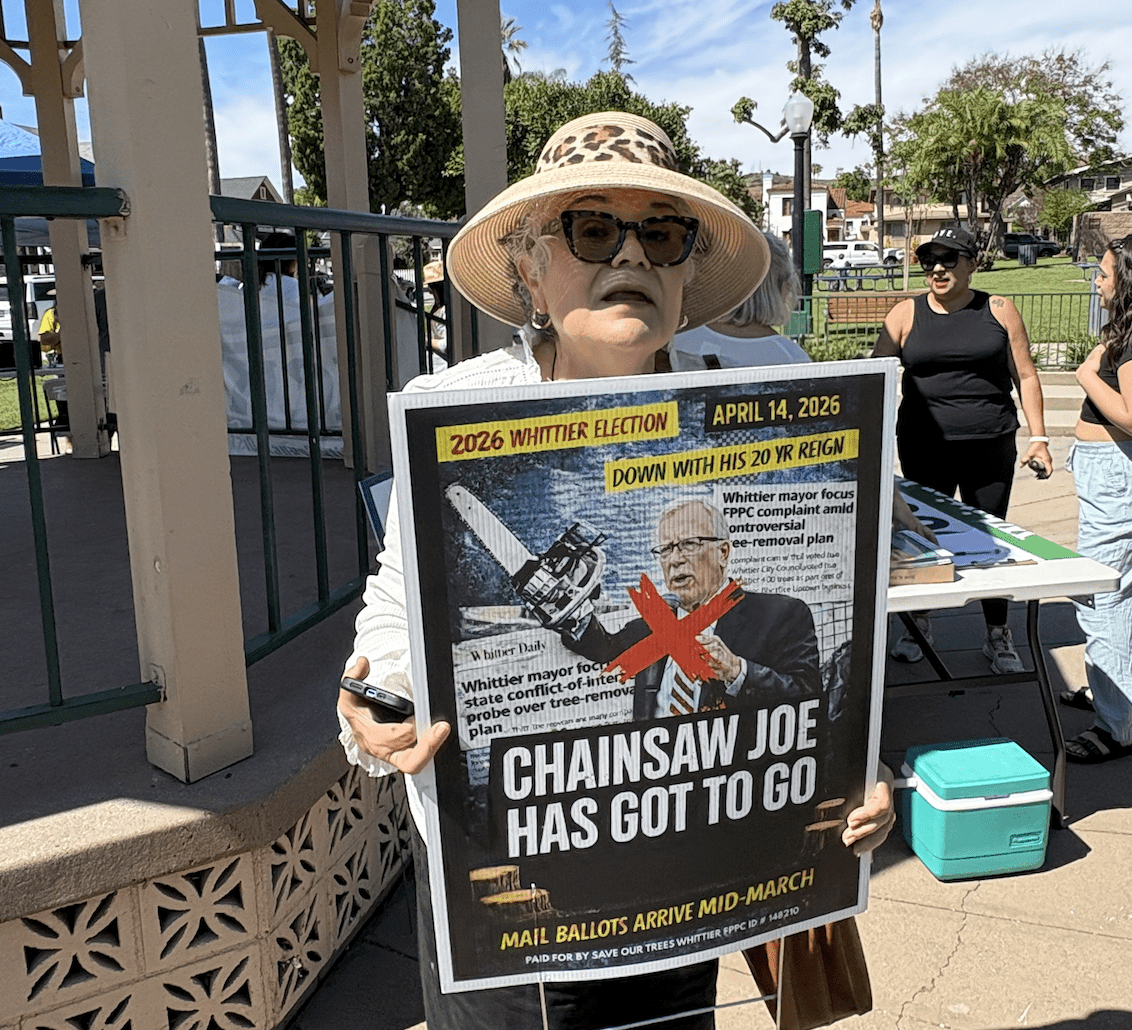
The three Democratic-backed challengers also made the timing of these elections one of their chief rallying calls. Their supporters had to focus on simply reminding voters there was an Election Day mid-April, separate from the June primary they’ve been hearing about in TV ads and mailers—that’s when they’ll get to vote for governor and other high-profile offices.
“We have double the burden,” Escutia told Bolts during the campaign. “We have to inform people that there is an April election this year, and at the same time we have to ask them to vote MAGA out.”
Macedo, who ran against Councilor Fernando Dutra in the fourth district, denounced the council’s decision in 2021 to revert to an April election schedule. She compared that move to other tactics employed by conservatives nationwide that make it harder to vote.
“People don’t know about the election by design,” she told a crowd of supporters in the final days of her campaign. “People don’t know because the incumbents at City Hall don’t want them to know. And it’s our job to tell them why people don’t want them to vote. It’s happening at the national level, and it’s happening here in Whittier.”
Mark Ramos, chair of the Los Angeles County Democratic Party, also attended the rally at Whittier’s Central Park to support the challengers. The party helped recruit volunteers and send ads endorsing candidates as part of an effort to flip Republican-controlled cities in LA County and bring their local results in line with how they vote in state and federal races.
“Why have an election in April?” Ramos asked the crowd. “Move it to June or November and let democracy happen. That’s what this election is about.”.
Under Becerra’s leadership, Whittier may soon amend its city charter to change the timing of its local elections. “Unequivocally and emphatically, we are going to bring Whittier’s elections back on-cycle,” he told Bolts.
If the city council approves such an ordinance, it’d still need to be approved at the polls before it takes effect.
Voters have approved such measures in many other cities, often by large margins, including in 2015 in the city of Los Angeles, which now holds its mayoral contests alongside California’s gubernatorial election. The defeat of a similar measure in New York City last fall stands out as a huge exception; meanwhile, the city of Coral Gables, Florida, easily approved this change in late April.
With its new liberal majority, the city council should also have the votes to take a stronger stance against ICE’s presence in Whittier than what local officials offered last summer.
When Pacheco, the sitting liberal member, first proposed an ordinance last July to ban face coverings for ICE agents and require them to identify themselves during operations in Whittier, the mayor shut the plan down on the basis that the city has no authority over federal officers.
Jurisdictions that have tried to regulate ICE have indeed run into problems getting the agency to comply. A federal court recently struck down a California law requiring ICE officers to identify themselves; another federal judge ruled earlier this year that California’s mask ban targeting federal agents was unconstitutional, though Democrats celebrated that the ruling left the door open to a law requiring officers from all levels of government to show their faces.
Some local activists who have formed rapid response networks to protect undocumented immigrants say they’re not convinced that federal agents would be deterred by Pacheco’s proposal. They declined to endorse both the ordinance and the candidates that back it.
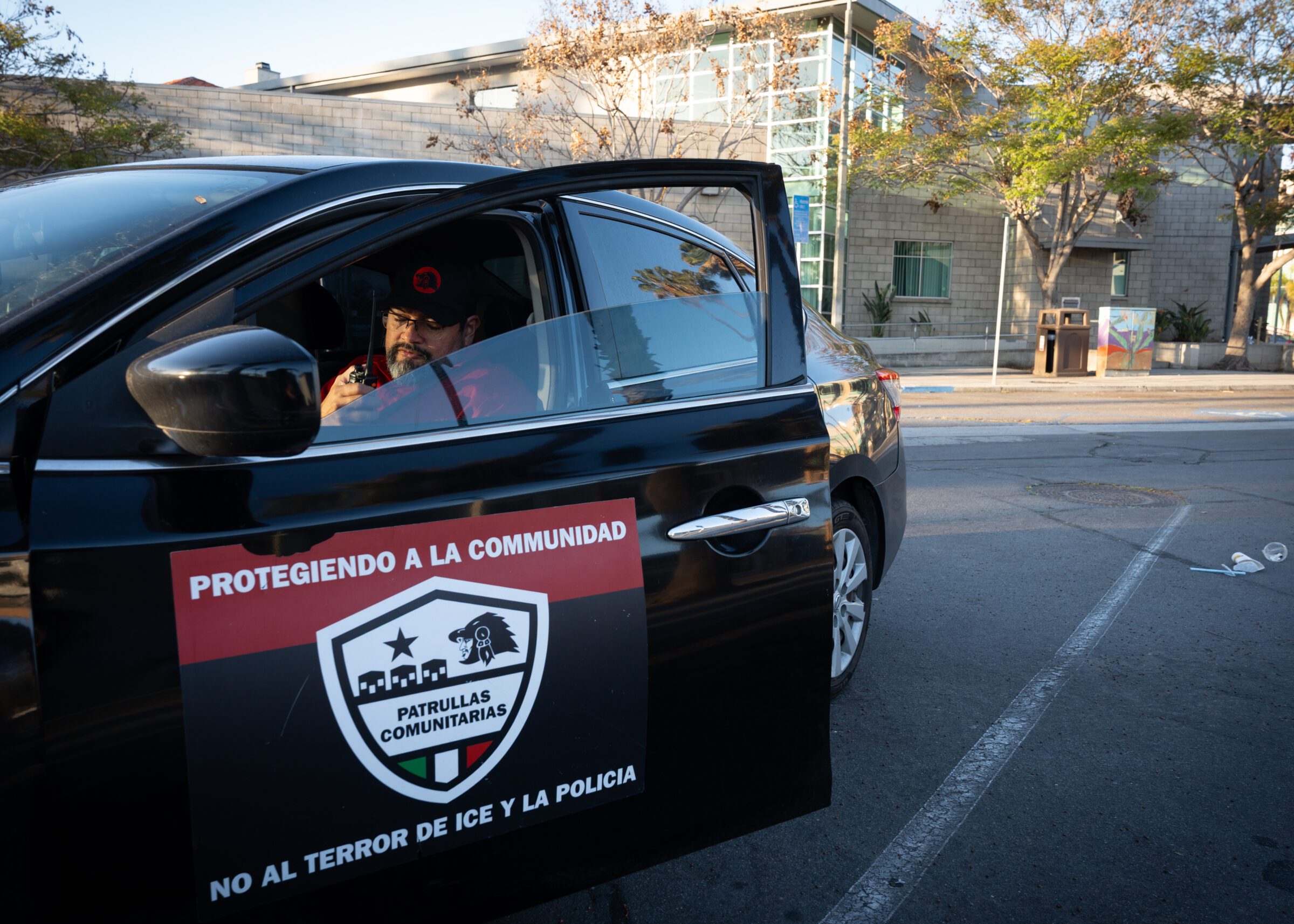
Instead they’ve pursued avenues outside of conventional politics to keep residents safe. Whittier groups have joined with dozens of Los Angeles-area organizations to form the Community Self Defense Coalition, which trains people to patrol their neighborhoods to keep watch for ICE and show up quickly to document arrests when they are reported. Volunteers also visit detention centers to help people get access to legal assistance and aid their families. Similar efforts have taken root elsewhere in California, Bolts has reported.
Still, for Escutia, who drafted the initial ordinance for Pacheco and later helped LA County adopt similar ICE restrictions, putting the issue to a vote was worthwhile because it allowed residents to see clearly whether their leaders cared about the issues that mattered to them.
Becerra also believes that Whittier should take action and align with cities that are already working to rein in ICE activity.
“We need to show the next generation that Whittier is a city that has values, that we value our Constitution, and our protections from unreasonable search and seizure,” he said. “So getting that ordinance passed, that would be a value statement.”
Sign up and stay up-to-date
Get timely updates about pressing stories and elections.
Support us
Bolts is a non-profit newsroom that relies on donations, and it takes resources to produce this work. If you appreciate our value, become a monthly donor or make a contribution.
Related Posts