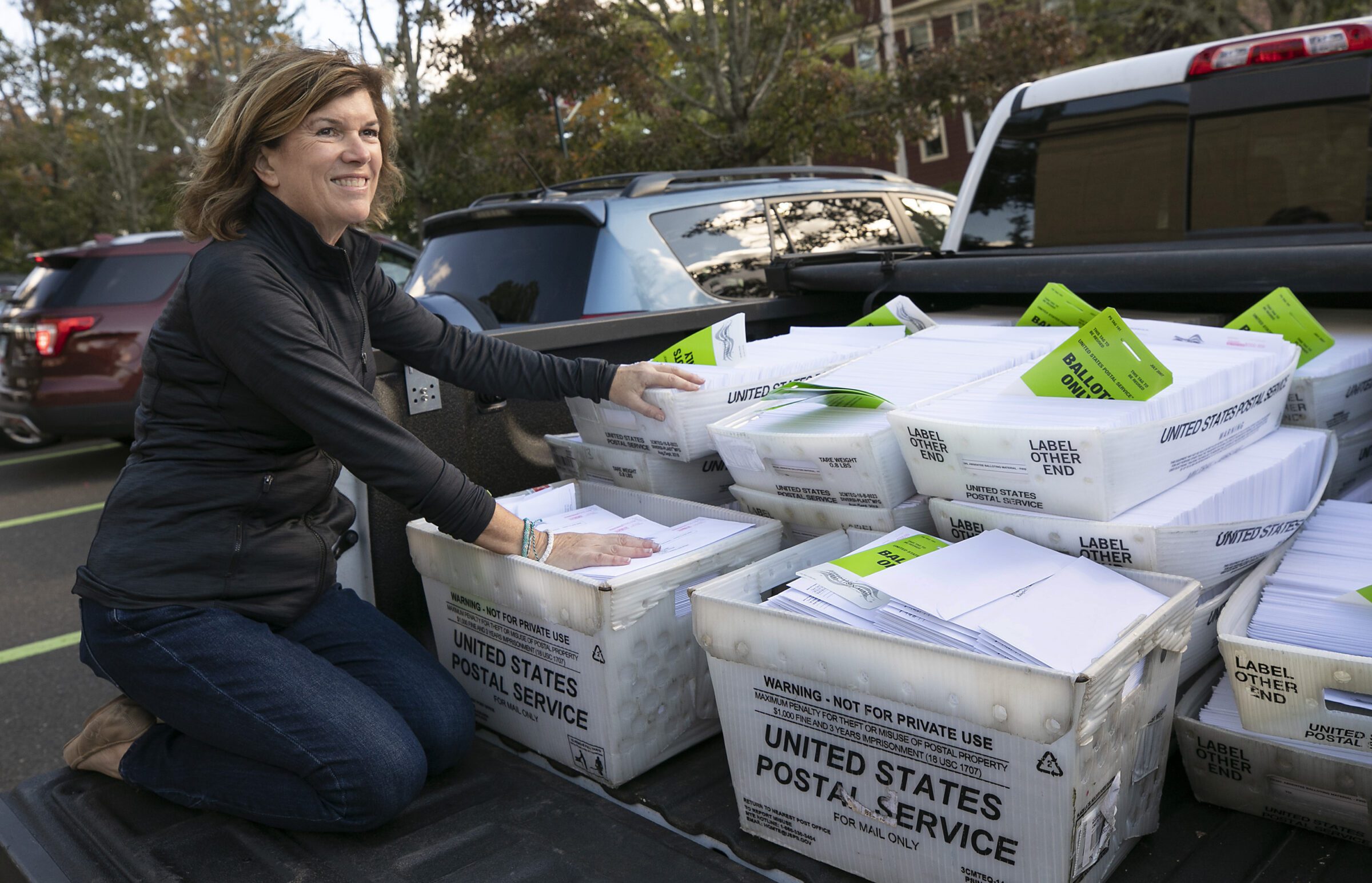

Connecticut Expands Mail Voting, Catching Up to Most Other States
A new law will allow any voter to get a mail ballot; the state had fallen far behind national norms by still requiring an excuse. The reform runs counter to Trump’s attacks on mail voting.
| May 22, 2026

Connecticut has for years stood apart from most of the country, including nearly every other blue state, by requiring anyone who wishes to vote by mail to fill out an application asserting a specific excuse, such as active military service or illness.
That changed on Tuesday, when Democratic Governor Ned Lamont signed House Bill 5001, allowing any Connecticut voter to simply request a mail ballot without needing to provide any reason.
“More people will vote because now they have better access, and more people will be inclined to vote,” said Carol Scully of CT Adapt, an organization that advocates for people with disabilities, who disproportionately benefit from convenient mail voting. “They’ve got access that they should have had all along.”
Among other changes, the bill also allows mail voters who’ve made a mistake in the casting process—failure to sign or properly date a ballot envelope, for instance—to correct those errors at an elections office and ensure that their votes are counted. Thousands of voters make these kinds of mistakes every cycle in Connecticut, but have had their votes rejected because the state hasn’t facilitated ballot curing.
Connecticut joins 36 other states, red and blue alike, plus Washington, D.C., and two U.S. territories, in allowing anyone to vote by mail.
For more on voting rights
Subscribe to our newsletter
Nine of those states go further by allowing what’s known as permanent absentee voting, meaning that a voter need only request a mail ballot once in order to automatically receive one for all elections moving forward. Permanent absentee voting was dropped from Connecticut’s bill during the legislative debates.
The remaining 13 states and three territories all require voters to provide an excuse to vote absentee. This group mostly comprises red states, such as Tennessee and Texas. Following Connecticut’s reform, Delaware and New Hampshire are the only two states that voted for Kamala Harris in 2024 that still require an excuse to vote absentee. Delaware passed legislation to allow no-excuse mail voting, but the reform was struck down in 2022 by the state supreme court; lawmakers there are trying again now.
“Connecticut was one of the most restrictive states in the nation,” John Erlingheuser, who directs advocacy and community outreach efforts for Connecticut’s AARP branch, told Bolts this week. “It was a long process to get us to where we are today.”
Erlingheuser said he and AARP spent a decade pushing for this change—older voters are more likely than the rest of the electorate to vote by mail—and characterized it as but one part in a broader series of reforms that have overall made voting easier in Connecticut.
“We didn’t have in-person early voting up until a couple of years ago. We didn’t have same-day voter registration, and we didn’t have no-excuse absentee balloting,” he said. “We now have all of these things.”
Connecticut took a long path to get here. Its state constitution explicitly required that election officials allow absentee voting only for those who could provide any of a specific set of excuses. An exception was made in 2020, when, under pandemic duress, state election officials decided to temporarily lift this constitutional restriction; some 650,000 people in Connecticut, a third of the electorate that year, wound up voting by mail.
But voting rights advocates like Erlingheuser sought lasting change, and continued organizing to undo the constitutional restriction, culminating in a 2024 amendment proposal to strike that language in the constitution.
The amendment was put to voters, about 58 percent of whom supported it, opening the chance for the state legislature, which is controlled by Democrats, to introduce and pass HB 5001, and for Lamont to sign it.
“Connecticut voters overwhelmingly demanded absentee voting for all, and now we have delivered,” state Senator Matt Blumenthal, a Democrat who sponsored the legislation, said at the bill’s signing ceremony.
Connecticut’s decision to expand mail voting contrasts sharply with the recent trend in red states, which, at President Donald Trump’s behest, have moved to make the practice less convenient. Republicans had often supported mail voting in the past, and no-excuse mail voting is legal in many red states, but Trump has crusaded against it since 2020, when he falsely alleged fraud in the presidential election.
Republicans in states like Kansas, Ohio, and Utah, where mail voting is broadly popular, have restricted the practice over the last year in direct response to Trump.
And in Connecticut, HB 5001 passed the state legislature on a party-line vote, with all Republicans opposing it.
Republicans argued against adding new voting options through this bill. In recent years they’ve pushed unsuccessfully at the legislature against mail-voting expansion and in favor of new restrictions, pointing to a vote-by-mail fraud scandal in Bridgeport, Connecticut’s biggest city.
Beyond mail voting, HB 5001 also featured a slew of provisions, also opposed by Republicans, that Democratic lawmakers intend as protections against election interference, as Trump threatens to send troops to polling places and issues executive orders meant to increase federal control over state and local election administration.
These changes include increased criminal penalties for people accused of harassing election workers or tampering with ballot drop boxes, and new restrictions on federal law enforcement officials from appearing within 250 feet of a polling place without specific permission from a court or Connecticut election officials. HB 5001 grants the state attorney general’s office to enforce these rules, and the current AG, Democrat William Tong, said in testimony at the legislature, “I stand ready.”
Sign up and stay up-to-date
Get timely updates about pressing stories and elections.
Support us
Bolts is a non-profit newsroom that relies on donations, and it takes resources to produce this work. If you appreciate our value, become a monthly donor or make a contribution.
Related Posts