
In 2025, Democrats Flipped 21 Percent of GOP-Held Legislative Seats
The party secured strong gains reminiscent of 2017, our annual review of state legislative results shows. They won multiple new seats in New Jersey, Virginia, Iowa, and Mississippi.
| December 10, 2025

Editor’s note: The article was updated on Dec. 31 to reflect the results of three special elections held in late December, none of which resulted in a partisan flip.
At the start of Donald Trump’s first presidency, in 2017, large Democratic victories in New Jersey and Virginia, paired with overperformances in special elections, foreshadowed the blue wave of the 2018 midterms. Eight years later, Trump’s return to power has been followed by similar Republican setbacks, including Democrats’ sweep of all 13 statewide elections that took place this November, plus myriad gains for local offices.
Now, with this year’s contests nearly all completed after Tuesday, which saw Democrats stage an upset and flip a state House seat in Georgia, the extent to which the GOP struggled in legislative races has also come into view.
Democrats, buoyed by Trump’s unpopularity and a fired-up base, flipped 21 percent of all the GOP-held seats that were on the ballot throughout 2025.
According to Bolts’ analysis, Democrats gained 25 state Senate and House seats that were held by the GOP, out of the 119 that were resolved this year in regular or special elections.
The swing is even stronger than in 2017, when Democrats flipped 20 percent of all GOP-held legislative seats up for election, per Bolts’ review of data compiled at the time by elections websites Ballotpedia and The Downballot.
Among their 2025 gains, Democrats have secured their largest majority in the Virginia House since the 1980s, expanded their control of the New Jersey Assembly, and broken Republican supermajorities in the state senates of Iowa and Mississippi. They also flipped a state Senate seat in a deeply Republican region of Pennsylvania, and staged Tuesday’s upset in a Georgia district that Trump had carried by double-digits last year.
Subscribe to our newsletter
Read more on local elections
Meanwhile, Republicans failed to flip any legislative seats this year, losing ground even in New Jersey, where they had high hopes, and failing to gain several districts in New York State that Trump carried last year. (The GOP did manage to flip a handful of seats in 2017.)
And the GOP may have gotten lucky this year: Most of the legislative elections that occurred in 2025 were for seats that Democrats already held, which limited their opportunity for gains. The Downballot has found that, in special elections that both parties contested this year, Democrats performed 13 percentage points better on average than they did in the 2024 presidential race.
| Seats at play, heading into 2025 | Results of 2025 races | Gain for Democrats | |
|---|---|---|---|
| Regular elections in the fall of 2025 | |||
| New Jersey Assembly | 52 D 28 R | 57 D 23 R | +5 |
| Virginia House | 51 D 49 R | 64 D 36 R | +13 |
| Special elections in 2025 | |||
| In Georgia | 2 D 2 R | 3 D 1 R | +1 |
| In Iowa | 2 D 4 R | 4 D 2 R | +2 |
| In Mississippi | 9 D 11 R | 12 D 8 R | +3 |
| In Pennsylvania | 1 D 1 R | 2 D | +1 |
| All other special elections | 38 D 24 R | 38 D 24 R | No flip |
| For the purposes of this analysis, Bolts is treating the city council of Washington, D.C., as equivalent to a state legislature, as we have in past years. (The table has been updated since the original publication to include three late-December special elections that were still being contested as of publication.) Bolts is grateful to Ballotpedia and The Downballot for their exhaustive tracking of legislative special elections, which was used for this analysis. |
The 25-seat swing from Republicans to Democrats this year represents a shift of 9 percent out of the 274 elections that have been resolved this year—another echo of the state legislative elections in 2017, which also saw a 9-point shift against the GOP. (Editor’s note: This paragraph was updated after the completion of the final three special elections of 2025, all safe districts that did not flip.)
Other recent cycles didn’t see this sort of swing. Bolts has conducted an annual review of legislative elections for the last three years and the shifts were minimal in each.
In 2022, the GOP gained a net 20 seats out of the thousands of districts on the ballot, a deflating result in a midterm for which they had high expectations.
In 2023, Democrats gained a net five seats out of the more than 600 seats in play.
And in 2024, the GOP gained a net 57 out of roughly 6,000 contests; the haul helped them break some Democratic majorities but fell short of replicating their success at the top of the ticket.
In each of these cycles, the overall swing in partisan control was no more than one percentage point of all the seats in play, compared to 9-point swings in 2017 and 2025. By comparison, the major gains the GOP scored in 2021, at the outset of Joe Biden’s presidency, included a five-point shift in legislative seats, roughly half of what Democrats achieved this year.
Below, Bolts looks more closely at the results in the four states that saw multiple seats flip this year—New Jersey and Virginia, which elected all members of their lower chambers, as well as Iowa and Mississippi—with special attention to how they matter for criminal justice and voting rights.
1. Democrats regain control of Virginia’s state government
Virginia may now be known as a blue state, but Democrats have only enjoyed full control of the state government for two of the last 30 years. That brief period of control, during the 2020 and 2021 sessions, was a busy one: The party abolished the death penalty and life without parole for children, ended prison gerrymandering, and expanded mail voting, among other reforms. Republican Glenn Youngkin’s election as governor in 2021 broke Democrats’ streak and ushered in conservative executive changes—including new partnerships with ICE, a major rollback to voting rights restoration, and the unraveling of parole grants, as Bolts has reported.
Democrats regained control with striking ease this fall, as Abigail Spanberger captured the governor’s mansion, and Democrats expanded their majority in the 100-seat House from 51 to 64. (The Democratic-led Senate was not on the ballot at all.)
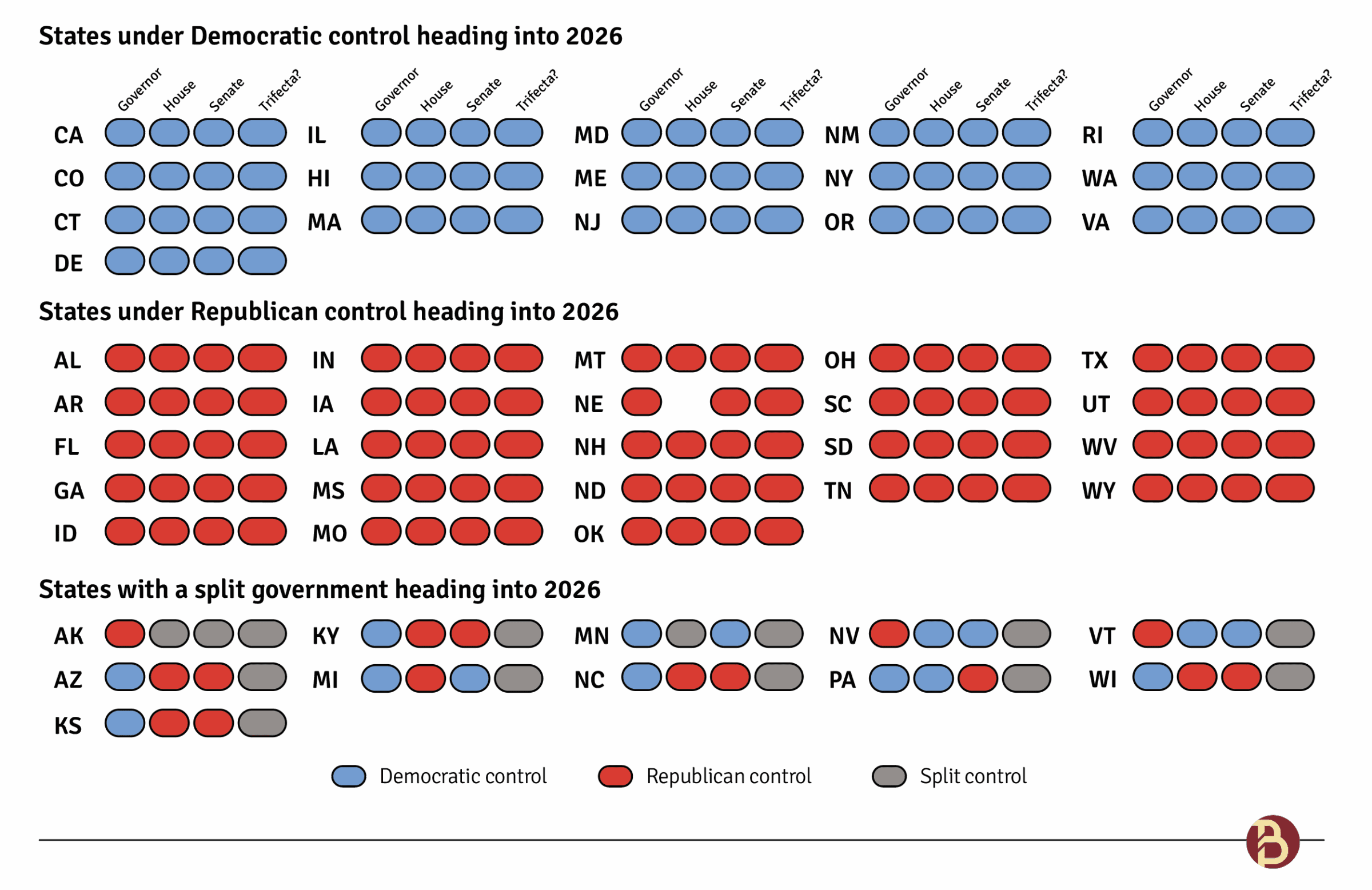
This adds one trifecta—one-party control of both legislative chambers and the governorship—to Democrats’ national haul, up to 16. The GOP still holds a trifecta in 23 states, and 11 states now have divided governments (down one from last year).
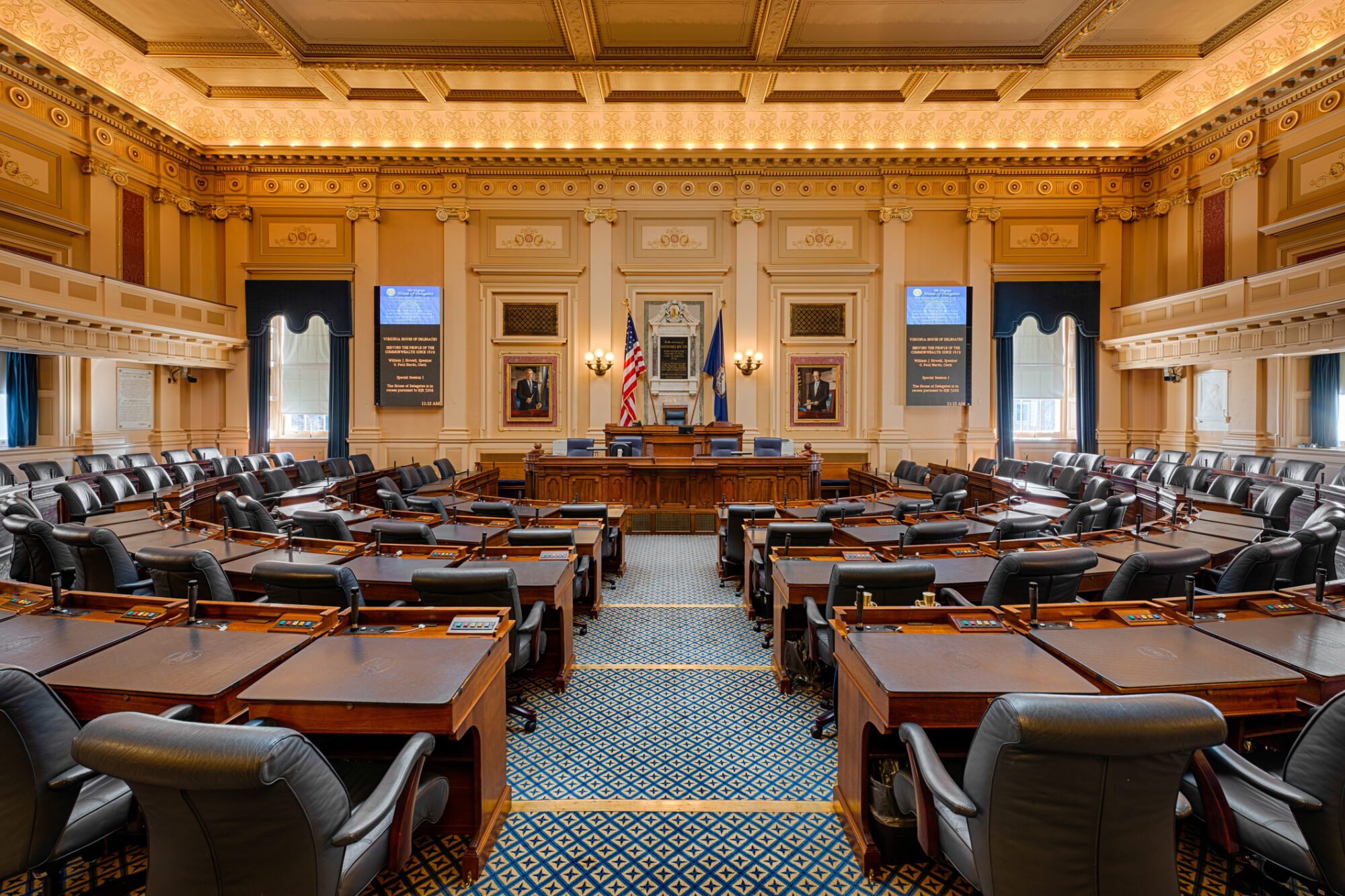
Virginia Democrats are likely to start the 2026 session by advancing a set of constitutional amendments they’ve already passed once in 2025. (Amendments to the state constitution must be adopted by two consecutive legislative sessions and then be referred to voters.) This includes a measure to enshrine abortion rights, and a measure to restore people’s voting rights once they are released from prison, which would end Virginia’s current practice of lifetime disenfranchisement.
It also includes a constitutional amendment that would allow Democrats to gerrymander the state before the 2026 midterms. Virginia Senate Majority Leader Scott Surovell told Bolts in November the measure would be “one of the first orders of business,” and other Democratic leaders have since echoed his stance.
Meanwhile, advocates for criminal justice reform have already renewed policy priorities that include several reforms passed by lawmakers but vetoed by Youngkin in recent years, such as legislation that would have barred prosecutors from making people waive constitutional protections against unreasonable police searches as a condition of plea deals.
2. Democrats solidify control in New Jersey
New Jersey has been under full Democratic control since the 2017 cycle, but Republicans this year talked a big game about gaining in the legislature, if not outright flipping the state. They had a rude awakening on Nov. 4, when Democrat Mikie Sherrill won the governor’s race by over 14 percentage points and her party gained five seats in the state Assembly, including flipping districts in South Jersey, a region that was trending red.
These gains give Democrats a new supermajority in the lower chamber, and their largest edge there since 1973. But Democrats won’t have a supermajority in the Senate, which they’d need to advance a constitutional amendment on a party-line vote; seats in that chamber weren’t up this year.
The legislative shifts are unlikely to mark a significant change to how Trenton operates, since Democrats have already decided to retain the same leadership in both chambers.
Bolts reported earlier this year that the legislature’s Democratic leadership has frustrated immigrants’ rights and criminal justice reform advocates by sitting on some of their priorities, including bills to enshrine protections for immigrants and create a path out of prison for incarcerated survivors of domestic violence. On each of these issues, Governor Phil Murphy’s administration took executive actions to circumvent the legislature; Sherrill, a moderate Democrat, has not publicly said much about how she’ll address these issues as governor.
3. Republicans lose their supermajorities in two states
Democrats in both Iowa and Mississippi flipped two seats in their upper chambers, breaking GOP supermajorities. Iowa Democrats staged upsets in two significantly conservative Senate districts, while in Mississippi they benefited from new maps ordered earlier this year by state judges who found that the state’s GOP-drawn maps illegally diluted the voting power of Black residents.
Practically, the impact of these gains could be relatively limited. The GOP’s supermajorities allowed them to override gubernatorial vetoes, but both states have Republican governors that aren’t looking to block GOP priorities.
The Democratic gains in Mississippi mean that Republicans will no longer have the power to advance constitutional amendments on a party-line vote, since that takes a supermajority. But that hasn’t happened anyway over the last two decades; the rare amendments the legislature has passed drew near-unanimous support.
One major impact of the two-seat shift in the Iowa Senate: Without a supermajority, Republicans can no longer confirm appointees of Governor Kim Reynolds on a party-line vote.
While many of her nominations have drawn broad support, some of her recent picks received no Democratic votes and only passed thanks to the GOP’s supermajority. That includes Iowa Department of Education Director McKenzie Snow, whose work on behalf of private school vouchers drew opposition from proponents of public schools last year, and two members of the Iowa Board of Regents who were confirmed this spring over opposition from LGBTQ groups.

Still, Reynolds has a history of sidestepping resistance in the Senate. During her first full term, before the GOP gained a supermajority in the 2022 midterms, Reynolds periodically reappointed a nominee who failed to get Senate approval to different state board seats, allowing him to continue serving without confirmation.
4. What lies ahead?
Thousands of legislative seats, plus 36 governorships, will be on the ballot during the next year’s midterm elections. At least on paper, partisan control of virtually every state government could shift, but there are a dozen states that already look like key battlegrounds.
Democrats’ priorities for next year include regaining trifectas in Michigan, Minnesota, and Nevada, all of which they lost in 2024, as well as breaking longtime GOP trifectas in Arizona, Georgia, Iowa, New Hampshire, and Ohio.
Meanwhile, Republicans hope to gain a new trifecta in Kansas, where they currently control the legislature but not the governorship, and break the Democratic trifectas in Maine and Oregon. Meanwhile, Pennsylvania and Wisconsin currently have split governments but either party has a plausible shot at controlling the state come 2027.
Sign up and stay up-to-date
Support us
Bolts is a non-profit newsroom that relies on donations, and it takes resources to produce this work. If you appreciate our value, become a monthly donor or make a contribution.