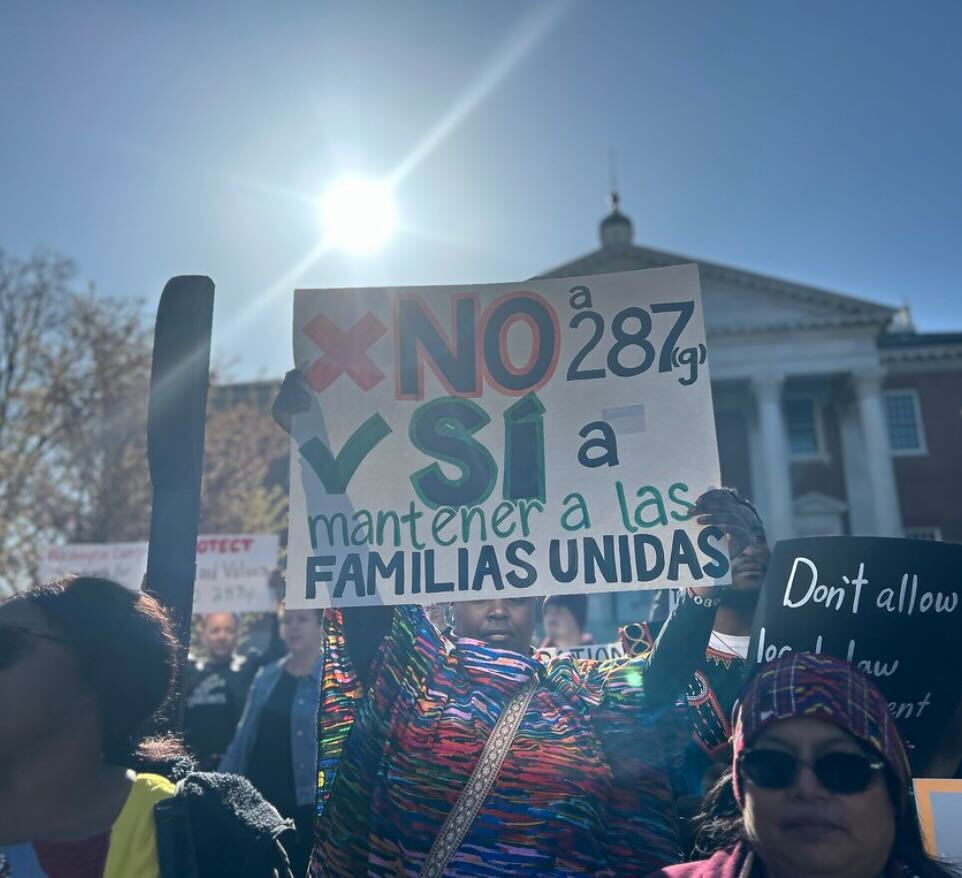

Inside ICE’s Only Contract with a Blue State
As part of a 287(g) contract between state officials and ICE, Massachusetts continues to release prisoners into deportation—even as state lawmakers look to ban other forms of ICE collaboration.
| February 9, 2026
Luis Perez waited 53 and a half years to be freed from prison. When his day finally came, on Jan. 16, 2025, he could practically feel the warmth and quiet of his daughter’s guest bedroom, where he planned to live after his release, and he could practically taste the home-cooked yellow rice and fried pork awaiting him. He was 73 years old, a lifetime removed from the murder he committed as a teenager after moving from Cuba to Massachusetts.
In prison, Perez became a licensed minister and earned a community college degree. He mentored hundreds of younger prisoners in whom he saw the same societal failures that led him to prison in the first place: “Broken homes,” he said. “These were kids who got involved in gangs, who did drugs, who did robberies. No one wants to go to the root of the cases, but it’s not cut and dry.”
Just prior to his release, Perez has gotten a glowing review from the state parole board, which, he says, unanimously supported him, and made him feel as though he’d cleared every possible hurdle to freedom and had nothing more to worry about. His pre-release plan, which called for him to move in with his daughter, was approved at the prison.
The day he was set to leave, he said goodbye to incarcerated friends and spent some final, heavy moments in his tiny cell. He walked out to the fence at the edge of the prison yard. “I wanted to look at it because I thought that was the last fence I was ever going to see,” he said.
Prison staff came to show him out: “They said, ‘Are you ready to go?’ I said yes. I was happy,” he said. “After so many years, it was going to be something different for me.” On his walk from the cell block to fresh air and freedom and family, he was ushered through a doorway, on the other side of which stood three men he’d never seen before: ICE officers. They handcuffed him and drove him in a van to a detention facility in Maine.
He spent 10 days in Maine, he said, before ICE put him on a plane bound for Texas, where he spent almost seven months in detention, before being ordered into a van that drove him, over three days and more than 1,000 miles, to Tabasco, Mexico, a place he’d never been before, and where he knew no one. There, at last, he was released. He bought and ate his first mango in decades.
“I felt happy for my freedom, but sad—no family with me,” Perez said over the phone from Tabasco in late January. He had nowhere to go and knew nobody there, and so he spent his first two nights sleeping on a park bench. He woke up to stray dogs sniffing and barking at him; he hadn’t showered in a long time.
I normally wouldn’t print Perez’s full name, as many in his position are understandably nervous to draw attention to themselves and risk retribution by the government. But he told me he wants his name and story published, and that he wants to advocate for other immigrants still behind bars in Massachusetts. “I’ve lost everything. I’m old. I don’t want to be hiding anything,” he said. “So I speak up. If I die, I die.”
It was no coincidence that ICE was waiting for Perez on the day of his release. The Massachusetts Department of Correction, which had custody of him for all those decades, formally partners with ICE to transfer people who have finished their sentences: Since 2007, the state prison system has participated in the federal 287(g) program and, as part of its contract, regularly sends people exiting Massachusetts prisons directly into ICE custody.
In fact, Massachusetts is the only state that voted against Donald Trump in 2024, and where the governor is a Democrat, where a state agency is contracting with the 287(g) program. It’s also the only state where Democrats fully control the state government that has such an agreement.
Virginia shared the distinction until last week, when new Democratic Governor Abigail Spanberger announced she is withdrawing Virginia state agencies, including the state’s DOC, from the 287(g) contracts she inherited from her Republican predecessor, Glenn Youngkin.
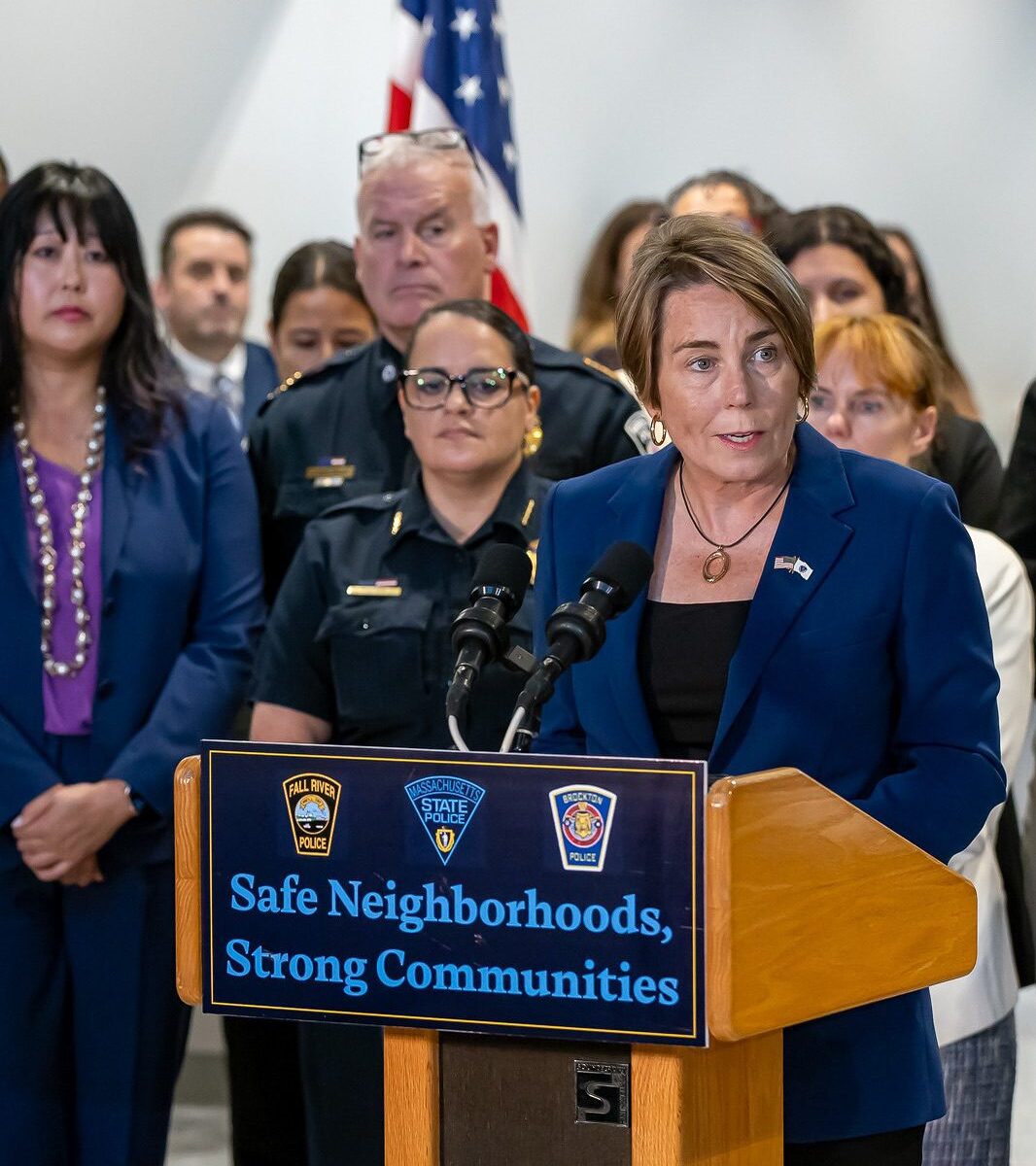
Massachusetts Governor Maura Healey, a Democrat, also has the authority to decide if her state’s DOC remains in the ICE program. She has defended and preserved the 287(g) agreement, even as she otherwise seeks to limit ICE activity in the state. Her office has not responded to my repeated calls and emails about the state’s participation in the program.

According to data I received from the state, the Massachusetts DOC facilitated a total of 164 transfers to ICE in 2023 and 2024. It’s unclear how often the state has transferred people from prison to ICE since Donald Trump retook office last year; the Massachusetts DOC repeatedly denied my request for 2025 data, stating that its 287(g) agreement “prohibits” the release and that information about the program “is under the control of ICE.”
After I appealed that denial, the state supervisor of records found that the Massachusetts DOC improperly denied my request and has ordered the agency to provide a new response that complies with Massachusetts’ public records law. (ICE also denied my request for information about transfers under the program, which I am also appealing.)
The 287(g) program is a major force multiplier for Trump and ICE: It primarily involves local law enforcement agencies, deputizing city or county officers to question people’s immigration status and to detain people past their scheduled release date so that ICE can pick them up. Last year, sheriffs, who as a group lean dramatically to the political right, rushed into the 287(g) program, which had 135 participating agencies before January of 2025 and now has about 1,300.
Among these 1,300 contracts are a few dozen with state agencies, the vast majority of them in states like Florida and Texas, run by Republicans. Massachusetts stands out as the bluest state on this list, by far.
Healey, like many Democratic officials across the country, has taken a harsher tone toward ICE since the killings by federal immigration agents in Minneapolis last month, including by calling for the resignation of Homeland Security Secretary Kristi Noem.
But Healey has also responded to Republican criticism about “sanctuary policies” in the state by pointing out that she has been supportive of immigration enforcement against people with criminal records. “I’m all for getting the bad guys,” she told Boston’s CBS affiliate. Of the state’s continued participation in 287(g), she said last week, “I actually support that agreement.”
Subscribe to our newsletter
for more reporting on local and state collaboration with ICE
Lawyers and organizers who work closely with immigrants in Massachusetts’ criminal legal system say that rhetoric like Healey’s about going after “bad guys” ignores important nuances.
“Overwhelmingly, the folks I work with who are incarcerated came here as children, many of them with legal permanent residency,” said Leah Hastings, an attorney who advocates for and represents detained immigrants at the nonprofit Prisoners’ Legal Services of Massachusetts. “A lot of them dealt with a lot of trauma and instability early on in their lives, often for the same systemic reasons that citizens are funneled into the criminal legal system: They didn’t have what they needed, many of them ended up in the foster care system, or had mental illnesses without access to treatment.”
Added Jennifer Klein, director of the Immigration Impact Unit at the state public defender office, “People create this dichotomy of ‘good’ and ‘bad’ immigrants, and it’s just not true.”
Perez speaks openly and regretfully about the harm he caused all those decades ago. He says he spent many years reflecting, and working to better himself while incarcerated. It’s awfully ironic, he tells me from Tabasco, that he came to the U.S. as a reckless young person and found a welcoming home, but now that he’s become a minister and a devoted, responsible family member, the U.S. has rejected him.
“The moment they moved me out of prison,” he said, “Massachusetts should have stood up and said, ‘Yes, this guy committed a crime, yes he is responsible for it, but this guy has had good conduct, he works, he has changed his life.’”
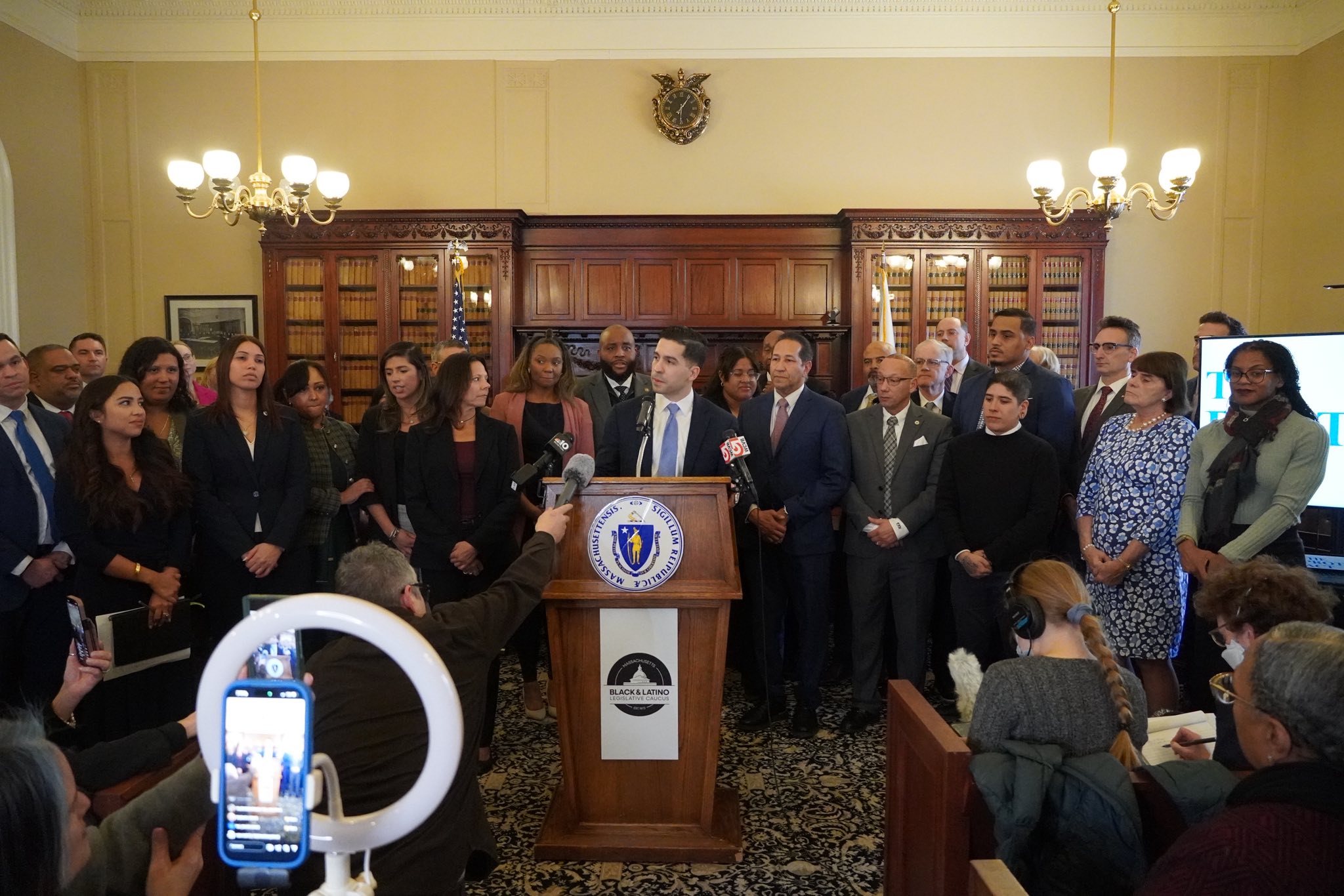
Late last month, members of the Massachusetts Black and Latino Legislative Caucus stood united behind a lectern at the statehouse for a press conference announcing their signature immigrant rights bill of this legislative session: “An Act Promoting Rule of Law, Oversight, Trust, and Equal Constitutional Treatment”—P.R.O.T.E.C.T. Act for short.
This bill contains a lot, including provisions to limit ICE arrests in Massachusetts courthouses and to force any ICE or Customs and Border Protection officer to disclose that work if they apply for a job in law enforcement in the state. It also proposes to ban local and state agencies from joining the 287(g) program—but it makes an exception for the Massachusetts DOC.
There are currently no 287(g) agreements anywhere in Massachusetts outside of the DOC. The last county-level 287(g) program there died in early 2023, when the Cape Cod sheriff’s office flipped to a Democrat, Donna Buckley, who promptly terminated the agreement. By creating a carve-out for the DOC in the P.R.O.T.E.C.T. Act, the bill’s Democratic sponsors are preserving the only 287(g) program that actually exists today in Massachusetts.
Representative Andy Vargas, chair of the Black and Latino Caucus, explained that decision to me in an email: “Candidly, people serving DOC sentences are in for more serious crimes and the Caucus came to a consensus that the state should collaborate with federal officials on individuals that commit serious crimes.”
Vargas continued, “It is important to draw a distinction between people who have been tried and convicted of serious crimes and the indiscriminate actions of ICE on witnesses, survivors, and people of good will that have been targeted by this administration.”
Hastings, the Prisoners’ Legal Services attorney, told me that many of the politicians and groups who are usually allies in the fight for immigrant rights have refused to push back on the state’s only 287(g) agreement with ICE because it targets prisoners.
“People are more willing to talk about banning a hypothetical 287(g) with a hypothetical police department than they are a real 287(g) with the Massachusetts Department of Correction,” she said.
Hastings said she feels like she’s “going crazy” when speaking to lawmakers and lobbyists who criticize ICE at the same time they abandon people like Perez.
“There’s a model minoritization of immigrants in Democrat discourse,” she said. “We’ve invested so much in painting the ideal of the hardworking, grateful, squeaky-clean immigrant neighbor, in every story and every piece of legislation. That’s the pinnacle, that’s who we’re fighting for.”
She continued, “Somehow there’s this unspoken agreement that if we acknowledge that anyone who is an immigrant has also been impacted by the criminal legal system, somehow we’re ceding ground to the right, to anti-immigrant racists. No—by refusing to have these conversations, that’s where we’re ceding the ground.”
Klein, the immigration director at the public defender office, agreed with Hastings. She also said she believes state leaders should do more than simply terminate the DOC’s 287(g) program; there are many ways to collaborate with federal immigration enforcement, with or without a formal contract. The Plymouth County jail, for example, reserves more than 500 beds for federal immigration detainees, despite having no 287(g) agreement in place.
Sheriffs across Massachusetts told GBH News last year that they maintain regular contact with ICE, and that ICE frequently intercepts immigrants as they’re being released from the local jails that sheriffs oversee. In some cases, GBH found, sheriffs proactively reach out to ICE to alert them to a coming release or court appearance.
Between January and October of last year, ICE made at least 89 arrests at Massachusetts county jails, according to data Klein’s office shared with me. This data showed at least one arrest in eight of the 13 Massachusetts counties with a local jail.
“For me, as an advocate, I focus less on that one 287(g), because it’s currently only being used for the same thing that is happening in virtually every House of Correction in the state without a 287(g),” Klein told me. “It’s awful, but it’s happening everywhere, and it’s not happening just because of the 287(g).”
Multiple Massachusetts sheriffs confirmed to me in interviews last week that jails in the state regularly transfer people into ICE custody, even without 287(g) agreements. One of those sheriffs is Buckley, who terminated Cape Cod’s 287(g) agreement three years ago. She said, “We allow that transfer to take place because that’s in the interest of public safety. We’re not going to let people run down the driveway, try to escape, and create a public safety risk. That’s normal, that’s been happening for 20 years, and that has nothing to do with 287(g).”
In late January, I spoke with an Armenian man who I won’t identify by name, as he still lives in the U.S. and could be vulnerable to future arrest or deportation. He arrived in this country as a refugee some 30 years ago, and described a difficult childhood: “I always kind of lived in an unstable family. My stepfather has been a very violent man. I grew up in that kind of environment since I was a child. Being in the financial situation we were in, unstable, pushed me towards the path of committing crimes.”
In 1999, when he was 19, he participated in an armed home invasion in Springfield, Massachusetts, during which an associate of his killed someone. He was convicted of a string of felonies and sent to prison in 2001. In late 2024, exactly one week after Trump’s election victory, he was finally set for release from the Massachusetts DOC. He described the milestone much like Perez had described his own: “My second chance in life finally came. I’d been waiting for that moment for decades.”
“I was about to get paroled to supervision, to my house, to my family in Springfield,” he said. “Everything was ready with a parole officer. My whole plan was approved. I was ready. But in the back of my mind, I didn’t know if ICE was going to come for me or not.”
ICE did come for him, taking him directly from the prison, then shuttling him around to detention facilities in various states increasingly far from Springfield.
In detention in Rhode Island, the Armenian man said he witnessed such severe medical neglect that he felt he and other immigrant prisoners were constantly on the verge of rioting. In detention in New York, he said he grew ill and regularly vomited after being served rice and beans and pasta for every meal. He also said he was placed in solitary confinement for two months for complaining about his living conditions. In the solitary ward, he said, he heard fellow prisoners banging their heads against walls and pulling sprinklers to intentionally flood their own cells.
ICE transferred the man from New York to Arizona in the spring of 2025, though he was quickly transferred to yet another facility—this time in California, where he spent five more miserable weeks before finally being released in July with an ICE ankle monitor. He flew home to Massachusetts thanks to a plane ticket bought for him by the Boston-based Political Asylum/Representation Project.
He told me he wonders how Massachusetts can justify working in partnership with federal law enforcement that, he said, “is like a Gestapo these days.”
In Tabasco, Perez wonders the same.
“The governor has the power to hold back,” he said. “But they played a role to allow this to happen to me, making me think I was going to get released when they knew better than that.”
Perez has no idea if he’ll ever make it back to the U.S., and he dearly misses his family. Still, he’s excited to be free, and the novelty hasn’t worn off; he finds himself shooting awake around 3 a.m. sometimes to go walking, just because he can.
On some of his walks, he swings by the bench where he slept after the U.S. government dumped him in Tabasco.
“I look at it with mixed feelings,” he said. “When I got there, I’d never seen such a beautiful bench, because you don’t know what you have until you lose it.
“But I’ve got children and grandchildren and great-grandchildren at home. I’m old. I just want to be around them. But I’m not; I’m here, in Mexico.”
Update (Feb. 9): The article has been corrected to reflect that New Hampshire, a state that voted for Harris in 2024 but has a Republican governor, also has a state-level 287(g) contract with ICE.
Sign up and stay up-to-date
Support us
Bolts is a non-profit newsroom that relies on donations, and it takes resources to produce this work. If you appreciate our value, become a monthly donor or make a contribution.