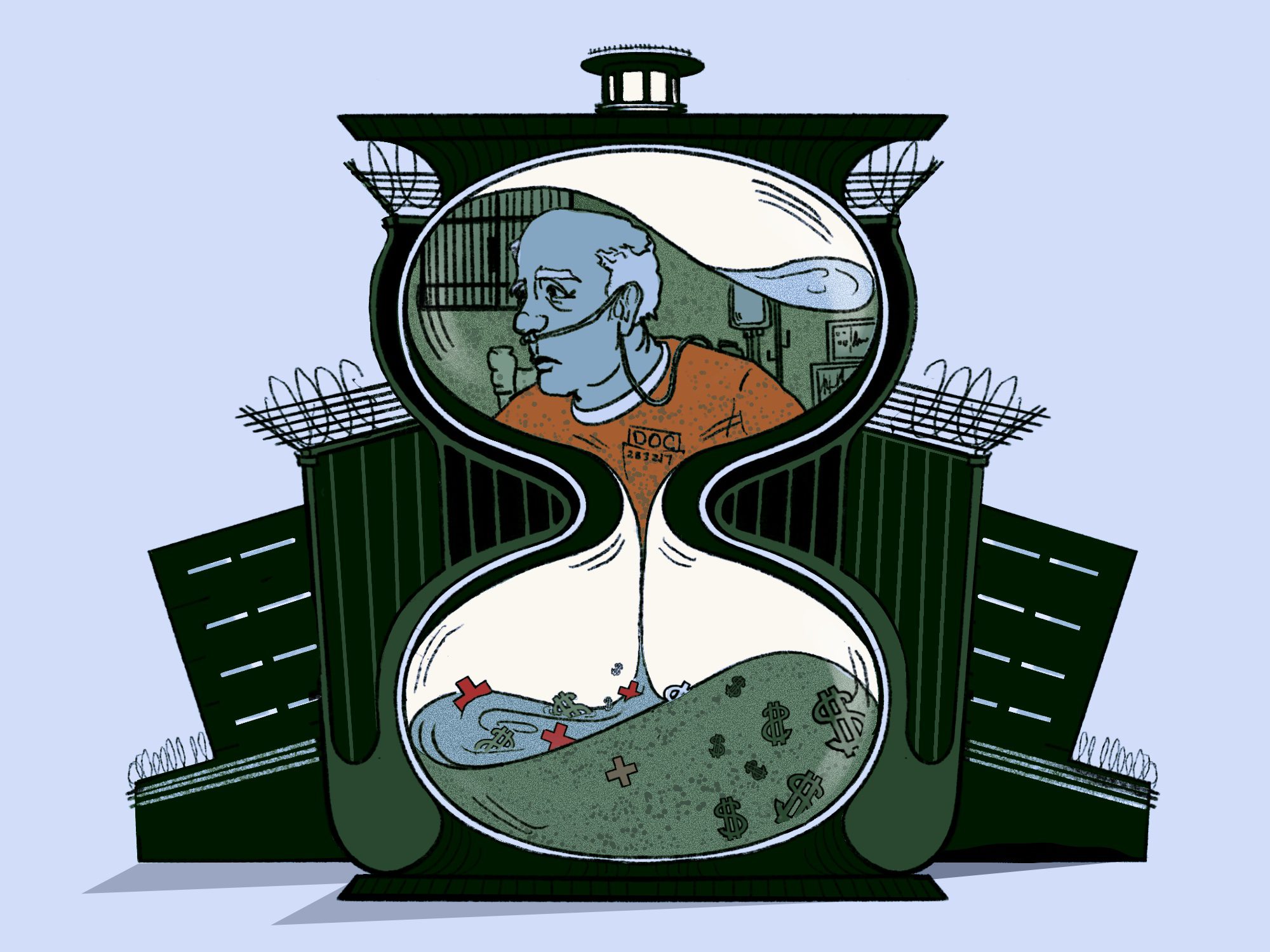

North Carolina Prison Officials Raise Prices for Those Who Can Least Afford It
An increased markup on canteen goods adds to the financial burden on incarcerated people and their families, highlighting how prison systems squeeze them for revenue.
| December 2, 2025
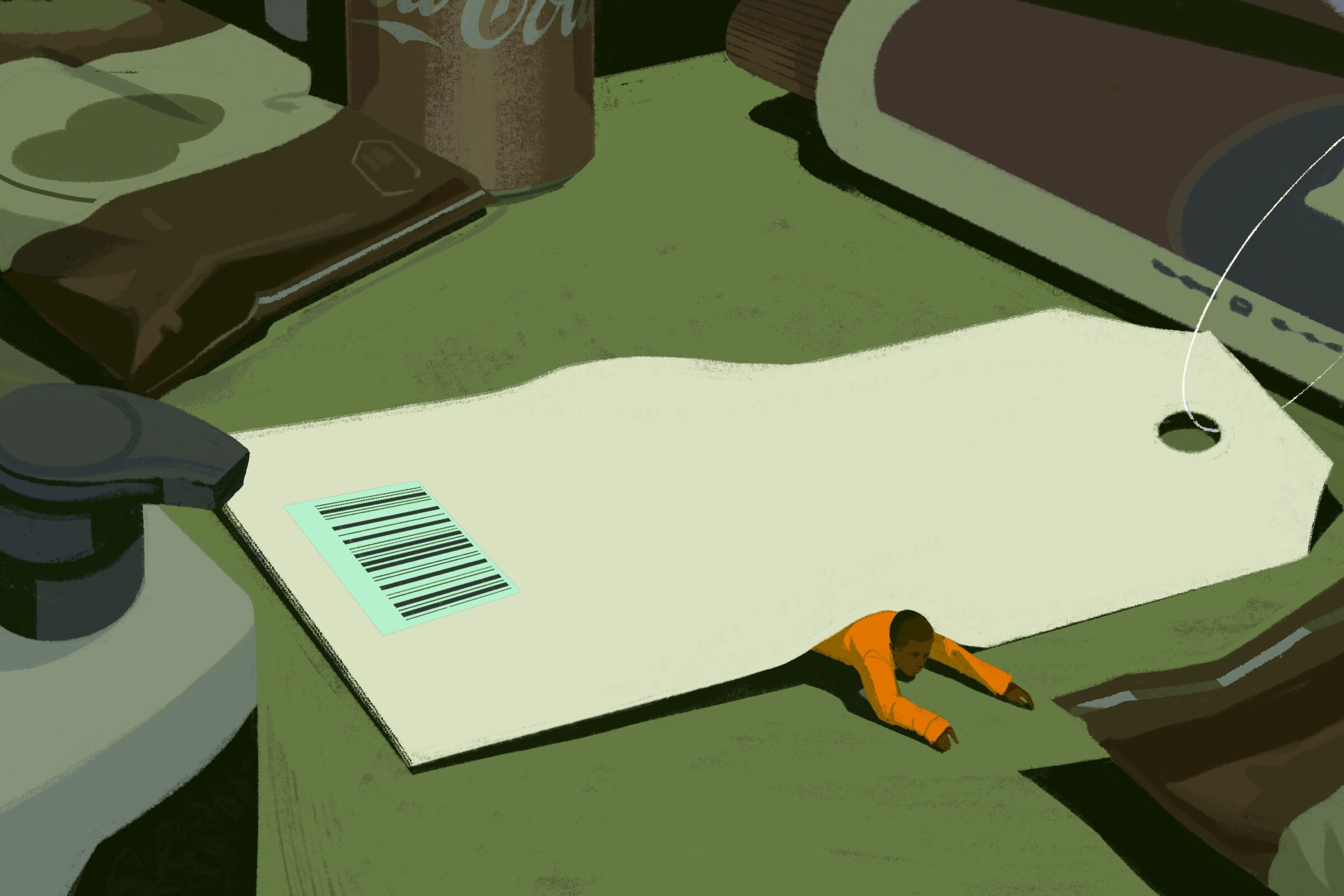
It’s 4:30 pm on a Monday as Colell Steele stands in front of the closed canteen window at Neuse Correctional, a medium-custody prison in North Carolina. He’s lined up to wait an hour before the canteen opens so he can purchase his usual: four postage stamps, at 78 cents each; two AAA batteries, each costing 22 cents, needed for listening to his AM/FM radio; and then whatever hygiene items he can afford with the rest, which usually isn’t much. Since Steele receives no money from back home, he must stretch the $4.90 he earns each week working as a media clerk who cleans tablets for his cellblock.
“Every blue moon I might buy a bag of chips or a soda,” Steele told me as we sat in a day room at Neuse. “I can’t afford much anymore because inflation has decreased the amount of food and supplies I can buy. I spend more to get less.”
Inflation isn’t the only reason Steele’s meager earnings in prison don’t stretch as far as they used to at the canteen. On Aug. 1, the North Carolina Department of Adult Correction (DAC) raised the markup it charges on top of the wholesale cost for non-hygiene products, like food and drinks, to 25 percent—a hike from the previous 20 percent markup it had placed on those canteen goods since 2018.
The DAC raising the cost of these products by five cents on the dollar is a significant increase to incarcerated workers, like Steele, who typically earn between forty cents and $1.25 per day, depending on the job they hold.
In a memo to the state’s incarcerated population this summer, the DAC said the decision to hike prices on these canteen items “reflects our ongoing efforts to adapt to shifting economic conditions while ensuring we can maintain and improve the services we provide.” People incarcerated in North Carolina prisons, myself included, received the message on tablets provided by ViaPath, which contracts with the state to charge us exorbitant rates for calls and other messaging from prison.
Steele told me that he wasn’t surprised the prison system was raising the already high prices he pays for basic goods. “Obviously they need more money for their budget,” he said. “They’re always looking for ways to make more money, primarily off of us.”
North Carolina’s prison system has historically squeezed revenue from the incarcerated population through canteen purchases, commissions from private companies that sell goods and services to incarcerated people, and from the labor that incarcerated people provide through a network of prison-based industries.
And currently, the DAC says that it desperately needs more money.
During her confirmation hearing to lead North Carolina’s prison system in May, DAC Secretary Leslie Dismukes listed a number of financial struggles that are looming. Aside from the DAC’s annual budget of nearly $2 billion, Dismukes said the agency needed an extra $1.4 billion to repair aging infrastructure. “Our fire suppression systems are outdated or completely inoperable in 23 prisons and several don’t have air conditioning,” Dismukes told lawmakers during the hearing.
Sign up for our newsletter
for more reporting on prison policy
And while prisoner health care already costs the DAC around $400 million per year, Dismukes told lawmakers she expects that to soon rise to an annual $425 million because it’s costing more to care for the aging prison population. Meanwhile, the DAC is also facing pressure to raise salaries for correctional staff amid a 40 percent vacancy rate for officers across the state’s prison system.
Facing rising expenses, the DAC has looked for more ways to derive revenue from incarcerated people and their loved ones—such as raising the markup on canteen products.
“North Carolina lawmakers have always wanted it both ways,” Amanda Bell Hughett, a law professor at the University of Illinois-Springfield who studies prison labor and revenue, including in North Carolina, told me in an email. “They want to put a shocking number of people behind bars, but they don’t want to pay for it.”
“By shifting financial burdens onto imprisoned people, service providers effectively conceal some of the true costs of mass incarceration from the public,” she said.
The growing markup on canteen products is just one of the ways the DAC, like other carceral systems, can derive revenue from the high costs that incarcerated people and their loved ones must pay for goods and services.
For instance, Correction Enterprises—the division of the DAC that runs a network of prison-based industries, ranging from farms to an optical plant and a furniture factory—employs more than 1,400 incarcerated people who work 40 hours a week to sell various goods and services back to the state prison system, as well as to state employees and various government agencies, like local jails or even school systems. According to state law, these incarcerated workers’ wages are generally capped at $5 per day. (For North Carolinians who are not incarcerated, the minimum wage is $7.25 per hour, which comes to $58 for an 8-hour day.)
Correction Enterprises posted a net income of $10 million in the fiscal year that ended in June 2024, according to its most recent annual report.
Correction Enterprises has also contracted with private companies that in turn agree to pay high commissions back to the state for goods sold to prisoners and their families, which only further inflates the prices that we pay as the cost of these commissions get passed on to us.
Starting in 2013, Correction Enterprises entered into a contract with one of the largest private prison vendors in the country, Union Supply Group (USG), to sell quarterly food packages to incarcerated people. The company established a distribution hub at what is now called Anson Correctional and began paying Correction Enterprises to deliver the packages through its prison-wide trucking subsidiary. Between 2018 and 2023, USG paid Correction Enterprises a 20 percent commission from each sale, netting almost $3 million in kickbacks to the state through Correction Enterprises.
In 2021, after USG lost the contract for food packages to another private prison vendor, Keefe Commissary Network, which had promised to hike the commission paid back to the prison system to 35 percent, USG filed a legal challenge claiming the state had improperly awarded the contract. As part of its challenge, USG argued that Keefe’s bid for the contract failed to meet state requirements because the company didn’t disclose its involvement in litigation stemming from a sweeping scandal in Mississippi where the country’s largest private prison companies were accused of funneling bribes and kickbacks to a former corrections commissioner.
After USG won its legal challenge to keep the food-package contract for North Carolina prisons in 2023, it agreed to keep paying the higher 35-percent commission to the prison system anyway. Incarcerated people and their families now pay even more than what it costs for these products on the outside; for instance, a 4.25-ounce bag of Chex Cheesy Pizza Snack Mix costs $8.75 to order from USG’s quarterly food packages, even as Walmart sells an 11-ounce bag of the same product for less than $4.
While North Carolina law requires Correction Enterprises to pay out five percent of the profit it generates to a state victim compensation fund, profits generated from canteen sales in the state’s prisons are supposed to be split between the victim’s compensation fund and an inmate welfare fund—which is then supposed to be divided between each prison for programs that benefit prisoners. From the inside, it’s hard to see how the state’s profit-sharing arrangement with private companies that charge us and our families more than free people have resulted in better conditions when we’re served scraps at the chow hall, our clothes are stained and frayed in tatters, and the dorms we inhabit resemble mold-infested dungeons in desperate need of repairs.
DAC communications director Keith Acree said in an email to Bolts that proceeds from canteen sales into the inmate welfare fund totaled $5.8 million last fiscal year, and that the fund “provides new recreation equipment and recreational programs for facilities, education and program supplies, common area TVs and cable TV service, etc.”
Hughett, the professor at the University of Illinois-Springfield, told me that prisons rely too much on prisoners and their families to pay for mass incarceration. “North Carolina has long expected imprisoned people to shoulder part of the cost of their incarceration,” she wrote.
Her research highlights the long history of how incarcerated people have been used to generate revenue in North Carolina—including a time during the Jim Crow era, between 1933 and 1956, when imprisoned people working on road crews, farming operations, and other industries without pay brought in enough money to fund most of the budget of the state penal system, which then operated as a subsidiary of the state highway commission. By 1975, after nearly a decade of lawsuits and work-stoppages threatened to cripple the prison system, North Carolina started paying incarcerated workers so-called incentive wages ranging from 10 cents to one dollar per day.
During one 1968 incident, after incarcerated people at Central Prison launched a protest about, among other conditions, forced and unpaid labor, riot-control officers opened fire killing six inmates and injuring 77 others.
Hughett says that while financial gains from squeezing prisoners and their families may benefit a cash-strapped prison system or state, the cost increases fall especially hard on incarcerated people and their families. A 2015 report by the Ella Baker Center For Human Rights found that nearly 2 in 3 families with someone incarcerated were unable to meet their family’s basic needs. Another report this year by the advocacy group FWD.us estimates that incarceration costs families across the country with someone behind bars nearly $350 billion each year—or about four times the estimated cost to taxpayers annually to run the nation’s prisons and jails.
Some states have started to address the burden of high commissary prices and have taken action to limit the markups that prisons and vendors can impose. In 2023, California passed legislation to prohibit commissaries from charging more than a 35 percent markup above the price of the goods paid to the vendor; the state’s prison commissaries had previously sold items, ranging from snacks to medications, at a markup ranging from 65 to 200 percent.
Michigan in recent years has eliminated the markup on hygiene products sold to prisoners and reduced the markup for most food items, according to reporting from The Appeal.
“Commissaries are often selling critical items, not optional amenities,” Stephen Raher, former general counsel for the Prison Policy Initiative who has written extensively about the high cost of commissary prices, told me in a phone call. “If you need hygiene items, or over-the-counter medicine, and the only source is the prison commissary, then that item should be free or provided at cost; it shouldn’t be a tool for opportunistic investors to make money.”
As a man who has served more than 23 years in North Carolina prisons, I’ve seen the price of Little Debbie snack cakes go from 25 cents in 2002 to over one dollar in 2025. My pay has ranged from 40 cents per day as a janitor to as much as 26 cents an hour as a graphic designer in the printing plant when I was at Nash Correctional, where, among other duties, my job entailed proofreading the 2016, 2017, and 2018 annual reports for Correction Enterprises.
The rising price of canteen goods has meant that many can’t afford to buy basic necessities, like a $9 stick of Right Guard gel deodorant. And even as inflation and DAC markups have gone up, the pay for most prison jobs here has remained largely stagnant.
Meanwhile, the DAC has found ways to cut corners. The declining quality of our food has been the most noticeable. Instead of real meat, like a chicken leg or a piece of fish, our kitchens now serve ultra-processed chicken and beef patties made in a meatpacking plant located at Harnett Correctional in Lillington. Fresh vegetables are a rarity, and for most meals we typically get no more than a four-ounce scoop of vegetables grown and canned at Roanoke River Correctional.
For a decade or more, I viewed buying food from the canteen as a luxury. But it is now a necessity to make up for what the chow hall doesn’t serve.
Cindy Tate-Gibson’s husband Jason is currently at Nash Correctional serving a 14- to 18-year sentence for a hit and run. Because Jason is autistic, his frequent outbursts and social awkwardness prevent him from holding a job in prison. And so he effectively survives solely on money from home. For the six years that Jason has been incarcerated, his mother has sent him about $600 a month to spend on canteen, phone calls, and tablet services, like e-messaging.
“Because of inflation, the prices are going to be high, but that doesn’t excuse the state from tacking on more unfairly,” Cindy told me over the phone. “The way they charge doesn’t set you up for success in any way, shape, or form, especially when you’re not earning any money. What do you do to get what you need to improve your situation when you can’t work for it?”
Sign up and stay up-to-date
Support us
Bolts is a non-profit newsroom that relies on donations, and it takes resources to produce this work. If you appreciate our value, become a monthly donor or make a contribution.
More from Phillip Vance Smith II
Priced Out of Phone Calls Home