
In Bay Area, Felony Charges Against Student Protesters Prompt Free Speech Concerns
Local prosecutors are seeking felony-level charges against pro-Palestine demonstrators. Even if they don’t stick, critics say the response is harsh and could chill protests.
| February 3, 2026
German Gonzalez grew up about an hour south of Stanford University, in a dusty California farming town where the apples for Martinelli’s sparkling cider are juiced and packaged. In high school, he worked construction alongside his father. When he got into Stanford, his parents, who had come to the U.S. as refugees fleeing El Salvador’s brutal civil war, were overjoyed.
Gonzalez didn’t know much about the history of the Israeli-Palestinian conflict before Oct. 7, 2023. But he had grown up hearing about his parents’ experiences hiding from aerial bombardments in the 1980s. In a conversation after Oct. 7, his parents expressed their sense that the Palestinians were experiencing something even worse than what they’d gone through decades ago. It galvanized Gonzalez to learn more about the conflict and get involved with the campus movement against Israel’s escalating assault on Gaza. Israel, he learned, had supplied a large percentage of the bombs that had terrorized his parents in the 1980s, and now, his university, the place that represented his best chance to lift his family out of poverty, was heavily invested in companies with financial ties to the Israeli military.
“I love my parents, they’re my whole heart and soul,” Gonzalez told Bolts. “I was just pretty immediately moved to action.”
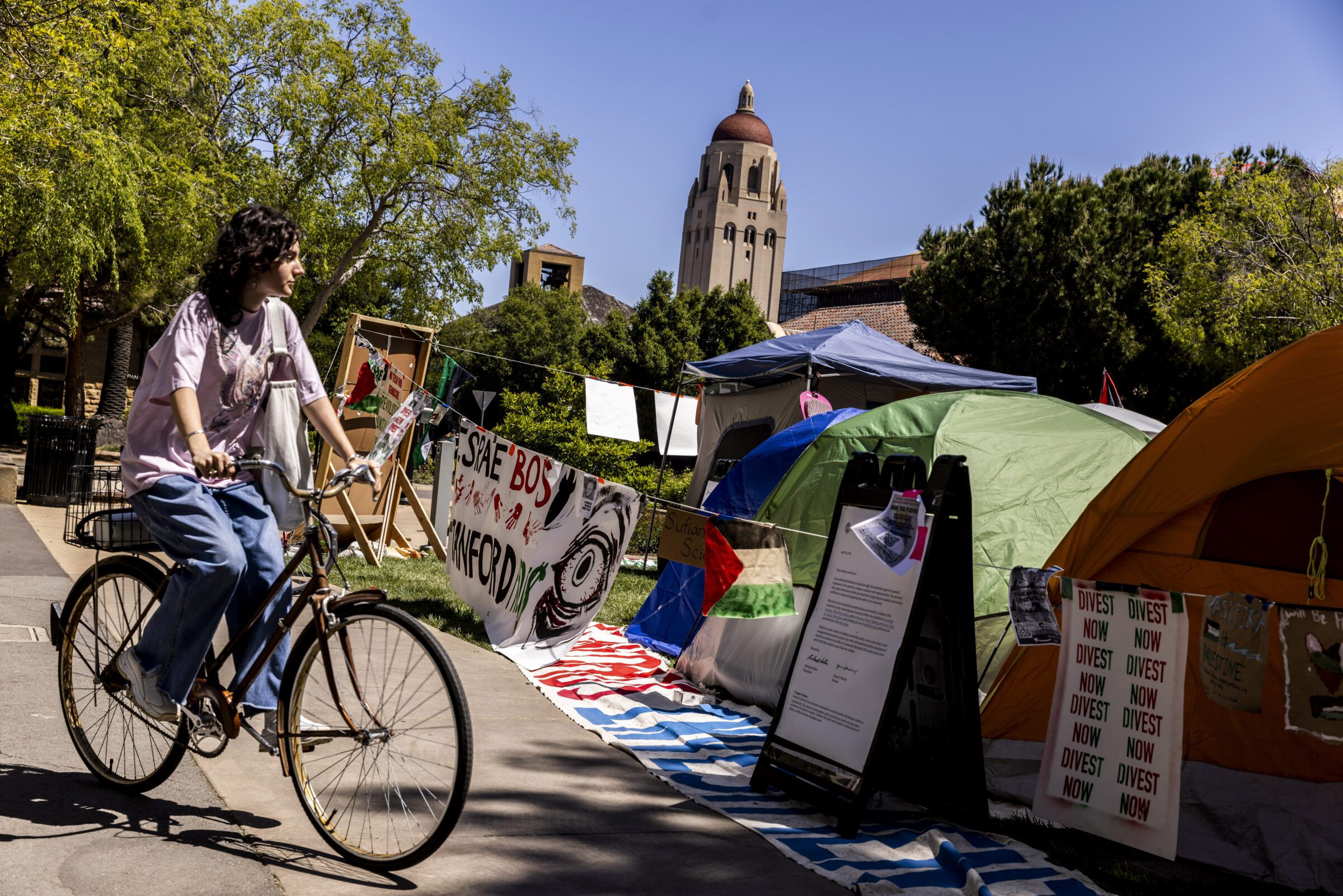
In June 2024, after the university refused to hold talks with students about divestment, Gonzalez and a group of fellow students and alumni occupied the president’s office in protest before being arrested and removed by police. Nearly a year later, the district attorney of Santa Clara County, Democrat Jeff Rosen, announced he would file felony vandalism and conspiracy charges against Gonzalez and 11 others, making him the only prosecutor in the country to try a felony case against pro-Palestine student protesters since the campus movement began. “Dissent is American,” Rosen said in a statement announcing the charges. “Speech is protected by the First Amendment. Vandalism is prosecuted under the Penal Code.”
The trial, which began on Jan. 9, has now entered jury deliberations and a verdict is expected in the coming days. Gonzalez and four fellow defendants who opted to put the case before a jury could receive up to three years in prison and a permanent felony record. The DA is also seeking $329,000 in restitution to Stanford, whose endowment tops $40 billion, following the university’s accusations of extensive property damage. (The defense disputes these claims.) “It would ruin my family financially for the rest of our lives,” Gonzalez told me.

As Gonzalez’s case plays out, a parallel situation has been unfolding just across the Bay. San Francisco DA Brooke Jenkins, also a Democrat in a liberal county, has pursued felony conspiracy charges against eight pro-Palestine protesters who took over the Golden Gate Bridge during a demonstration in April 2024. The next hearing is Feb. 17. The judge initially declined to downgrade the charges because the bridge administrators were demanding over $160,000 in restitution, but after this demand was dropped in November, the judge has signalled his readiness to reduce the felony charges to misdemeanors.
In a region with a rich history of civil disobedience, including the birth of the campus Free Speech Movement, the two cases represent a notable escalation in charging against nonviolent demonstrators, highlighting apparent double standards in how law enforcement deal with pro-Palestinian speech and activism. “Why is Brooke Jenkins filing felonies when people are protesting against a genocide in Palestine, but the DA’s office doesn’t have that practice when it’s any other subject matter?” asked San Francisco public defender Nuha Abusamra, who is representing one of the felony defendants in the Golden Gate case.
The cases also underscore prosecutors’ increasing use of felony conspiracy charges to quash protest. “This crime that’s really been developed to go after secret group criminality—think mafia, drug crime, that kind of thing—is now really effective at going after social movements and coordinated action amongst activists,” Steffen Seitz, a litigation fellow at the University of Denver who has studied felony conspiracy and social movements, told Bolts. “That’s really concerning for the health of our democracy.”
On June 5, 2024, in the early hours of the morning, Gonzalez and his fellow defendants allegedly broke into the Stanford president’s office and barricaded themselves inside, renaming the building Dr. Adnan al-Bursh Hall after a Palestinian surgeon who was allegedly tortured to death in Israeli custody. After a multi-hour standoff, they were removed by campus police and county sheriff’s deputies. Stanford alleges the group caused hundreds of thousands of dollars of property damage. The defendants contend they offered to come out voluntarily, that the law enforcement response created much of the damage, and that prosecutors and Stanford have inflated the extent of the destruction; a university facilities manager had testified during the grand jury hearing that there was only around $10,000 in losses.
That day, while Gonzalez and his fellow arrestees were still in custody, Stanford’s president faxed a letter to the Santa Clara County jail, letting them know they were suspended and banned from campus. In the months that followed, Gonzalez slept on friends’ couches, took up brief residence in a Berkeley co-op, and even bunked in the playroom of a sympathetic professor. He got a job at a coffee shop, then moved back home and picked up construction gigs with his dad. “Some of the other defendants literally had nowhere to go; they were sleeping in their cars,” he told Bolts. Four months after the sit-in, in October, the university’s internal disciplinary committee, which is composed of student and faculty representatives, decided to allow them back onto campus.
For more stories about protest rights
subscribe to our newsletter
Just a few months before the Stanford sit-in, on April 15, 2024, Tax Day, 26 other demonstrators had occupied the Golden Gate Bridge to protest the use of American tax dollars to fund Israel’s war on Gaza, shutting down traffic for several hours before they were arrested and removed.
In the aftermath, San Francisco DA Jenkins took the highly unusual step of putting out a public call for victims on X, urging “Anyone who was detained against their will (falsely imprisoned) on the Golden Gate Bridge on 4/15/24” to contact the California Highway Patrol and potentially claim monetary restitution. Elizabeth Camacho, Abusamra’s co-counsel, told Bolts that in her fifteen years as a San Francisco public defender, “I have never, ever seen a public call for people to file claims.”
The seven protestors who’d chained themselves to the bridge plus the group’s police liaison were charged with felony conspiracy, while the other 18 were charged with misdemeanor conspiracy; all 26 received additional protest-related charges, including unlawful assembly. In addition, the government body that oversees the bridge demanded nearly $163,000 in financial restitution for lost tolls. The press release announcing the affidavit stresses that “more than 200 people” came forward “expressing how they were affected by this unlawful protest.”
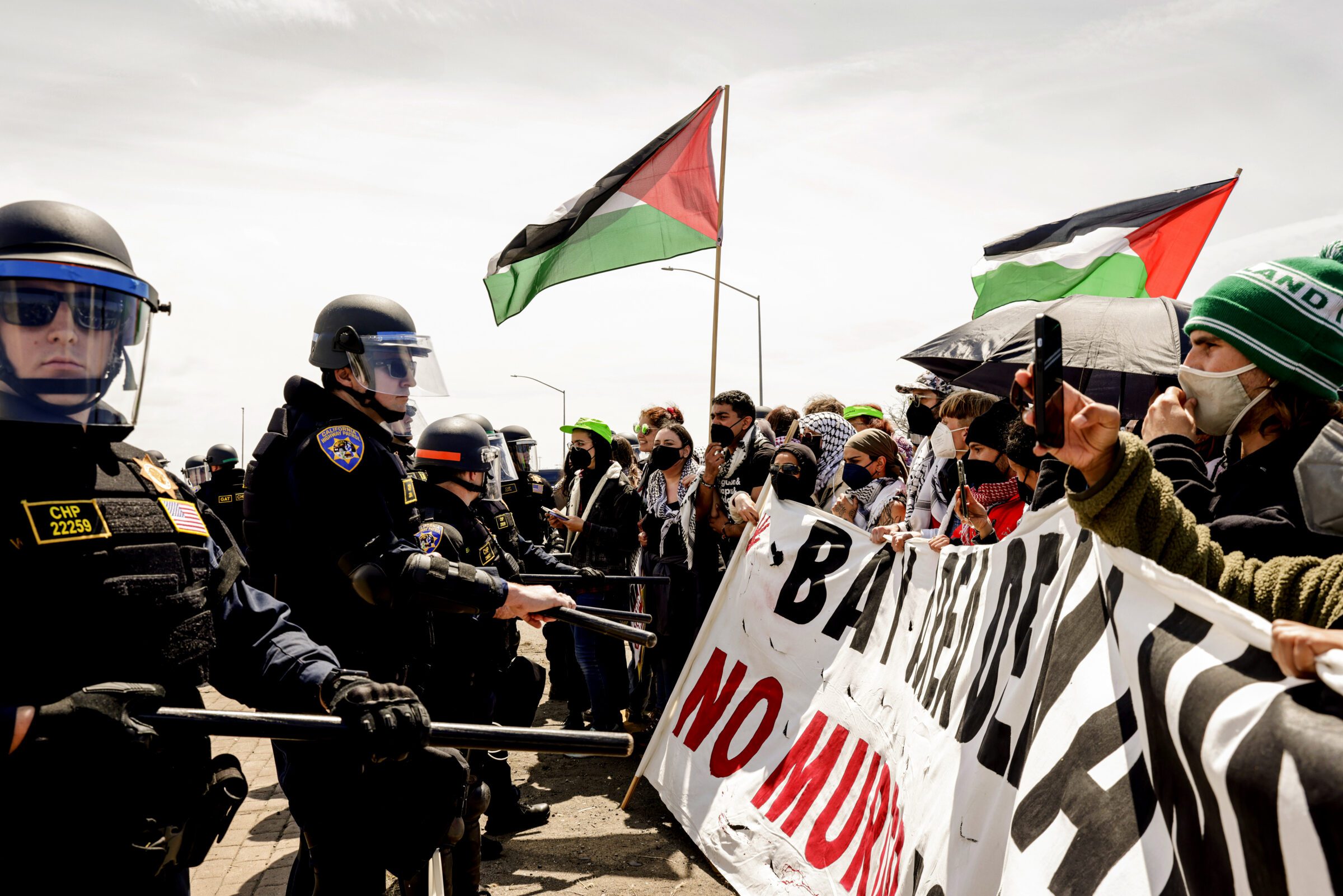
This is not the first time protestors have stopped cars on the Golden Gate Bridge—the bridge’s official website references a 1996 protest against redwood logging, anti-war protests in 2002 and 2007, and a BLM protest in June 2020, all of which caused traffic backups. The broader region has seen many more demonstrations over the decades; the University of California, Berkeley was the birthplace of the Free Speech Movement, which in the 1960s brought the issue of political activism on campus to the fore. While Berkeley saw thousands of arrests during the 1964-65 school year, many of those demonstrators were never charged, and none were charged with felony-level crimes.
Retired Santa Clara superior court judge LaDoris Cordell explained to Bolts that, even if law enforcement chooses to make arrests to disperse a protest, prosecutors have no obligation to carry forward the case—and they bear a higher standard of proof to boot. “An officer might want to arrest you, but the officer only needs probable cause,” she said. Prosecutors’ obligation, meanwhile, is to “not file charges unless they truly believe in good faith that they can prove their case beyond a reasonable doubt.”
Stanford is no stranger to sit-ins either. Between 1969 and 1970, students affiliated with a variety of causes occupied a handful of different buildings, including one instance where students broke into a building overnight, one that lasted nine days, and one that devolved into an hours-long battle with several area police forces that deployed tear gas against students who threw rocks.
But the felony charges in response to recent pro-Palestine actions represents a significant departure. At Berkeley in the 1960s, students were arrested en masse, but any misdemeanor charges were later dropped. During the same period, Stanford pursued disciplinary and civil penalties against its students, even in cases with allegations of arson and vandalism. “Over at least the last 35 years, every Bay Area bridge protest has been handled as infractions and/or ultimately dismissed,” defense attorneys wrote in a filing.
All of the attorneys Bolts spoke to for this piece said they have never before seen felony charges levied against nonviolent protesters. Cordell, who spent some 20 years on the bench, said she never witnessed a felony charged for non-violent protest actions such as blocking traffic, sitting in, or even property damage.
The presence of felony conspiracy charges in these cases is particularly concerning, according to Seitz, the University of Denver fellow, who also defends animal rights activists and whistleblowers in criminal cases. “Conspiracy directly targets collective action,” he told Bolts. “In some ways, it is easier to convict someone of conspiracy to commit a crime than the underlying crime itself.”
For cases involving activists, Seitz said, charging conspiracy allows prosecutors to expand what they can bring in as evidence—including material that would normally count as speech protected under the First Amendment. “Suddenly, every time you coordinated with anyone else who’s an alleged co-conspirator becomes relevant, and that includes all of your political speech, every post that you made, everything that shows some kind of coordination or motive,” he told Bolts. And the abundance of information available on social media makes prosecutors’ jobs easier.
In California, a quirk of the law means that conspiracy doesn’t just expand prosecutors’ evidentiary options—it also ratchets up the potential consequences for defendants. That’s because prosecutors have the discretion to charge conspiracy as a felony even if the actual crime someone’s accused of conspiring to commit is only a misdemeanor. In both the Stanford and Golden Gate cases, the underlying crime alleged is trespassing, which in California can be either a misdemeanor or a felony. (In 2024, students in the pro-Palestine encampments at Berkeley and UCLA were also arrested on suspicion of conspiracy, though formal charges were never ultimately filed in either case.)
At the same time, when it comes to the defendants’ motives, prosecutors have sought to keep politics out of the courtroom. “This case is not about genocide. This case is not about the Gaza War,” Santa Clara prosecutors wrote in a filing. “This case is about one thing: whether the defendants, current and former Stanford students, conspired to occupy Building 10 and caused $400 or more in damage in doing so.” The lead attorney on the case has “referred to me as the ring leader, as if I was a sort of Mafia boss,” Gonzalez told Bolts. Prosecutors have also filed several motions to exclude the word “genocide” from being used at trial, as well as mentions of protest and free speech. (The judge is allowing it in, but only sparingly.)
“In any other case, the prosecutors are going to look at motive,” said Jeff Wozniak, a criminal defense attorney who has represented defendants in both the Stanford and Santa Clara cases. “Here they’re trying to completely erase motive and the motivation of folks to stand up and demand accountability from their leaders to end the genocide. They’re just like, ‘Well, this is just trespassing.’”
“Courts think that they can somehow get themselves out of the political arena entirely,” Seitz said. But, he added, “these trials are always already politicized. The choice to charge is politicized. The action itself is obviously political.”
Gonzalez noted that Rosen’s decision to charge came just as Trump’s DOJ was threatening to pull federal funding from Stanford unless they addressed allegations of antisemitism on campus. “Palantir, Raytheon, Lockheed Martin, HP, all of those companies work very closely with Stanford University,” he said. “It’s in Stanford’s best interest to ensure that anyone who stands up against these companies gets punished as severely as possible.” Rosen himself travelled to Israel with his wife and adult daughter on a “solidarity mission” with the Israel Defense Forces in January 2024, by which time at least 22,000 Palestinians had already been killed. The family visited military bases and shared postcards written by students from his daughter’s alma mater with IDF soldiers, “putting smiles on their faces,” according to an interview the school conducted with Rosen’s daughter. Rosen, who is up for reelection this year, includes news items about the Stanford case under his campaign’s “fighting antisemitism” webpage.
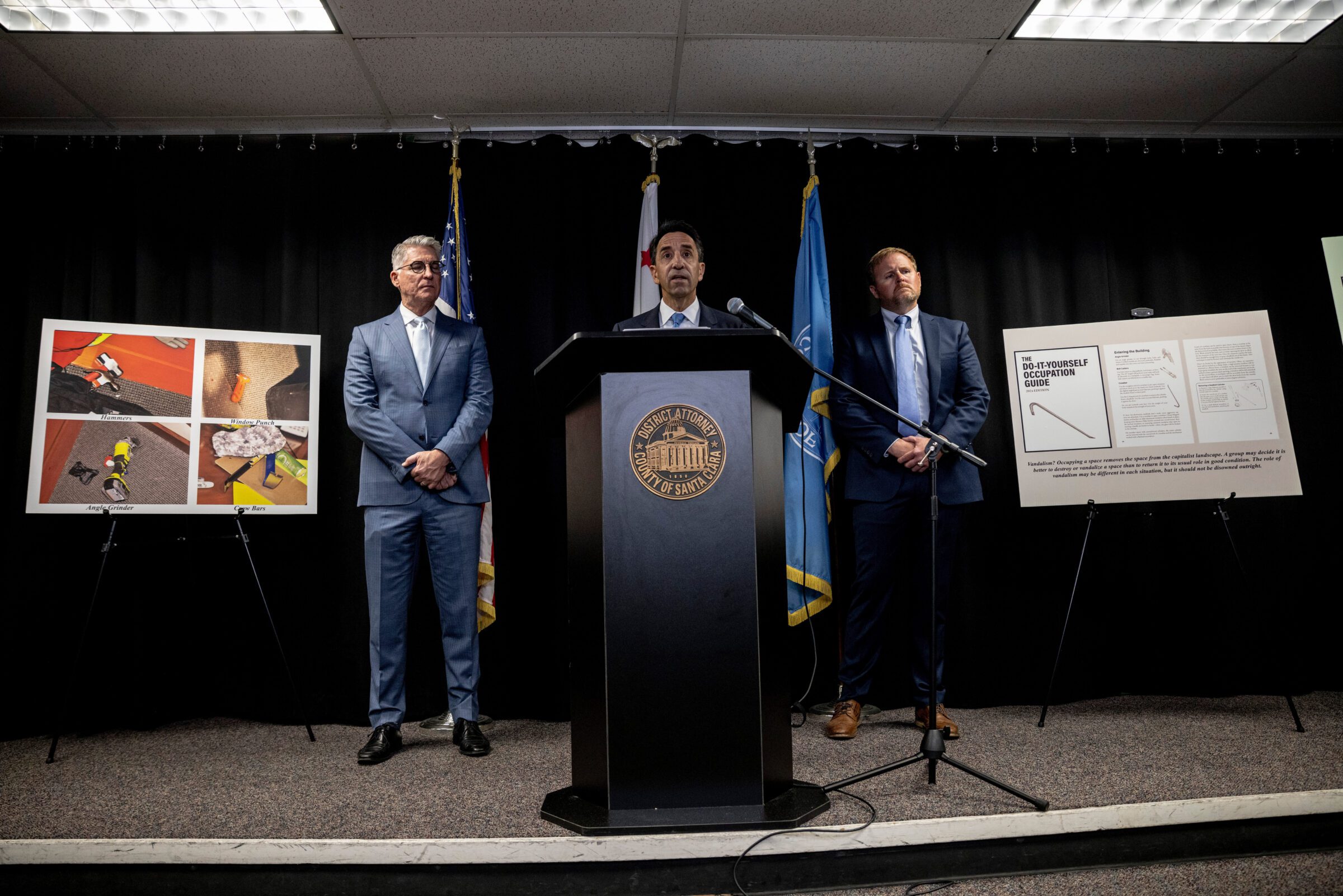
In response to a request for comment, Rosen’s communications director told Bolts, “As the trial is ongoing, we are only answering factual questions about the case, not extrajudicial allegations by the defense.” In April, Rosen told the LA Times his personal views do not factor into his decision to prosecute this case. “Everybody has biases,” he said. “I do, everyone does. I think the best we can hope for in our elected officials is that they recognize the biases, that they set them aside and do their duty. And that’s what I do every day.”
In October 2024, defense attorneys for the Golden Gate protesters filed a “vindictive prosecution” motion arguing that the San Francisco DA cannot impartially prosecute the case. They point to Jenkins’ decision to meet multiple times with the Israeli consulate and use of the term “pro-Hamas rally” in reference to a demonstration that was advertised as an “emergency protest for Gaza.” They also cite potential conflict of interests among Jenkins’ staff, including her director of public affairs’ previous work for the powerful Israeli lobbying group AIPAC. The motion also cited as precedent the California AG’s takeover of a protest case in which a DA with ties to opponents of the Black Lives Matter movement filed false imprisonment charges against BLM protesters; it was unsuccessful.
This past November, citing insufficient evidence that a crime was committed, a judge dismissed most of the charges against the Golden Gate protesters. The remaining seven defendants face a hearing on Feb. 17, at which Wozniak said he hopes the judge will reduce the felony charges to misdemeanors.
As the Stanford trial has gone on, Gonzalez said that his mother has been in court supporting him. It hasn’t been easy for his parents to come to terms with the gravity of the charges against their son. “My parents invested so much time, energy, resources into me so that we could have the possibility of me getting a good job and helping us get out of poverty,” he told Bolts. “They’ve been heartbroken, but they’ve grown to be very, very supportive, not only of me, but also of the cause for Palestine.”
Defense attorneys argue that these cases have already had reverberating consequences for free speech. Stanford students returning to campus in the fall of 2024 were briefly banned from hanging flags of any sort out their dorm windows, and the use of megaphones have been restricted to a small area of the campus between specific hours. “Students were scared to mourn publicly the loss of life at Stanford because they’re worried they’re going to be hit with disciplinary charges,” Gonzalez said. Gonzalez himself has faced further disciplinary action for leading chants during a rally in March after the Palestinian campus activist Mahmoud Khalil was detained.
“It definitely chills people’s ability to be engaged, to stand up, to demand justice,” Wozniak told Bolts. “There’s still people dying every day in Gaza. And of course, we know what’s happening in Minneapolis and around this country. These cases restrict people from getting involved in activism—and that was the intention.”
In Santa Clara, the state has also contended that not holding students accountable would have wider consequences. It would send the message, the lead prosecutor argued, that “personal property does not deserve protection from those seeking political changes through destruction.”
Sign up and stay up-to-date
Get timely updates about pressing stories and elections.
Support us
Bolts is a non-profit newsroom that relies on donations, and it takes resources to produce this work. If you appreciate our value, become a monthly donor or make a contribution.