

Supreme Court Upholds Grace Periods For Mail Ballots Postmarked by Election Day
SCOTUS allows states to keep accepting ballots that arrive after Election Day, even as conservatives on the court continue to cast doubt on mail voting.
| June 29, 2026
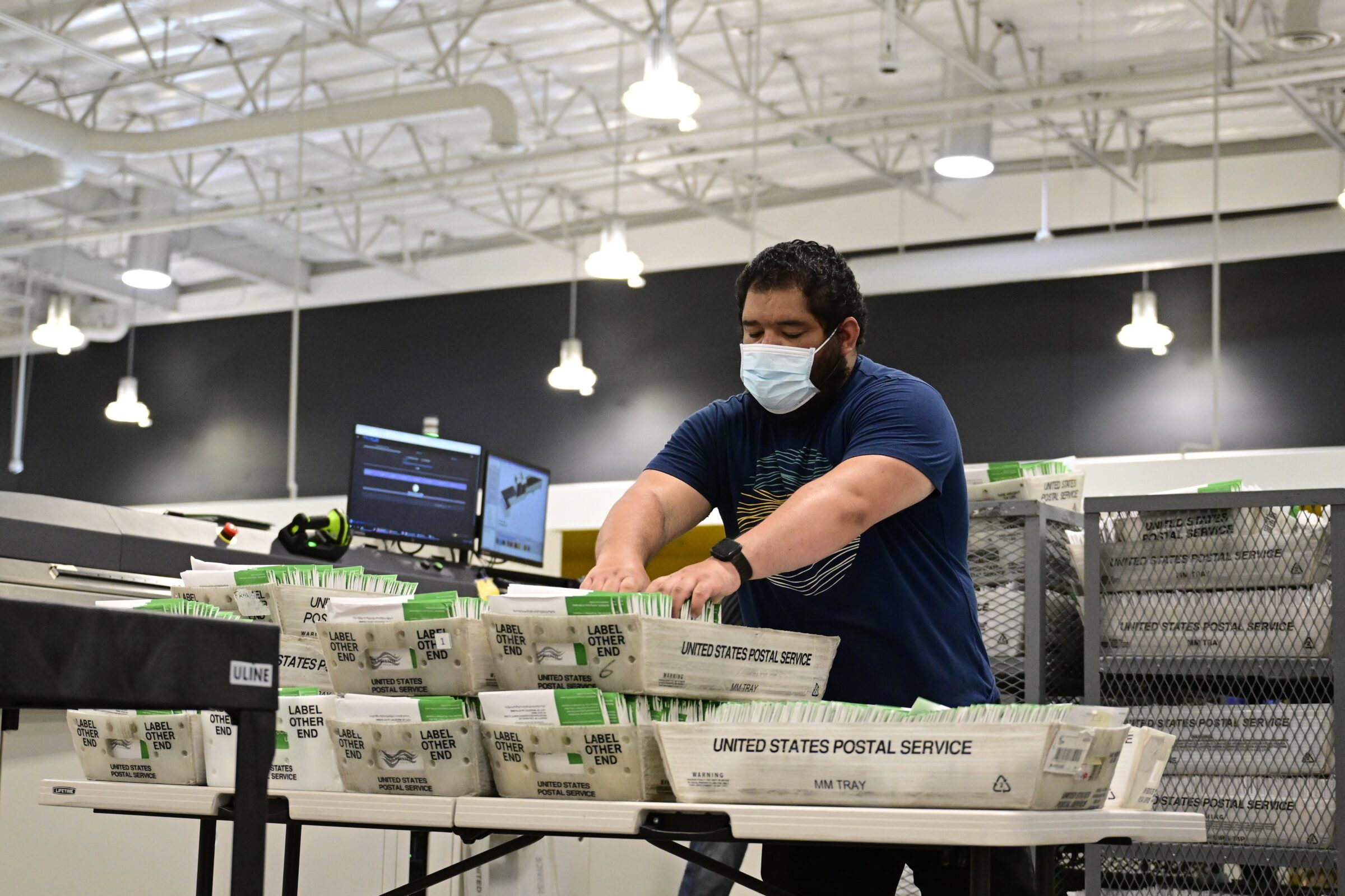
The right-wing attack on mail voting suffered a setback in a surprising venue on Monday, when the conservative-led U.S. Supreme Court, which just recently eviscerated the remains of the Voting Rights Act, ruled that states can still count mail ballots that were submitted on or before Election Day—even if election officials receive them days after polls have closed.
This ruling most immediately affects the 14 states, plus Washington, D.C., and three U.S. territories, with so-called grace periods for all mailed ballots. Another 16 states have grace periods just for military and overseas voters.
Conservative justices Amy Coney Barrett and John Roberts joined the court’s three liberals in the 5-4 decision.
The ruling was a pleasant surprise for voting rights advocates and election administrators who had worried that the court was poised to end grace periods, and send officials scrambling to educate voters during a busy midterm election year.
“Today’s Supreme Court decision allows our whole state to sigh with relief,” Alaska Democratic state Rep. Andrew Gray told Bolts. His state would have been especially hampered by a Supreme Court ruling against grace periods, which have helped accommodate voters in far-flung areas not accessible by roads. Votebeat found that Alaska joined California and Washington as the only states where more than 2 percent of ballots cast in 2024 were counted because of grace periods.
Subscribe to our newsletter
Get more news about voting rights
Nevada Secretary of State Francisco Aguilar, whose state also has a grace period, called the ruling “a huge win,” especially for rural voters and those voting from the military or overseas. “I’m grateful to the Supreme Court for upholding states’ rights to run elections,” Aguilar, who chairs the Democratic Association of Secretaries of State, said in a statement.
Still, many felt that the court should have never entertained this question to begin with, as it concerns the ability of states to set their own rules for election administration.
Barrett, who authored the majority opinion, addressed this in Monday’s ruling: “The Framers recognized the difficulty of crafting election laws ‘applicable to every probable change in the situation of the country,’” she wrote. “So instead of constitutionalizing election law, they decided that ‘a discretionary power over elections’ needed to be lodged ‘somewhere.’ Suffice it to say, that power was not lodged in this Court.”
The dissenting justices disagreed, and also signalled sympathy with President Donald Trump’s lies that mail voting facilitates fraud. Justice Samuel Alito, in the dissenting opinion, wrote, “The majority’s holding spawns a slurry of troubling election-law questions and risks further undermining Americans’ confidence in election integrity.”
The case in question before the Supreme Court, Watson v. Republican National Committee, originated in Mississippi, where the RNC sued to block the state’s practice of counting mailed ballots that arrive within five business days of an election, so long as they were postmarked by Election Day. The Trump administration signed on in support of the RNC, and argued with it before the court in March.
The RNC and Trump administration suggested in their respective arguments that grace periods could lead to voter fraud—even as Mississippi’s solicitor general, arguing on the state’s behalf, noted that the state has no evidence of any such thing.
Most of the conservative justices on the court are clearly receptive to this idea.
Neil Gorsuch, for one, spoke at some length during oral arguments about a hypothetical scenario in which a political scandal breaks out after Election Day, moving mail voters to call elections offices to cancel their ballots en masse before they can be counted. Though this has not happened, Gorsuch framed such a scenario as an inevitability if grace periods remain in place, saying during the March oral arguments, “As soon as something is allowed, it will happen eventually.”
A relatively small number of voters have had their ballots counted thanks to grace periods. A national analysis by Votebeat found at least 750,000 ballots in the 2024 presidential election were received after Election Day, which represents well under 1 percent of the country’s more than 158 million total voters that cycle.

In her majority opinion, Barrett wrote that the case for ending grace periods threatened to force the country to dial back to an antiquated elections system. “At bottom, plaintiffs’ theory is that because we are governed by 19th-century election-day laws, we are also governed by 19th-century voting practices,” she said. “Carried to its logical conclusion, this theory would call into question the way modern elections work.”
But even at the end of her opinion, Barrett still seems to take seriously the idea that grace periods can threaten elections, “because election results may appear to flip after Election Day,” which she called “a significant concern.”
Such remarks worry voting rights advocates, as they signal that the country’s high court is at least receptive to the GOP’s continuing crusade to limit mail voting—including by undermining the Postal Service—and to suppress participation.
Though the Mississippi case stood to affect only a small fraction of voters, it raised big questions about how elections are run, and so voting rights advocates and election experts remain wary of this court’s willingness to entertain voter-fraud panic.
Next term, the court will consider an Arizona case—like Mississippi’s, this one was also brought by the RNC—that threatens to allow states to disenfranchise huge numbers of people who lack certain identification documents.
The fight over grace periods represents “a very slippery slope,” Phil Keisling, the former secretary of state in Oregon, who is now a national advocate for mail voting, told Bolts earlier this month.
He added, “The relative impact of [the Mississippi case] is less important than future implications it might have for other kinds of arguments. The danger is in the pretense of increasing the confidence people have in the validity of election results.”
Grace periods were not controversial until 2020, when Trump and allies escalated their assault on mail voting generally. Just six years ago, Mississippi’s overwhelmingly Republican legislature voted 169-1 to adopt the state’s current grace period.
But at Trump’s urging, Republican lawmakers have now changed positions and conservative legislatures have been happy to do his bidding: Kansas, North Dakota, Ohio, and Utah have all eliminated their grace periods since the 2024 election.
In 2017, when the Kansas legislature voted 163-1 to adopt that state’s grace period, even GOP Secretary of State Kris Kobach, a longtime champion of voter restrictions and strong ally to Trump’s election denial efforts, backed the bill. In Ohio, Republicans sponsored and overwhelmingly backed the 2006 bill that permitted no-excuse mail voting in the state and allowed a 10-day grace period. Earlier this year, as that state’s GOP-controlled legislature banned Ohio’s grace period, the bill’s lead sponsor specifically said he wanted to follow Trump’s orders.
Ohio’s reform, adopted this spring, had the immediate effect of negating some 1,500 ballots in the state’s May primary.
Trump has tried and failed to block grace periods by executive orders that so far have had no force of law, because states, not the federal government, set their own rules for election administration.
Justice Ketanji Brown Jackson, in oral arguments in the Mississippi case, nodded to this; she’d argued that states control “drawing the various lines of election rules,” and that, as a result, the merits of Mississippi’s grace period should not have ever been up for debate before the federal judiciary.
Sign up and stay up-to-date
Support us
Bolts is a non-profit newsroom that relies on donations, and it takes resources to produce this work. If you appreciate our value, become a monthly donor or make a contribution.