
As Minneapolis Votes, Some Struggle to Keep Police Violence in the Spotlight
Five years after George Floyd, the mayor and his allies on city council claim credit for vast improvements, but critics keep pressing the case for more discipline and police alternatives.
| October 20, 2025
This article is part of our coverage of law enforcement issues in the municipal races of 2025. Read our stories on New York City and Seattle.
Update: Jacob Frey won the mayoral election in November, and Soren Stevenson won a city council seat.
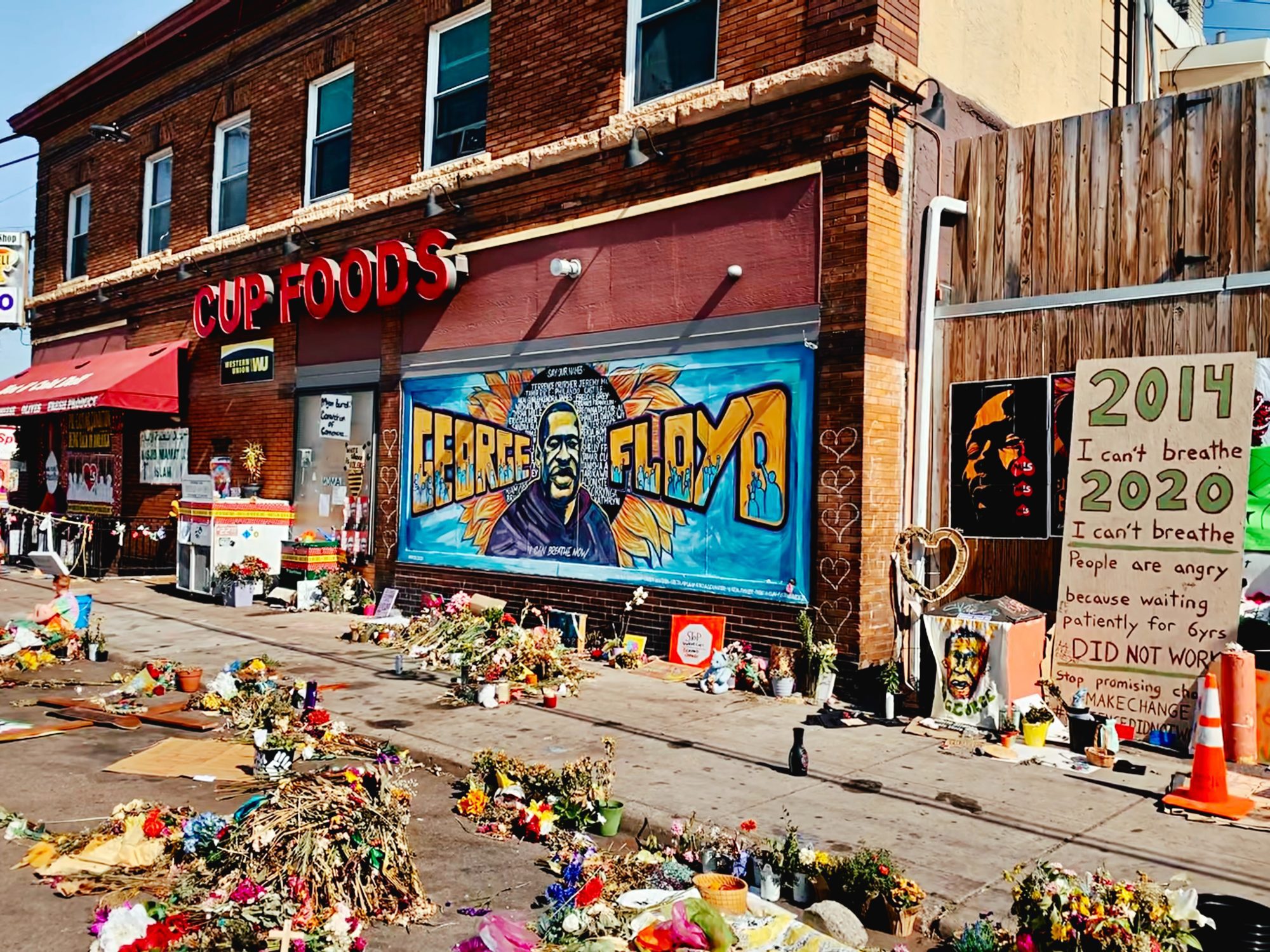
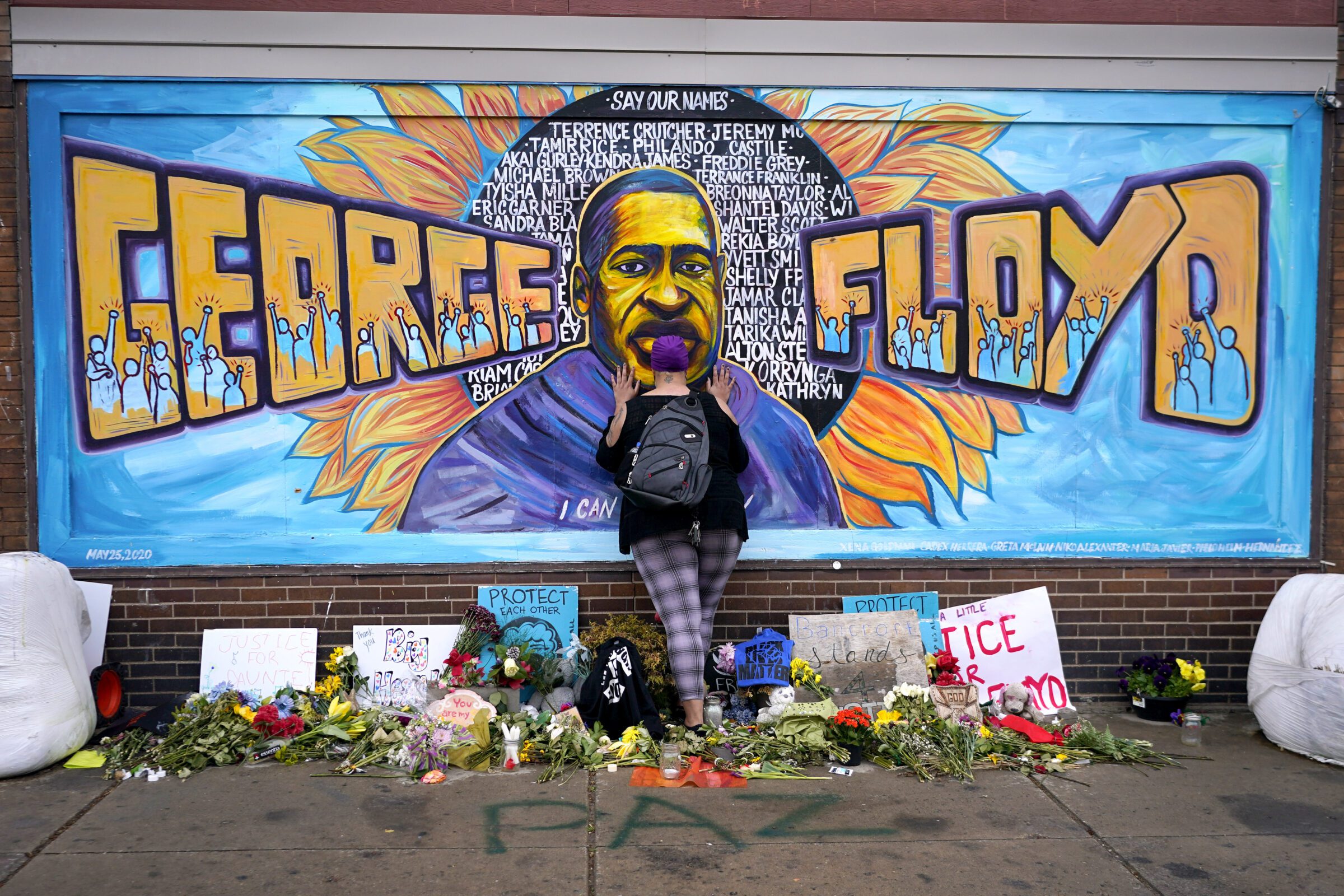
After the murder of George Floyd, police violence became an issue that no Minneapolis politician could avoid. The massive protests that followed sparked federal and state investigations and a bevy of major proposals that culminated in a failed referendum, in 2021, to dismantle the Minneapolis Police Department.
Today, police accountability has largely taken a backseat in electoral debates nationwide, and even in the city that sparked the 2020 protests, clashes between candidates have grown less outwardly contentious. The two leading candidates for mayor this fall were on opposite ends of that 2021 referendum but that has not defined their current contest. Mayor Jacob Frey, who wanted to preserve the MPD that year, is now claiming credit for championing reforms; meanwhile, Frey’s challenger Omar Fateh, who backed the 2021 measure, has emphasized other issues during his campaign this year.
Still, MPD remains beleaguered with problems of misconduct, and what a state report labeled a “warrior mindset,” leaving many of the advocates who took to the streets in 2020 balking at the insistence by the mayor and his allies that the city has turned a corner on policing. “This is political theatre,” says Nekima Levy Armstrong, a civil rights attorney and former president of the Minneapolis NAACP. Frey appointed Levy Armstrong in late 2021 to co-chair a community safety panel, which later released recommendations that Frey says he’s using as a blueprint. But today, Levy Armstrong is a staunch critic of Frey’s record and says he hasn’t kept his promises.
“There is a lack of political will to take definitive steps to eradicate the harms that police are allowed to inflict without any real accountability,” she told Bolts.
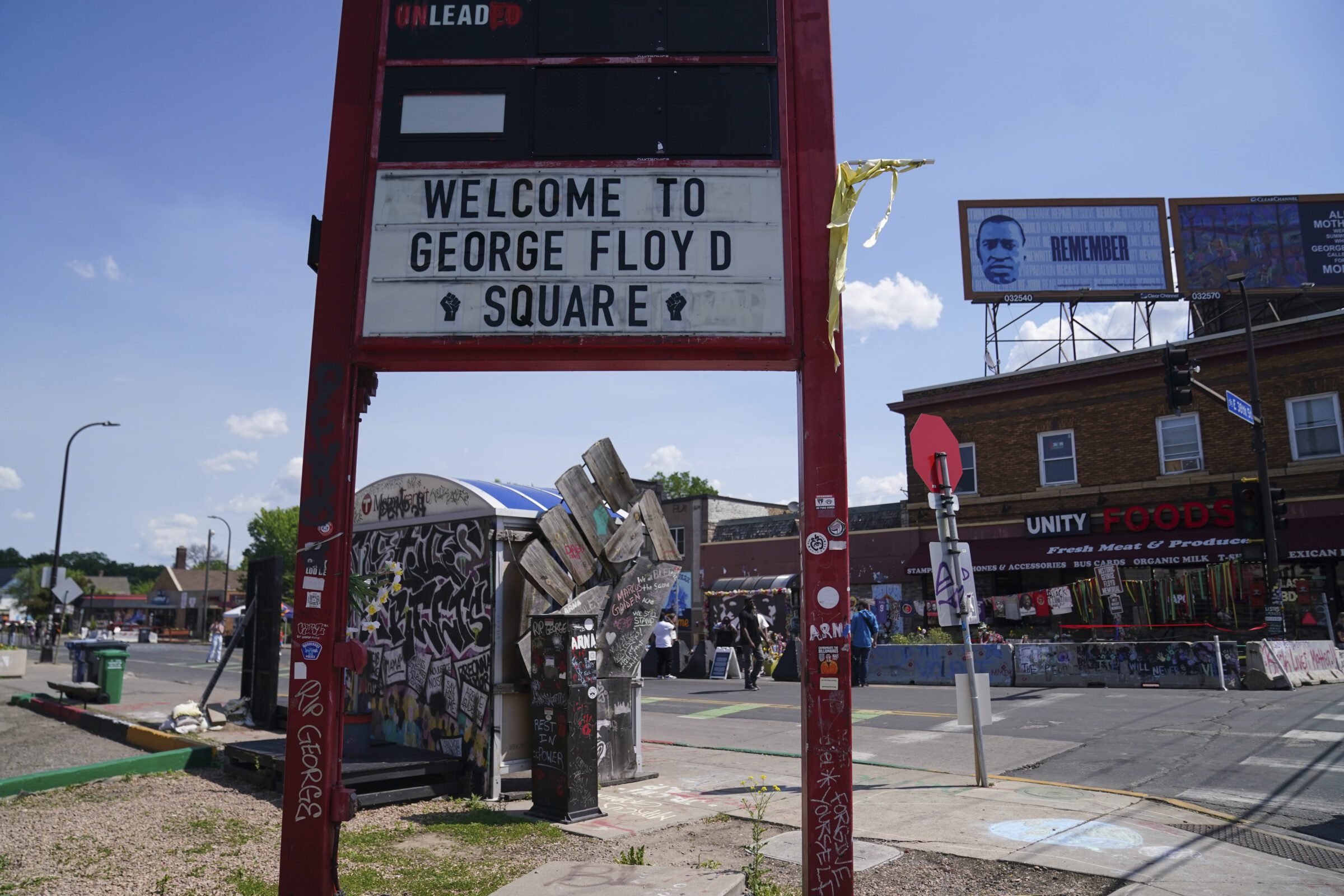
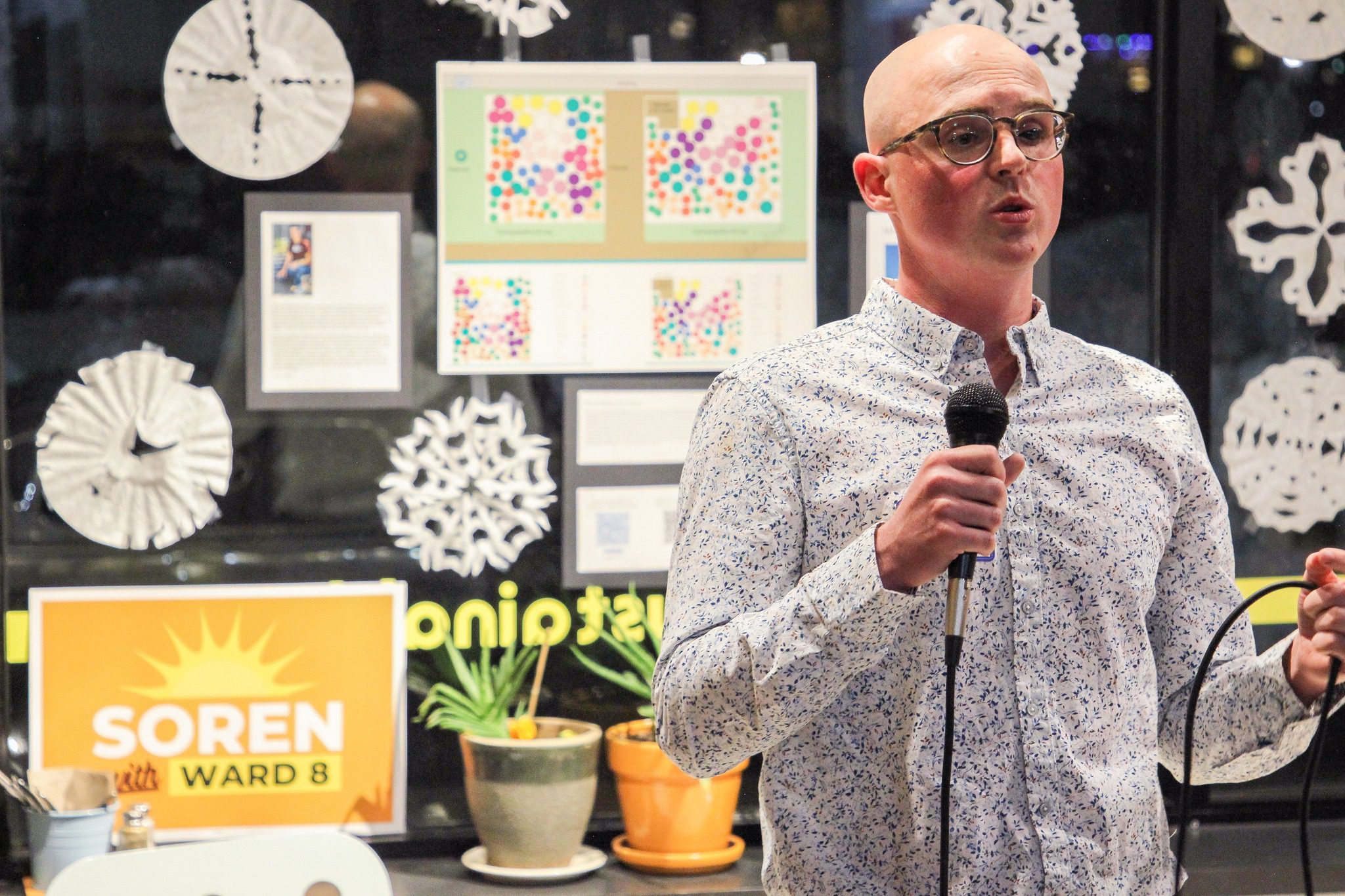
For Soren Stevenson, who is running for city council next month in the Eighth Ward, which includes part of George Floyd Square, the changes made by the city over the past five years haven’t been enough to stop police violence or ensure abusive cops are punished. He says he’s unwilling to downplay the issue because he has still seen no justice in his own encounter with police violence.
Stevenson was shot in the face by a foam projectile fired by a police officer on May 31, 2020, while peacefully protesting days into the demonstrations following Floyd’s murder. He lost his left eye and most of his sense of smell from the injury, but the officer who shot him never faced discipline.
When he joined Families Supporting Families Against Police Violence—a network of people with similar stories—he realized his experience was not an outlier, and that the department had a pattern of shielding officers accused of abuse. “Serious crimes were done against us. And in the vast, vast majority of cases, there were no repercussions,” Stevenson told Bolts.
“I do talk about police accountability, because it is vital to who I am as a person,” he said.
Sign up to our newsletter
For more stories on policing
Stevenson first ran for city council in 2023, challenging City Council President Andrea Jenkins, an ally of Frey, and lost by just 38 votes. Jenkins is not seeking reelection this year, and Stevenson is mounting a second run for the seat. He acknowledges that left-leaning candidates this year have grown less vocal on policing than in the recent past; pointing to Fateh and New York’s Zohran Mamdani, he said, “They’re supporters of public safety that builds our communities up instead of tearing us apart, but they’re choosing to run on something else.”
Still, Stevenson has aligned with a bloc of local politicians who largely agree with Levy Amstrong that the city has not adequately mended its broken police system, and that current reforms are not enough. “A lot of promises were made, and a lot of promises were not kept when it comes to police accountability,” he said.
He says Minneapolis needs to do more to punish cops for bad behavior and also to reduce the opportunities for violence arising in the first place by dramatically expanding the menu of unarmed first responders who are available to answer emergency calls. Several advocates involved in the 2020 protests echoed those demands in interviews with Bolts.
Frey insists the city has made progress on both fronts. He has pointed to the city’s work to meet the demands of two consent decrees, one adopted after an investigation by Minnesota state officials in 2023 to curb civil rights violations, and the other with the federal government in January of this year, which followed a lengthy investigation by the Biden administration’s Department of Justice. The agreements included measures to prevent discriminatory stops and searches, rein in excessive force, and strengthen internal systems for tracking officer misconduct.
While the state agreement remains in place today, the Trump administration withdrew from enforcing the federal consent decree in May, as part of a broader step back from police accountability. But Frey has pledged to keep implementing the changes demanded by the federal agreement anyway, positioning himself against Trump as a champion for accountability.
“We are committed to police reform, even if the Trump administration is not,” Frey said in June. “Our residents demanded meaningful change, and we’re delivering on that promise.” (Frey’s office and campaign did not respond to requests for comment for this article, nor did the campaigns of challengers Fateh and DeWayne Davis. MPD also didn’t respond.)
The mayor’s supporters echo his view that the city’s embrace of the two consent decrees is a promising baseline for reshaping the police department and holding officers accountable. That’s the argument made by Josh Bassais, a former labor representative who is supporting Frey for mayor and is running for the Eighth Ward seat against Stevenson.
“I do think that the city is foundationally going into a better place,” Bassais told Bolts. He has the support of Jenkins, the retiring councilmember.
But critics of Frey, including Stevenson, think the mayor and his allies have stalled progress on the underlying issues that the consent decrees were meant to address. And some local organizers are concerned that, while consent decrees may be powerful tools in the right hands, they can’t change deeply rooted patterns of misconduct unless there’s strong political will. They hope that the upcoming elections will strengthen the resolve of the city leadership to deliver on the promises made in the aftermath of Floyd’s killing.
“We have local leaders that might want to talk about it a little bit when it’s convenient, but they don’t want to ruffle feathers,” Stevenson said.
The federal DOJ and the Minnesota Department of Human Rights both raised the alarm on MPD’s widespread use of a practice known as coaching: When police officers are hit with a complaint, MPD frequently resolves the matter by forwarding it to a supervisor who simply speaks with the officer about the complaint, rather than triggering a formal investigation or mediation.
On paper, MPD policy is to only use coaching when the misconduct allegations are minor. But the DOJ found that MPD was also resolving serious complaints through coaching, including an incident where an officer tased a teenager accused of shoplifting. The Minnesota Star Tribune reported last year on other instances where serious violations were addressed through coaching, such as an off-leash K-9 unit attacking a civilian.
Referring complaints to coaching allows MPD officers to avoid facing investigations and serious discipline for misconduct. Even then, in the vast majority of these cases, supervisors never actually follow through with coaching, or verbally reprimanding the officer, the DOJ found.
Minnesota law allows police to withhold records of complaints that don’t result in discipline. That means misconduct complaints resolved through coaching are shielded from public scrutiny, and Minneapolis has denied outside watchdog groups access to those records. Last December, a judge ruled against the ACLU of Minnesota after it sued for the release of those records and argued that the city should have to make them public if it’s effectively using coaching to discipline officers for serious misconduct.
“Since they never discipline them, then that means we never get to know even what the allegations were,” said Communities United Against Police Brutality President Michelle Gross.
While the consent decrees do require Minneapolis to review police use of coaching in lieu of formal discipline, they don’t set clear standards for what changes should happen. Gross fears police will continue to use coaching to sweep misconduct under the rug and avoid the financial liability that may result from enhanced transparency for complaints against officers.
“Minneapolis doesn’t want to discipline cops, because if you discipline cops and you’ve got a lawsuit, it gives credibility to the lawsuit,” Gross told Bolts. “To hold them accountable and to give credibility to what they’d done to people would possibly cost the city money.”
Derek Chauvin, the officer who was convicted of murdering Floyd, previously had 17 misconduct complaints filed against him, but only one had led to formal discipline; after Floyd’s death, the city agreed to pay $27 million to his family in 2021 to settle a wrongful death lawsuit. In 2022, a man who was beaten and tased by police while trying to surrender was awarded $1.5 million. The city settled for $2.4 million with Stevenson after he was injured during the 2020 protests.
Now Stevenson wants the city to crack down on coaching to strengthen accountability.
This issue came to a head during the city’s negotiations for a new police union contract in 2022 and in 2024. A coalition of grassroots groups, known as Mpls for a Better Police Contract, pressed city officials to add some disciplinary requirements to the union contract, but they were unsuccessful. But the most recent police contract, approved by the city council in 2024, lacks guardrails on the use of coaching. And it explicitly states that coaching is not a form of discipline, which continues to give MPD cover to withhold records.
Frey has maintained that contract negotiations are not the place for implementing reforms, and said it’s easier to impose discipline when the mayor and police chief can decide how to do it than when that’s codified into a contract. Frey also argued during the 2022 negotiations that putting discipline on the bargaining table would also embolden the union to demand significant concessions.
Left-leaning members of the city council, like Jason Chavez and Robin Wonsley have said contract renewals are the right time to target coaching. (Both voted against approving the 2024 contract, and both are up for reelection this fall.) Stevenson agrees with them. “When it comes to eliminating coaching, the mayor could do that, or we could have fought for that in the union contract,” he said. “But when the union contract came up, we got temporary improvements with massive wage increases.”
The city must negotiate a new police contract next year, and Stevenson’s arrival on the council could strengthen the bloc that wants the city to take a stronger stance.
Stevenson’s opponent, Bassais, says that, when it comes to striking a deal for a better contract, “anything is up for negotiation,” including discipline. But he did not commit to a position on coaching.
“When it’s us against them, it’s a stalemate, and nothing gets done,” Bassais told Bolts. “But if you come in good faith and say, ‘This provision would benefit both sides,’ you’ll have better cops, you’ll have happier citizens.”
After the 2021 ballot measure that would have fully dismantled MPD failed, Frey launched a new city division, the Minneapolis Office of Community Safety. The idea was to promote a public health approach to reducing crime and expand initiatives that respond to emergency calls with unarmed first-responders in lieu of, or in addition to, armed police.
Frey’s administration consolidated some existing public safety programs into that new office, including a Behavioral Crisis Response team launched in 2021 to deescalate emergencies and avoid volatile police encounters. That program has since expanded to operate 24/7 in every precinct in the city, with a $5.9 million annual budget to vastly increase its capacity.
But critics say those investments have fallen well short of Minneapolis’ needs, and that the city ought to significantly increase the budget for these services to make a real difference.
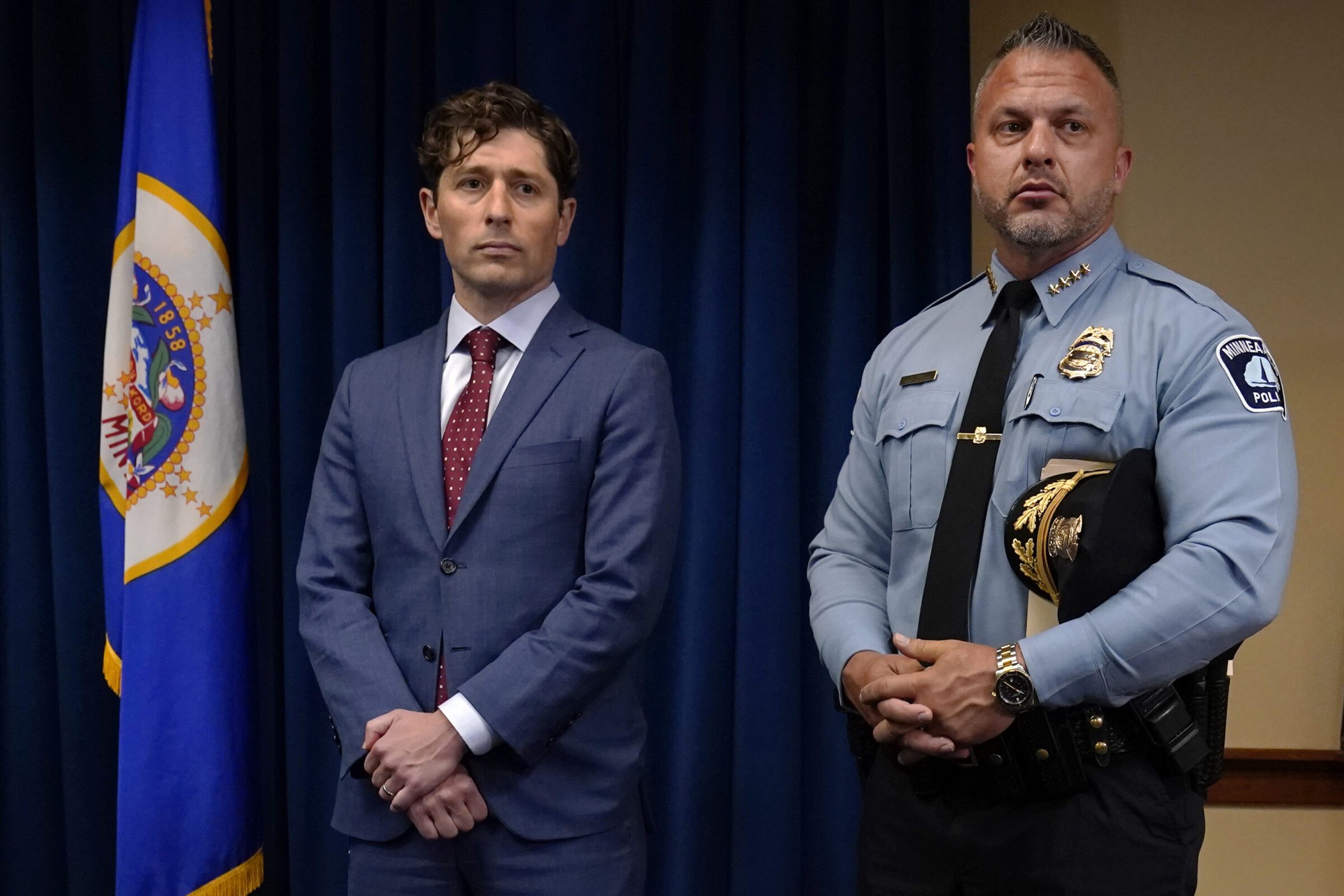
In 2023, a reform commission convened by the mayor released a report that included, among many other things, proposals of how the city should bolster alternatives to police responders. Frey presented the findings at a press conference, vowing to make it a blueprint for his work. But he later clashed with progressive councilors over his proposals to divert money allocated for alternatives to traditional policing to fund pay raises for police. Councilors also faulted him for resisting legislation that would commit the city to the report’s proposals; Wonsley proposed an ordinance in 2024 to formally adopt the plan but Frey did not support it.
Wonsley told Minnesota Public Radio at the time that the city has been slow to develop services for unarmed responders to be deployed in “a spectrum” of emergency situations.
The report said, for instance, that traffic accidents and roadside assistance could be diverted to third party responders, something that has been piloted in New Orleans to take about 12,000 calls a year off the workload of police; the development of a similar program in Minneapolis is still in planning stage. The report also suggested deploying civilian investigators and victim advocates to provide a trauma-informed response to some domestic abuse and sexual assault calls; Bassais and Stevenson both said they’ll push to ramp up this idea.
Brian Feintech, a spokesperson for the Office of Community Safety, told Bolts that his agency is working to implement the recommendations of the 2023 report “in a thoughtful and sustainable way,” including “measured steps” to advance the goal of diverting 20 percent of 911 calls. He said, “This is a 10-year plan, not a 10-day plan, and codifying it could remove the flexibility necessary to make the plan work for Minneapolis.”
The report also advised strengthening the city’s existing partnership with violence interruption groups to dispatch street outreach teams to handle some emergency calls by defusing conflicts before they erupt. Minneapolis launched the program in 2020, but Frey’s critics have assailed his management, starting with the selection of an organization led by a pastor who’d made homophobic and threatening statements toward council members. This summer’s rollout of the program for violence interrupters was then marred by contract disputes that kept outreach workers off the streets in some neighborhoods.
An analysis conducted by the NYU Policing Project for the city found that up to 47 percent of emergency calls could be diverted to civilian response programs to handle things like wellness checks, medical calls, sexual assault, domestic violence and traffic violations; the report said Minneapolis was only diverting 9 percent of 911 calls from police as of 2023. The city has set a goal of diverting 20 percent of calls to alternate responders in the next decade.
“This has not been a priority in the city. There’s not enough staff to do the work, and so things are just falling by the wayside,” Stevenson told Bolts. “We have leadership that has not made it a priority to see a behavioral crisis response system actually be implemented and integrated in such a way.”
Fateh, Frey’s mayoral challenger, has promised to pour more resources into a civilian network of first responders. He has also proposed expanding the city’s Behavioral Crisis Response team and fully implementing the 2023 public safety plan that he says Frey has failed to follow-through on. Still, he has distanced himself from his past support of cutting the police budget to foot the bill.
In the meantime, organizers say they’re impatient to see bolder changes given that allegations of misconduct and massive settlement payouts continue accumulating. Levy Armstrong blames city officials for increasing police department funding and raising officer salaries without having set up more guardrails to prevent abuse from happening in the first place.
She said, “How do we go from them wanting to shut down MPD to giving them way more money after George Floyd was killed without attaching reforms to that money?”
The article was updated in the evening of Oct. 20 with a statement that the Office of Community Safety sent after publication.
Sign up and stay up-to-date
Get timely updates about pressing stories and elections.
Support us
Bolts is a non-profit newsroom that relies on donations, and it takes resources to produce this work. If you appreciate our value, become a monthly donor or make a contribution.