
They’ve Long Clashed on Voting Rights. Now They’re Facing Off for a Supreme Court Seat.
North Carolina Justice Anita Earls, a former voting rights lawyer, and Sarah Stevens, a longtime legislator, have been on opposite sides of election issues for over a decade.
| September 11, 2026

This story is part of Bolts’s coverage of state supreme court elections in 2026; learn more.
In December 2022, the North Carolina Supreme Court delivered two key wins for voting rights advocates, striking down a voter ID bill as racially discriminatory and blocking a congressional gerrymander designed to hand most of the state’s seats to the GOP.
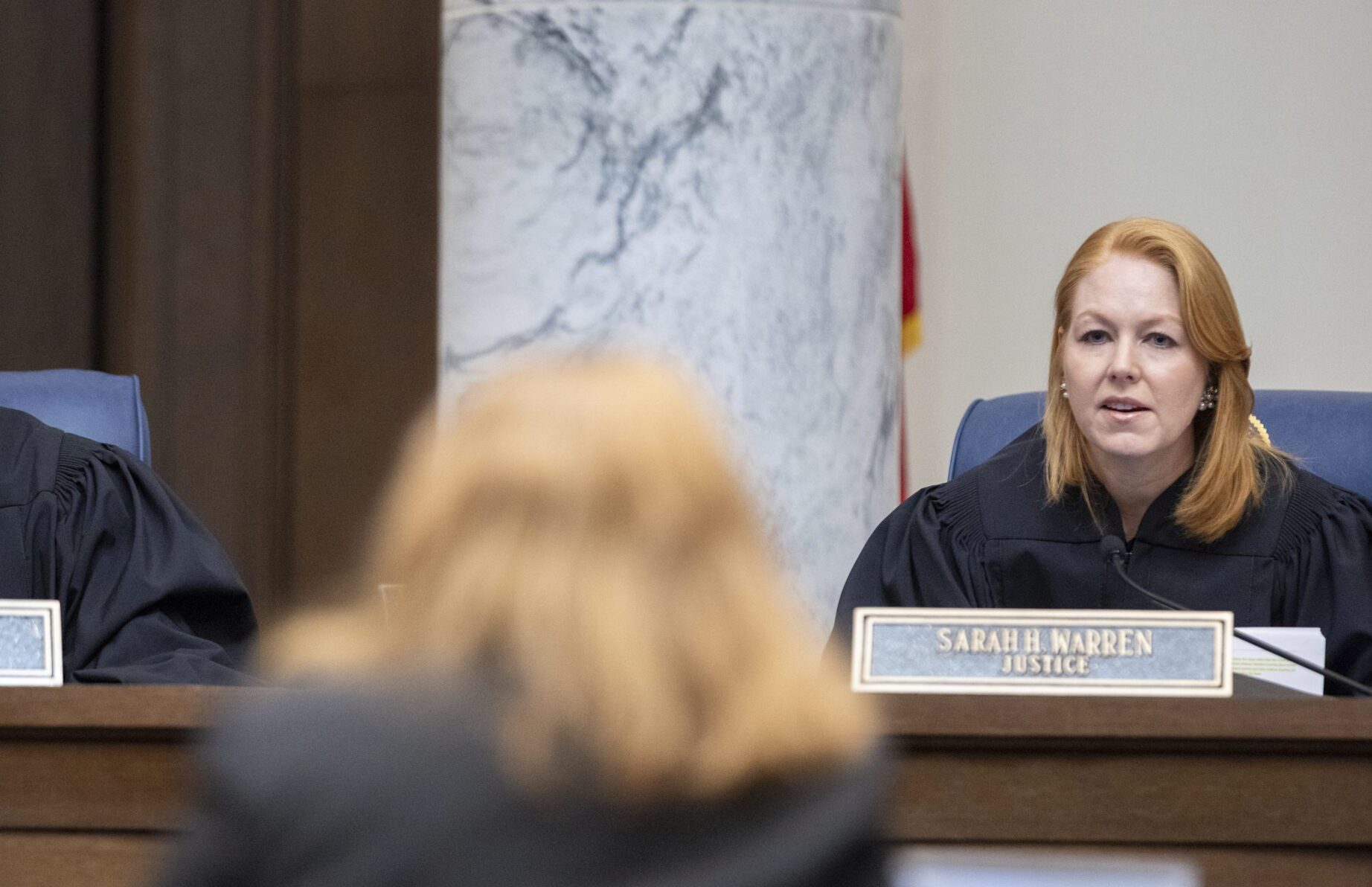
But just a few weeks later, Democrats lost their control of the court as two newly elected Republican justices were sworn in, giving the GOP a 5-2 majority. As that new GOP majority quickly ordered the voter ID and gerrymandering cases to be reheard, Justice Anita Earls, one of the Democrats who remained on the bench, issued a fiery dissent denouncing the move as a “radical break with 205 years of history.”
“It has long been the practice of this court to respect precedent and the principle that once the Court has ruled, that ruling will not be disturbed merely because of a change in the Court’s composition,” Earls wrote.
The new GOP-controlled court eventually reversed the decisions in both cases, leaving North Carolina with strict voter ID requirements and electoral maps that heavily favor Republicans, despite the state’s roughly 50-50 political divide. (The prior, court-drawn congressional map resulted in a 7-7 split; under the new map, the GOP won 10 of 14 seats.)
Earls, who worked as a voting rights attorney before joining the court, could only write another dissent as her GOP colleagues now had the votes to override her. In the gerrymandering case, she wrote, “These efforts to downplay the practice do not erase its consequences and the public will not be gaslighted.”
Since then, unshackled by a state supreme court that was no longer acting as a guardrail on their voting agenda, North Carolina Republicans have continued to move aggressively, including overhauling election boards and drawing yet another gerrymander.
Now Earls is up for reelection, hoping that her party doesn’t fall into an even bigger hole on the court.
Hers is the only seat on the ballot this year so the GOP will retain its majority no matter what. While Democrats have a path to flipping the court in 2028 and possibly revisit gerrymandering and other voting issues, a loss by Earls would set them back.
As Earls fights to keep her seat, she faces a familiar foe: Sarah Stevens, a longtime Republican state representative from Surry County. Stevens has supported many of the election laws that Earls opposed as a civil rights lawyer and that she has found unlawful as a justice.
Earls says she encounters voters on the campaign trail who question whether democracy in North Carolina is “going to work the way we believe it should in America.”
Learn more about state courts
Subscribe to our newsletter
Voters in her state are facing real barriers, she told Bolts in an interview. “In my view,” she said, “it is harder to vote in North Carolina now than in Mississippi.”
Stevens’ campaign declined an interview request for this story.
Brooks Fuller, policy director at Common Cause North Carolina, a nonprofit primarily focused on voting rights, shares a dark view of the state’s election landscape. He calls North Carolina “a laboratory of anti-democracy,” and says that every legislative session “some additional hurdle or requirement has either been offered in proposed legislation or has been enacted into law that affects North Carolina voters.”
“Just about everything that you can imagine on the voting rights front, North Carolinians have faced it,” he told Bolts.
Over her nine terms in the state House, Stevens has helped advance many of the election bills that voting rights advocates denounce as anti-voter.
In 2013, she co-sponsored House Bill 589, a sweeping election bill that drew heavy protests; it included a strict photo ID requirement, cut in-person early voting by a week, and eliminated same-day voter registration and out-of-precinct voting.
When it was signed into law, critics viewed it as one of the most suppressive election laws passed in the wake of the U.S. Supreme Court’s 2013 decision in Shelby County v. Holder, a landmark ruling that gutted the Voting Rights Act of 1965 and allowed Southern states to modify their election laws without seeking preclearance from the U.S. Department of Justice.
At the time, Earls worked as the executive director of Southern Coalition for Social Justice, an organization she founded, and she helped challenge the voter ID law in federal court, arguing that its provisions discriminated against Black voters.
“We have to have the value that it’s the government’s role to make it easy for every citizen to vote rather than the citizen’s responsibility to jump through all these hurdles,” Earls said in a 2014 interview on why she was bringing such lawsuits. “They’ve put in place all these hurdles and all these technicalities that make it try to selectively pick who is going to vote.”

The Department of Justice, under then-President Barack Obama, also sued to stop HB 589. In 2016, the 4th U.S. Circuit Court of Appeals agreed, striking the law down on the grounds that its changes “target African Americans with almost surgical precision.”
Stevens helped her party take another swing at voter ID requirements two years later when she co-sponsored a constitutional amendment that required voters to present an ID before voting.
Voters approved the amendment in the fall of 2018 but also elected Earls to the state supreme court on that same ballot. Years later, in 2022, Earls authored the short-lived, 4-3 ruling that struck down the law implementing those voter ID rules.
“The risk of disenfranchisement is very real,” Earls wrote in her majority opinion, citing research that shows Black voters in North Carolina are more likely than white voters to lack the required ID documents. Earls said the law was enacted with “discriminatory intent to disproportionately disenfranchise and burden African-American voters.”
But five months later, with the GOP now in control, the court reversed Earls’ decision. Justice Phil Berger Jr., a Republican, wrote that the claim that the law will disproportionately affect Black voters “is entirely speculative.”
Since then, Stevens has also supported legislation that has eliminated the so-called grace period for mail ballots and stripped the governor of his authority over election boards. Now, Republicans control the state and local panels that decide election rules, certify results, and determine polling place locations.
In the current legislative session, Stevens was one of the two main sponsors of HB 958, the GOP’s latest legislative vehicle to push still more changes to election law.
In fact, Stevens co-chaired the House Elections Committee in mid-2025 when the panel advanced a version of the bill that barred the state board of elections from doing anything to encourage turnout and provided that much of the board’s nonpartisan staff would be replaced with partisan hires; Democratic lawmakers denounced this as “a purge.”

Stevens resigned from the legislature in June 2026 to focus on her run for the supreme court and so she did not vote on HB 958’s final passage through the legislature in July. Democratic Governor Josh Stein vetoed HB 958 last month and Republicans are expected to attempt an override of Stein’s veto when they return to Raleigh in November.
When Stevens’ campaign declined Bolts’ request to interview her on her record and proposals on election issues, her spokesperson called it “a violation of judicial standards for a judge or judicial candidate to take a stand, or what may be perceived as a stand, on any issue that may appear before the court.”
But in a judicial voter guide published last month by the state board of elections, Stevens clearly named her disagreements with Earls’ approach to voting rights as core to her campaign.
“I am running because my opponent has twice ruled against the constitution on issues of voter identification and redistricting,” Stevens writes. “She has also rewritten the law and disturbed 90 years of common law.”
In an interview with Bolts, Earls said she disagreed with Stevens’ statement and said, “The precedent that was broken by the Republican majority was the notion that we could rehear a case after there had been a final ruling and change that ruling.”
“I don’t know exactly what precedent she was referring to, but I think that’s absolutely wrong,” Earls added.
Andy Jackson, director of the Civitas Center for Public Integrity at the John Locke Foundation, a conservative think tank, defended the election laws passed by Republican lawmakers in recent years as reforms that are “a good step” to properly run and boost confidence in elections.
“I don’t think we have seen any marked decrease in voter participation,” Jackson said. “Some of this is just basic election security and improved election administration.”
Critics of the state’s recent reforms point to evidence of disenfranchisement, such as the surge in mail votes that were rejected in 2024 because they arrived in the three days after Election Day. The GOP’s 2023 law ended the three-day grace period that meant ballots were still accepted as long as they were postmarked by Election Day.
In her interview with Bolts, Earls said she talks to voters who are worried they might not receive their absentee ballot, and if they do, are concerned it might not be counted.
“When I ran in 2018, no one was particularly worried that somebody might come along after the election and try to throw out their ballot,” she said. “There wasn’t the same fear that our democratic processes have been hijacked and interrupted.”
Some of that fear may result from what happened after the 2024 supreme court election, when the Republican nominee Jefferson Griffin asked courts to toss out 60,000 ballots that he said were cast unlawfully. His lawsuit even challenged the votes cast by the parents of his opponent, Democratic Justice Allison Riggs. Griffin only conceded six months after the election, after a federal court rebuffed his efforts.
The back and forth on voting rules risks sowing confusion and discourages people from voting, said Kat Roblez, a voting rights attorney at Forward Justice, a North Carolina-based law center that represented the NAACP in lawsuits against voter ID rules. Forward Justice also supported Earls during her 2023 clash against the Judicial Standards Commission, when the agency launched a short-lived investigation into comments she made to a journalist about the lack of diversity in the judiciary. Forward Justice denounced a “pattern of attempts to chill the free speech of a Black woman.”
“It gets sort of disheartening for people when they can see that there are people who are just constantly trying to make it harder to vote,” Roblez said.
Still, Roblez believes the supreme court race should be one voters pay attention to since the stakes are unusually clear. “It’s two candidates. There is no gerrymandering,” she said. “Everyone in the state is choosing between these two.”
Sign up and stay up-to-date
Get timely updates about pressing stories and elections.
Support us
Bolts is a non-profit newsroom that relies on donations, and it takes resources to produce this work. If you appreciate our value, become a monthly donor or make a contribution.