
Eyeing Upcoming Elections, Arizona Activists Want Their City Officials to Stand Up to ICE
Mesa’s longtime partnership with ICE has emerged as a major fault line in the July elections, as organizers work to limit local collaboration with federal immigration authorities.
| June 26, 2026

The article is published in a collaboration between the Arizona Mirror and Bolts.
It’s a sweltering 105 degrees on a Sunday afternoon in June when Jillian Ryan sets out to tell voters in east Mesa that their city has a contract with U.S. Immigration and Customs Enforcement to allow local police officers to be a cog in President Donald Trump’s mass deportation efforts.
The 39-year-old mother of two is the head of Indivisible Mesa, a local group formed in the wake of Trump’s 2024 election to oppose his policies, particularly his promise to deport millions of immigrants.
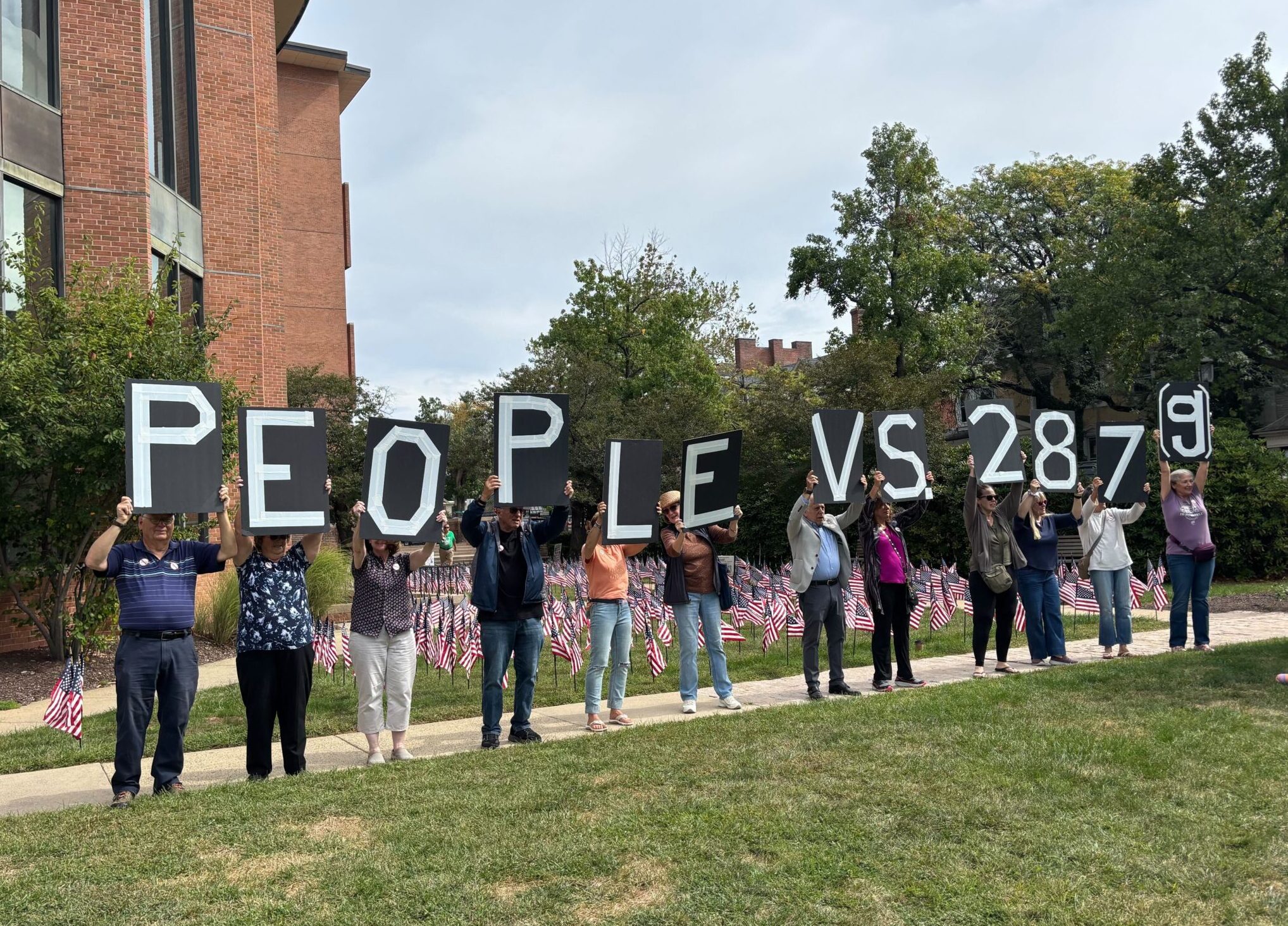
The Mesa Police Department has a 287(g) agreement with ICE that allows police officers to investigate the citizenship status of people once they’ve been arrested and booked into the local jail—even if they haven’t yet been charged with any crime. Mesa is the only city in Arizona that has chosen to join the 287(g) program, which is typically operated by county sheriffs instead, and activists have mobilized to pressure the city council to terminate that partnership without success. One meeting in September 2025 saw more than 100 people submit comment cards calling on the city council to rescind that partnership.
Now they’ve turned their efforts to the upcoming municipal elections in the hopes of reshaping the council’s ideological makeup into one that will. Mesa’s conservative-leaning council cannot flip this year since only three of six council seats are on the ballot for the July 21 election, and only two have contested races. But Indivisible Mesa hopes that any gain this year will set them up for 2028.

Immigrant organizing has rocked local politics and caused election upsets throughout the country during Trump’s second term, and Arizona activists hope they can similarly channel many residents’ anger toward his immigration crackdown—in Mesa, Arizona’s third most populous city, but also in smaller towns like Surprise and Marana where ICE wants to build immigration detention centers.
Past campaigns in these cities have revolved mainly around taxes and affordable housing, but this time candidates are also having to grapple with immigration policy and how local law enforcement partners with ICE.
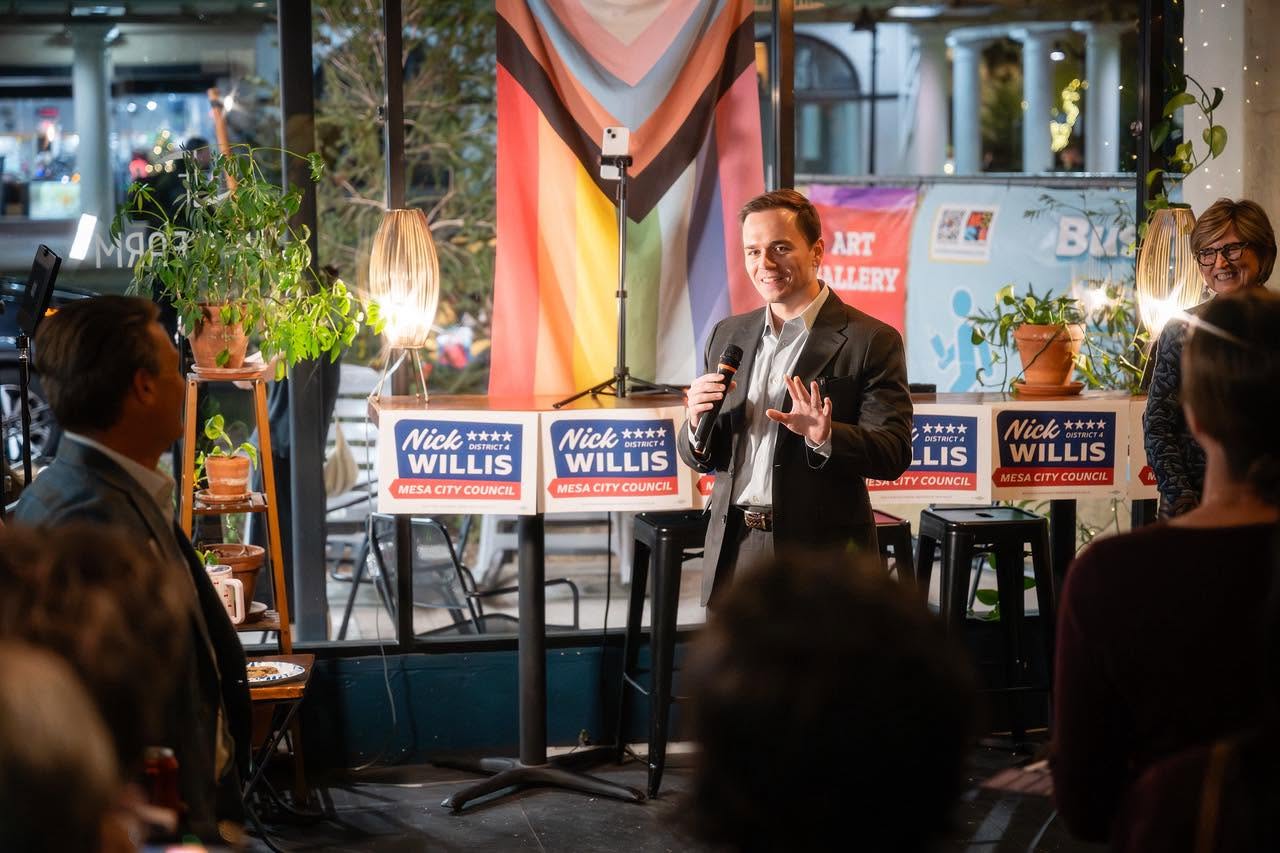
In Mesa’s Fourth District, which includes the city’s downtown core, two political newcomers have staked out opposing views on the subject as they run to replace Jenn Duff, who is retiring. Ray Johnson has given the city’s agreement with federal immigration officials his full-throated support, while Nick Willis has vowed to oppose it if elected.
Meanwhile, in the Fifth District, which includes the wealthier northeastern part of the city, incumbent Alicia Goforth supports keeping the partnership in place and is fending off three opponents who have each said they would at least consider reassessing the 287(g) agreement. If no one tops 50 percent of the vote in the July 21 primary, the top two candidates will move on to a runoff in November.
In that crowded field, self-described progressive Danny Hart was recruited by Indivisible Mesa. Hart is the only candidate in District 5 who has unequivocally said he would vote to terminate the city’s partnership with federal immigration officials.
Before running for council, Hart attended public meetings to speak up against the city’s 287(g) agreement, inspired by video footage of federal agents shooting and killing ICE observers Renee Good and Alex Pretti in Minnesota this winter. He said he doesn’t view immigrants as a problem for the country, noting that studies show they commit crimes at lower rates than citizens, and said he’s opposed to helping ICE agents make arrests in light of their tendency to violate civil rights.
“Are they a force that we want here?” he asked. “They’re a federal agency, they can come and go as they please, but do we have to help them and support them in their persecution?”
Ryan, the Indivisible activist, has been driving around east Mesa in the Fifth District four or five times a week in her hot pink car to canvass neighborhoods for Hart, and she calls voters to discuss Hart’s priorities just as often. A handful of other Mesa Indivisible members help, too, but she noted that it’s more difficult to get people to volunteer consistently on the campaign than it would be to get them to attend a protest or a contentious city council meeting.
Every time Ryan steps outside of her car, which she keeps running with the air conditioning cranked to the maximum setting to escape the heat between treks up driveways, she takes a dark blue cardstock with a picture of Hart on one side and bulleted list of his priorities printed on the other to hand to voters through their cracked doors or tuck under doormats when she sees a no soliciting sign.
At the top of that list is “end cooperation agreement with ICE.”

Making contact with voters is tough work, filled with slamming doors and perturbed voters hanging up dozens of times a day. Ryan estimates that Mesa Indivisible’s efforts have reached at least 1,000 voters by phone and knocked on more than 500 doors so far. It’s unclear if that will be enough, however, especially since the District 5 leans conservative. District 4 leans more Democratic.
Councilmember Scott Sommers, who supports preserving the city’s 287(g) agreement, is running for reelection unopposed in the Sixth District. Indivisible Mesa briefly supported a bid by Adam Windes, a young activist who promised to oppose the 287(g) agreement and posted educational videos about the program on social media, but he didn’t meet the signature requirement to qualify for the ballot.
Even if Hart and Willis win their elections, that would only be two seats in favor of ending Mesa’s 287(g) agreement. But with four other council members, plus the mayor, who are either supportive of partnering with ICE or have unclear stances on the issue, it’s unlikely that the city would scuttle the agreement.
Still, three more council seats, plus the mayor’s office, are on the ballot in two years, and Ryan remains determined to keep pushing, saying that giving up at this stage will do nothing but guarantee there won’t be any change.
“Yeah, the odds aren’t great,” she said, shrugging, as she drove to the next house. “But we can try.”
The biggest problem Ryan faces when speaking with voters isn’t hostility—she makes sure to filter her canvassing app for registered Democrats to avoid that—but a lack of information. Most people she talks to aren’t aware of their local police department’s participation in federal immigration enforcement efforts, or the city council’s authority to stop it.
Keith Boomgaard, a Mesa resident, said he doesn’t agree with Trump’s mass deportation campaign and wouldn’t vote for candidates who aim to facilitate it because he has relatives who are immigrants.
“Anyone who’s down with ICE isn’t someone I’d support,” he said.
But he didn’t know that the Mesa Police Department has a partnership with ICE that goes as far back as 2009. When Ryan assured him that Hart vowed to vote against continuing that partnership, Boomgaard appeared to approve, interrupting her rehearsed remarks to say, “That would be perfectly fine with me.”
Similarly, Robert Dewerd said he’s against ICE because what its agents are doing is “not good stuff,” but acknowledged that he doesn’t keep up with the city council and didn’t know what a 287(g) agreement is. Still, Dewerd and his wife, Kelsey Makin, who poked her head out of the door curiously after a few minutes, with a toddler peeking out from behind her, both agreed that a shakeup at the city council is long overdue.
“We need change,” Makin said, nodding.
For more stories about local elections
Subscribe to our newsletter
Hart, too, has encountered many voters over the course of his campaign who don’t know that Mesa City Council has the power to determine how involved local police officers are with federal immigration enforcement efforts.
“I don’t think anybody has a clue,” he said. “I’ve had people say to me: ‘Just keep the roads nice.’ They think that’s all it is.”
Hart said he is running to bring the issue to the forefront. Even if his candidacy won’t lead directly to the agreement being rescinded in the short term, he hopes that the dialogue he is helping create could make it possible in the future.
“Everything isn’t about what we can do, it’s what you maybe can start,” he said. “And maybe in my four years, I won’t be able to actually get rid of it, but maybe I can raise awareness about it and maybe the next guy that takes over will be able to make a majority and get rid of this nonsense.”
Local elections often fly under the radar, but progressive advocates hope this year’s midterms will pull in voters upset with the Trump administration’s policies who will then vote against the status quo in down-ballot races.
Mesa’s municipal contests are nonpartisan but they are taking place on the same day as Arizona’s statewide partisan primaries, and early analyses of primary elections in other states are showing an uptick in participation from Democratic voters. But Mesa progressives may face a challenge in the July contests that will decide at least one of the city’s council races, in that Republicans have many more high-profile statewide primaries on the ballot that will draw out their voters.
Ruth Harris, who showed up to a recent meet-and-greet with local candidates in Mesa, hopes to join a surge of Democratic voters. The 65-year-old registered to vote at the event and spent nearly two hours chatting with candidates, including Hart. Harris said she sat out the past few election cycles because she felt like her participation didn’t matter, but when Trump was elected for a second time, she was infuriated and motivated to try again.
“If you don’t vote, then you shouldn’t be able to say that you’re mad about what’s going on,” she said. “That’s what I tell myself, too.”

While Harris was unaware of the city’s 287(g) agreement before the event, she expressed concern and likened it to former Maricopa County Sheriff Joe Arpaio’s leadership. Under Arpaio, who served as the Republican sheriff of Arizona’s largest county from 1993 until 2017, the sheriff’s office was part of a more aggressive version of the 287(g) program, which allows deputies to investigate people’s investigation status during their regular patrol duties.
The Obama administration terminated Arpaio’s contract after the U.S. Department of Justice found that Latino drivers in Maricopa County were nine times more likely to be pulled over than non-Latino drivers, and a federal court found that Arpaio was racially profiling Latinos.
The Maricopa County sheriff’s office has not returned to the program since then, so today the city of Mesa is the only place within Maricopa where law enforcement officers are empowered to act as immigration agents under 287(g). Elsewhere in the state, the sheriffs of Cochise, La Paz, Navajo, and Pinal counties are part of the 287(g) program.
Mesa isn’t the only city in Arizona where concern over federal immigration enforcement efforts has bled into local politics. Local officials are aiding ICE in their communities in other ways than the 287(g) program, and they’re now feeling pressure to explain themselves as they face voters.
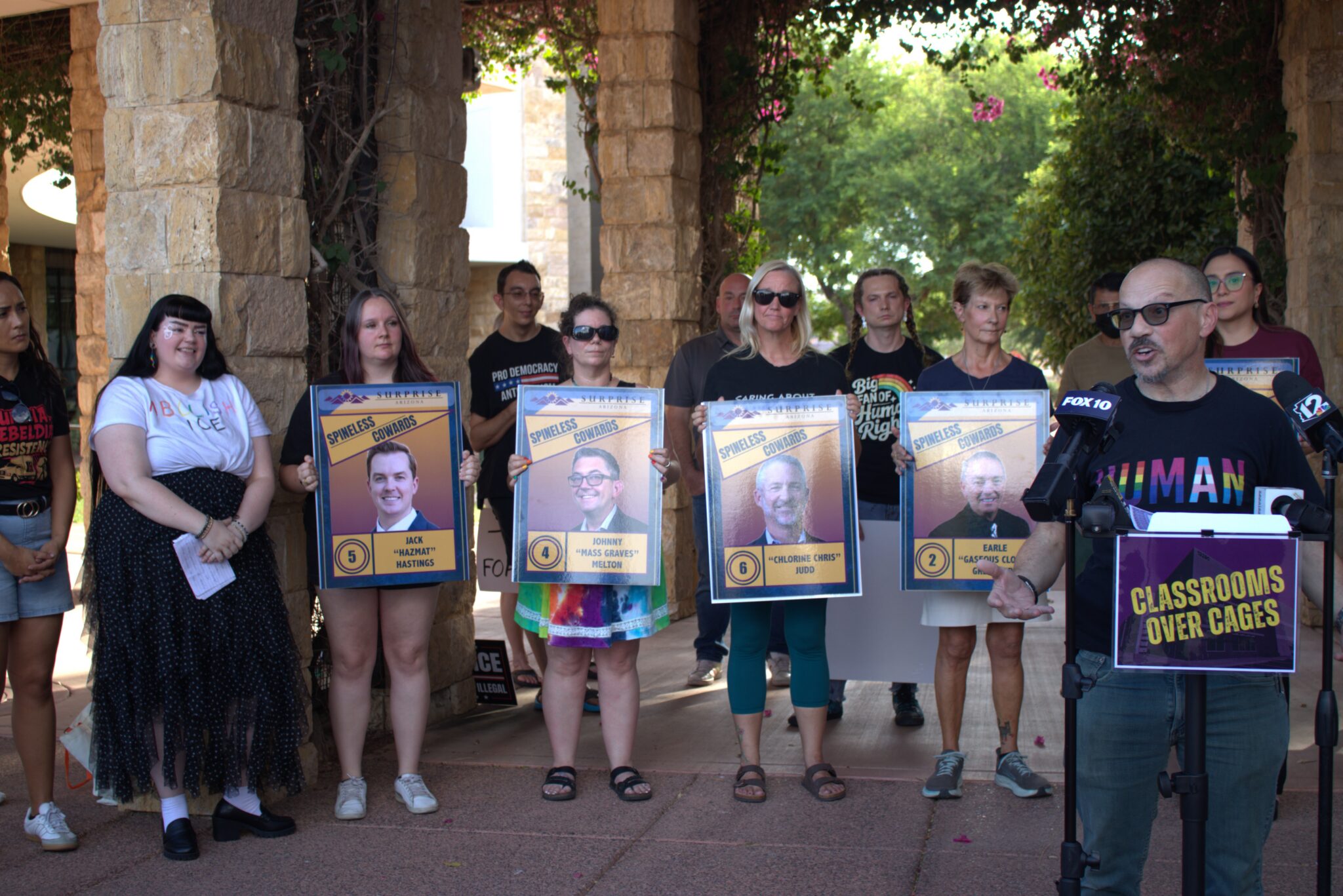
In Surprise, a city northwest of Phoenix, residents and progressive activists have repeatedly butted heads with the city council over how to respond to federal immigration enforcement, but the conservative council has so far been unwilling to push back on a federal plan to open an immigration detention center here.
One city council meeting in this normally quiet suburb saw a crowd of more than 1,000 people fill the hearing room and protest outside. After months of unsuccessful outcry and facing down an election that’s unlikely to yield a different outcome, activists are now calling for voters in the area to support a petition to outright dissolve the city. They hope placing Surprise under the control of the Maricopa County Board of Supervisors will result in action against the immigration detention center.
“The people of this city want leadership that will protect their safety, their security and their well-being, and the current leadership isn’t. And I think there’s a lack of confidence that anyone who replaces them won’t do more of the same at this point,” Jeremy Helfgot, who filed the petition, said during a June 16 news conference.
Three of six seats on the Surprise City Council are up for reelection this year, but only one of the three incumbents is facing any competition.
Another proposal to build an immigration detention facility in Marana, a town of about 63,000 people north of Tucson in Southern Arizona, has caused a similar uproar.
Last year, the state of Arizona sold a former prison in the town to a private company that runs ICE facilities, sparking immediate backlash from residents. Earlier this month, the federal government announced that the former prison, which has a capacity for 506, will be renovated to house more than 1,300 people.
Bennett Burke, a spokesperson for Pima Resists ICE, a volunteer group that formed to oppose the opening of the facility, said that the council hasn’t taken a meaningful stand against the plan. The group has mobilized residents to attend council meetings, organized social media campaigns to keep the public informed and plans to set up a mailer campaign to keep the issue on the radar of voters. The nonpartisan organization doesn’t endorse candidates, but Burke said it believes the issue is important for voters in the town.
“We strongly encourage the people of Marana to pay attention to this and understand that there’s going to be a brutal ICE detention center 10 minutes away from homes and schools,” he said. “We cannot imagine that the majority of Marana citizens want that for their community.”
He added that national polling has consistently shown that Americans are opposed to the Trump administration’s mass deportation campaign. A February poll found that 65 percent of Americans believed that the federal government’s immigration enforcement efforts had gone too far. And as much as 50 percent of Americans agree that the agency should be abolished.
The mayor’s office and four of six city council seats are up for reelection in July. All but one of the incumbents are running to win another term, and they’re facing off against a slate of candidates that has been vocally critical about the Trump administration’s plan to turn a correctional facility into an immigration detention center.
Julie Prince, who is running as a team with two other city council candidates, and Greg Johnson, who is running for Marana mayor, has been particularly outspoken about her opposition to the ICE facility. In a March 16 video posted to her campaign’s Facebook page captioned “Say NO to the Marana ICE facility,” Prince said she’s spoken to many voters who have expressed concern over it.
“I want to make it very clear,” the city council hopeful said. “I am completely against the ICE facility.”
Sign up and stay up-to-date
Get timely updates about pressing stories and elections.
Support us
Bolts is a non-profit newsroom that relies on donations, and it takes resources to produce this work. If you appreciate our value, become a monthly donor or make a contribution.