
How Border Patrol Is Helping Local Cops Expand Surveillance in California
Immigration enforcement funds have helped local police quietly grow their networks of automatic license plate readers, even as the public protests surveillance and mass deportations.
| November 19, 2026
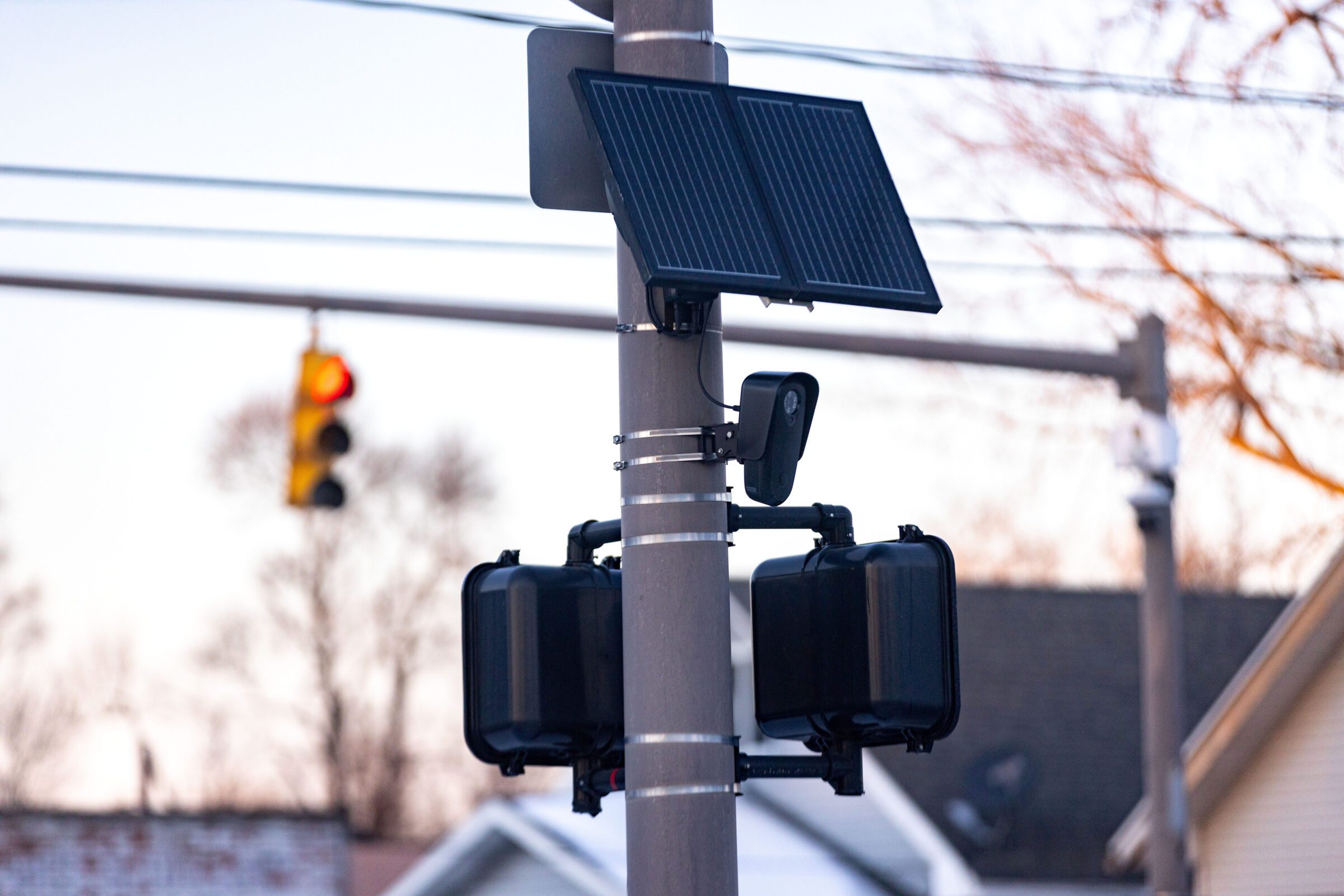
People in California’s Central Coast are being tracked by an ever expanding network of license plate reading cameras funded by federal immigration dollars, even as misgivings over both surveillance and the Trump administration’s deportation agenda have boiled over into full-blown protests.
In 2019, privacy advocates in California started sounding the alarm after discovering that the San Luis Obispo County Sheriff’s Office had given federal immigration officials access to data collected by the county’s surveillance network, which at the time consisted of just one license plate camera. Yet the sheriff’s network of automatic license-plate readers (ALPRs) has since quietly multiplied with the help of funding from the federal Department of Homeland Security aimed at forging more coordination between local police and Border Patrol.
Purchasing records obtained by Bolts show how San Luis Obispo County Sheriff Ian Parkinson, who has held the office since 2011, has used money from a little-known DHS program called Operation Stonegarden to grow his surveillance network. First in 2019, not long after coming under fire for sharing data with ICE, the sheriff tapped Stonegarden funds to expand his department’s network of Motorola Vigilant license plate readers.
And then last year, according to budget documents, the sheriff allocated $45,000 from the Stonegarden grant to pay for more ALPRs, just weeks before the department set up a new network of 23 cameras from Flock, the nation’s largest license plate reader company, which would cost the county $69,000 annually. A spokesperson for the San Luis Obispo County Sheriff told Bolts that the Stonegarden funds the county board approved last year were not spent on the expansion of the county’s Flock system, but would instead go to more Motorola ALPRs.
The federal money seems to have made it easier for the sheriff to expand this surveillance network without much oversight or scrutiny of the technology from other local officials. Bruce Gibson, who sits on the governing board for San Luis Obispo County, says there was no discussion of the surveillance cameras or potential concerns about the technology last year when the board approved using the Stonegarden grant to pay for license plate cameras as part of the annual budget process. Gibson told Bolts that the board typically defers to the sheriff to select the department’s contractors, especially when they are not paid by the county’s general funds.
Subscribe to our newsletter
Get more reporting on policing and surveillance
Gibson said the series of scandals involving Flock and the “heinous and cruel way” the federal government has used ALPR surveillance to carry out the president’s deportation dragnet have made him more aware of the potential for the technology to be abused.
“It didn’t enter my consciousness that there might be some significant policy issues until the misuse of Flock became much more obvious,” Gibson told Bolts.
Waves of reporting over in recent years have uncovered that Flock cameras and other surveillance tech are being used as a backdoor for local police to track immigrants for the federal government, even in states like California and Washington, where that kind of data-sharing is banned.
Bolts’ new investigation shows that this is no coincidence—the technology’s growth is fueled by funds meant to help enforce immigration laws in the first place.
Records obtained by Bolts via public information requests uncovered similar findings as in San Luis Obispo across the state of California.
Despite the state’s strict restrictions on collaboration with federal immigration authorities, and its broader reputation as a stalwart against the Trump administration’s aggressive immigration agenda, many local law enforcement agencies have funded their expansion of license plate reading surveillance cameras with funding from this federal program specifically aimed at increasing local collaboration with border enforcement: During the most recent grant period, starting in 2024, departments across California received at least $760,000 in Stonegarden grants to purchase license plate cameras, often from Flock.
Surveillance companies directly reached out to some law enforcement agencies, including the Imperial County Sheriff’s Office, to encourage them to apply for these immigration funds and use them to purchase their cameras, records show.
In San Luis Obispo County, the money helped the sheriff’s office grow its network of cameras even during a recent wave of local activism against such surveillance, as well as growing awareness of data breaches across the country tied to Flock. Beyond sharing data on immigrants, officers in other jurisdictions have used the company’s surveillance network to stalk romantic partners in at least 85 instances, and also to track protesters and people obtaining abortion care.
Students at California Polytechnic State University, an anchor of the Central Coast region, protested this year over the school contracting with Flock to mount 17 cameras around campus. The students collected over 1,500 signatures for a petition calling on the school to end its Flock contract, prompting the student government to unanimously demand that administrators take down the cameras.
And this July, nearby in the small community of Oceano, public officials rejected a request by the San Luis Obispo County Sheriff’s Office to install a Flock camera at a station run by the local utilities commission. Clara Fulks, a privacy advocate in San Luis Obispo who has fought against the cameras, says the community rejected the sheriff’s request because “people just don’t want to feel like they’re being watched all the time.”
“It was a rare opportunity to actually vote on this,” Fulks told Bolts. “Usually, it’s not up to a vote.”
But privacy advocates say the infusion of money from federal partnerships like Stonegarden has allowed local police to get around this sort of public pressure to deploy and scale up invasive surveillance technologies without the usual oversight. According to Gibson, the county board did vote to appropriate Stonegarden funds to the sheriff for ALPRs, but there was no meaningful discussion around the sheriff’s surveillance program since the item was buried in the budget that county supervisors approved last year.
“There really wasn’t any discussion,” Gibson said.
Fulks says “people would be up in arms” if the San Luis Obispo sheriff’s expansion of his ALPR network had been publicly discussed at county board meetings. Even the residents who are not tuned in to the privacy risks associated with mass surveillance would likely still balk at the use of border and immigration funding to grow the network because “people are really aware of the issues facing immigrants and ICE being in our jail,” Fulks told Bolts.
Last year, the county voted on a separate pot of federal dollars, the State Homeland Security Program, a grant meant to help police prevent terrorism that the sheriff had previously used to fund license-plate readers. Even though that program does not directly involve immigration enforcement, community members voiced concerns that the money would still incentivize the sheriff to assist with deportations.
“Why would they allocate this money and allow it to be spent on surveillance technology unless the federal agencies that are in these partnerships would benefit from it?” Fulks said.
California departments are already banned from sharing license plate reader data with agencies outside the state because of a privacy law adopted in 2015. Under that law, police in the state must log each time they search the cameras, and cities and counties are required to give the public an opportunity to give feedback on the technology before first deploying license plate cameras.
But that privacy protection law is riddled with loopholes. Sheriffs have to solicit public input before launching a surveillance program but need not follow that public feedback, and they don’t need approval from a city council or county board. In San Luis Obispo, Gibson said he thought the sheriff did not have to participate in a public discussion of Flock before contracting with the company in 2025 since the county already ran a license plate reader program for years, even if it used a different vendor.
Despite the guardrails in state law, there are documented examples of privacy violations where officers who are authorized to use local ALPRs have searched the network on behalf of someone who wasn’t supposed to have access, or have informally passed along private data. Investigations by CalMatters and Oakland Privacy over the past two years have uncovered search logs showing local officers across the state using the cameras to assist federal immigration officials, including officers at the Riverside County Sheriff’s Office, Los Angeles Police Department and the San Diego County Sheriff’s Office.
The San Luis Obispo County Sheriff’s Office has blocked the release of logs that document how the license plate cameras are being used, claiming those logs are exempt from public disclosure in response to public records requests filed by Bolts.
California Attorney General Rob Bonta has sought to enforce the ban on out-of-state sharing at least once, when he sued the city of El Cajon last year for sharing data gathered by ALPRs with federal immigration authorities and more than two dozen other states. But there have been no consequences for many other instances of police violating these data-sharing restrictions in recent years in places like San Diego County, Elk Grove, Newport Beach and Los Angeles.
It has largely been advocacy groups, rather than the attorney general, who have gone after departments for illegally sharing data with federal immigration agencies. The ACLU of Northern California sued the Marin County sheriff in 2021 to stop the data sharing, and San Diego advocates represented by the local ACLU affiliate sued the city of San Diego and the San Diego Police Department in September alleging violations of privacy protections and seeking to remove all license plate cameras from the city. Organizers seeking stronger guardrails around police technology have warned that existing regulations like the 2015 privacy law hadn’t accounted for the explosion in AI capabilities that make Flock’s network so powerful.

In recent years, advocates have pushed for surveillance protections that include a stronger enforcement mechanism. Last year, lawmakers in both of California’s legislative chambers passed regulations for automatic license plate readers that would have established annual random audits to make sure departments are not illegally sharing sensitive data, but Governor Gavin Newsom vetoed the bill, saying tighter rules could impede investigations and warning that the state hadn’t budgeted for such auditing.
Flock’s key selling point is that its subscribers can track drivers using not only their own cameras, but also those installed by other Flock customers across the company’s sprawling surveillance network. In a proposal the company made to the San Luis Obispo County Sheriff’s Office, obtained under an open records request, Flock touted how other nearby agencies are also part of its network, including the Santa Barbara County Sheriff’s Office with 25 cameras and the Ventura County Sheriff’s Office with 102.
The agreements local agencies enter into for Stonegarden funds specify that the program is meant to enhance intelligence sharing with Border Patrol by requiring participants to join bi-monthly meetings and provide activity reports to their federal partners. The version of the Stonegarden agreement signed by California agencies contains a provision specifically declaring that the partnership complies with state’s sanctuary protections that forbid local officers from assisting with immigration enforcement, and instead pertains to wider border security issues.
Some advocates say these Stonegarden agreements shouldn’t even be allowed in California due to the immigrant protections enacted in 2018 known as the California Values Act, or Senate Bill 54, which restricts local police from cooperating with federal immigration enforcement. There are still carveouts and exceptions in the law that give local police and sheriffs some discretion to maintain federal partnerships. The California Values Act also explicitly bans officers from working under the supervision of federal agents, and federal oversight is a key component of Stonegarden; still, the ban applies only when the operation’s primary purpose is immigration enforcement.
Tony Cipolla, spokesperson for the San Luis Obispo County Sheriff’s Office, told Bolts that the agency’s participation in Operation Stonegarden is mostly focused on coordinating with state and federal law enforcement “to jointly enhance security along the U.S. land and water borders,” noting that the county “has had a history for maritime narcotics smuggling.”
A spokesperson for the state agency that administers Homeland Security grants for California counties and tribal governments told Bolts that Stonegarden funds “aren’t used for immigration enforcement,” but instead support Border Patrol operations “to enhance border security and improve coordination on illegal drug seizures and anti-terrorism efforts.” The AG’s office has said it cannot determine whether Stonegarden grants comply with the law, while advocates argue that they don’t.
“Operation Stonegarden goes directly against the protections that California has established,” Frederick Carroll, legal director for the ACLU of San Diego & Imperial Counties, told Bolts.
In San Diego County, the state’s largest recipient of Stonegarden funds, advocates have long warned there’s a hidden price for such free money from the feds.
“If they say, ‘We’re going to give this to you for free,’ then there doesn’t have to be that public debate, and there doesn’t have to be a public, transparent conversation about what’s the purpose of this technology,” said Homayra Yusufi, senior policy strategist for the Partnership for the Advancement of New Americans and a privacy advocate with the Transparent and Responsible Use of Surveillance Technology coalition in San Diego.
“Does it actually make us safer? Is it effective? Who else has access to that information?” Yusufi told Bolts. “These are conversations that every locality should have when they’re going to be potentially getting technology that’s this powerful, and that impacts everyone’s rights in this way. But that conversation is cut all together when they’re just grant funded.”
Brian Hofer, executive director of Secure Justice, an organization that works to curb police surveillance in California, contends that when local police owe their equipment to a partnership with federal immigration authorities, they may feel obligated to share more information.
“There’s always going to be some sort of expectation, and it’s usually data sharing,” Hofer told Bolts. “They (the feds) give us equipment, so there is a financial incentive for the local police department to keep those central guys happy, which is often by cooperating and providing data, so that they can keep getting funding. It absolutely incentivizes that kind of relationship.”
Carroll with the ACLU called the Stonegarden program a kind of slush fund for quietly installing powerful police surveillance equipment and technology that’s incredibly hard for communities to dismantle once they become aware of it.
“These are toys that were initially intended to face outward—never to be turned on Americans,” Carroll said. “But what has happened is that increasingly, federal money is going towards corporations to monitor human beings, and it is being carried out against local rules and regulations and against the fundamental principles of what it means to live in this country.”
Participation in the $85 million Operation Stonegarden program is pretty common, but it has largely flown under the radar. In California, only three counties are listed as grant recipients on the federal award list for the most recent granting period, but those participating sheriffs then pass much of that money to dozens of other police agencies across the state. For instance, the police department for the University of California San Diego received a sub grant from the county sheriff’s office, which this year became highly contentious among students who argued it was inappropriate for campus officers to work closely alongside border patrol.
In some instances, counties have cut ties with Operation Stonegarden due to the concerns around working with federal agents. In Arizona, the Pima County Board of Supervisors voted to stop taking the federal money in 2018 after activists warned that local officers would be roped into doing immigration enforcement and risk incidents of racial profiling. In Santa Cruz County, also in Arizona, Sheriff David Hathaway pulled out of Operation Stonegarden last year out of concern that officers are expected to prioritize the orders of their federal partners over local interests if they accept the money.
Gibson, the San Luis Obispo County supervisor, says he’s grown nervous by how the technology has advanced in recent years from a more rudimentary network of cameras to a sprawling dragnet surveillance tool enabled by artificial intelligence. Flock cameras are known for being able to identify cars using bumper stickers or dents and able to track people across most of the country. Footage gathered by the cameras and stored has been used to track not just where people have gone but also to algorithmically predict where they will go next based on their prior movements.
“The technology gets its foot in the door with a simple use case that you can accept. And then as the technology evolves and gets more sophisticated, and more connected, and more powerful, there are consequences that come from that evolution,” Gibson told Bolts. “I think that’s very much what’s happened with these cameras.”
The growing privacy concerns in San Luis Obispo around the sheriff’s expanding surveillance network dovetail with local advocates’ criticism of his willingness to help immigration agents. California’s immigrant protections allow jails to turn people over to ICE if they have certain prior convictions, though it was done only once by the San Luis Obispo County Sheriff’s Office in 2024. But since President Donald Trump resumed his crusade of mass deportations the following year, Parkinson’s office has handed at least 107 people into ICE custody, the department’s records show. The jail has since become a regular site for protests against ICE.
Fulks, the local privacy advocate, suspects that community anger over the sheriff’s cooperation with ICE would have led to scrutiny of a Border Patrol-funded surveillance network, had county officials publicly discussed the Stonegarden agreement.
She says any assurance that the sheriff’s surveillance network isn’t assisting Border Patrol rings hollow considering it was purchased with funds meant for that purpose.
“They’re trying to say our data is not shared with federal agencies,” Fulks told Bolts. “But if our county is purchasing cameras with money from the federal government that is specifically for the purpose of connecting and strengthening relationships between county sheriff departments and federal agencies—then that would tell me that there is an intention to share this data as well with federal agencies.”
Sign up and stay up-to-date
Get timely updates about pressing stories and elections.
Support us
Bolts is a non-profit newsroom that relies on donations, and it takes resources to produce this work. If you appreciate our value, become a monthly donor or make a contribution.
Related coverage