

Under this GOP Measure, All of Missouri’s Recent Popular Initiatives Would Have Failed
Lawmakers just advanced a constitutional amendment to drastically raise the bar for approving citizen ballot measures. Voters get to weigh in on the scheme next year.
| September 18, 2025
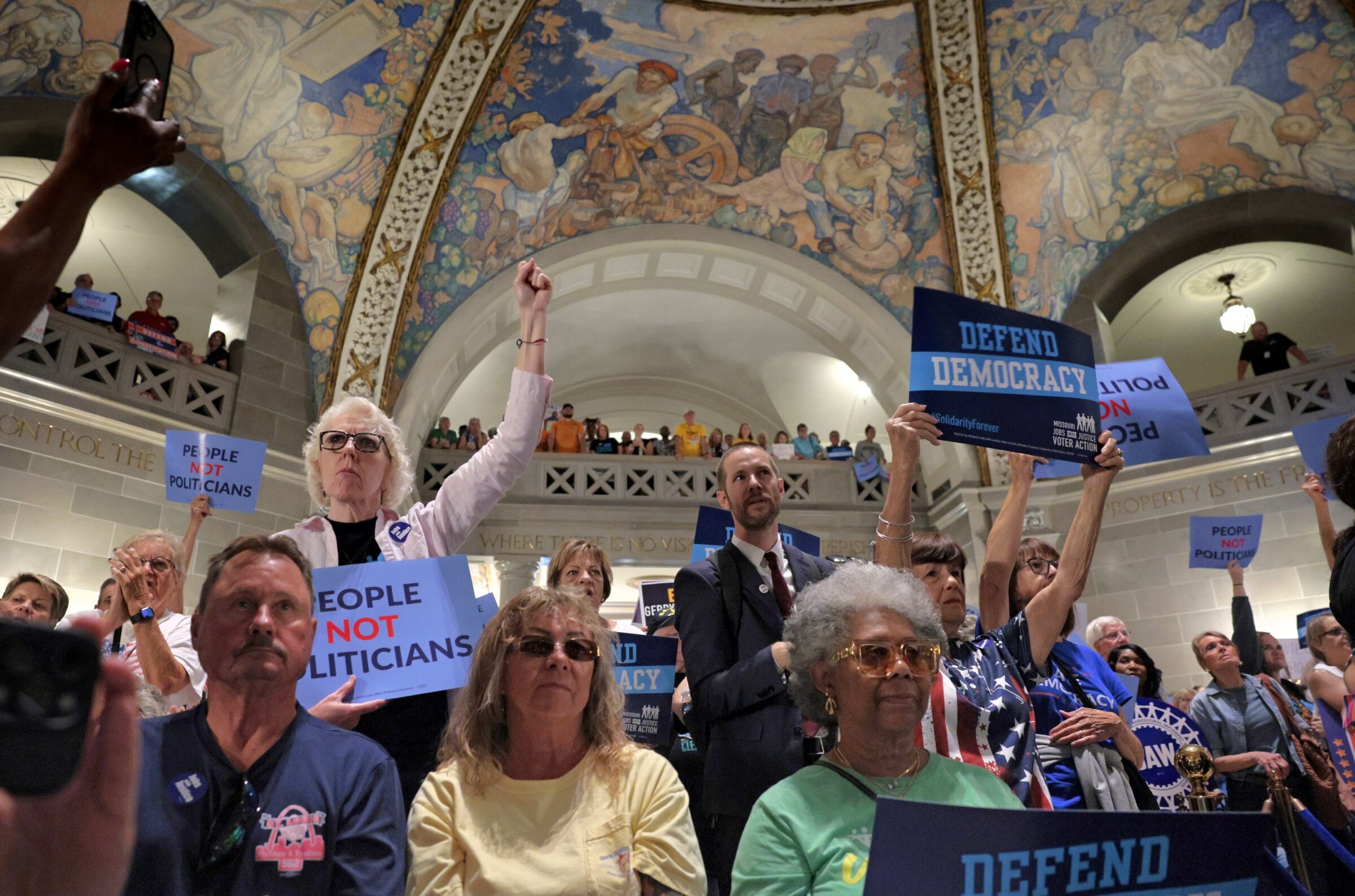
Republicans have dominated Missouri’s legislature for over two decades, but they haven’t entirely controlled state lawmaking, in large part because Missouri empowers citizens to petition for ballot referendums. Over the objections of the state’s conservative leaders, Missouri citizens since 2020 have launched successful petitions for ballot measures that saw voters legalize marijuana, raise the minimum wage, guarantee paid sick leave, expand Medicaid, and revoke the state’s abortion ban.
Angered by these citizen-led reforms, Republicans advanced a constitutional amendment last week that would effectively kill the initiative process.
The proposal, which will now go before voters for a statewide referendum in 2026, would drastically raise the threshold for a citizen-led initiative to pass. While all measures in the state currently require a majority vote statewide, the GOP proposal would require citizen-led initiatives to also win majorities in each of the state’s eight congressional districts.
Constitutional amendments placed on the ballot by legislators would be exempt from the new hurdle, and would still only require a statewide majority to pass.
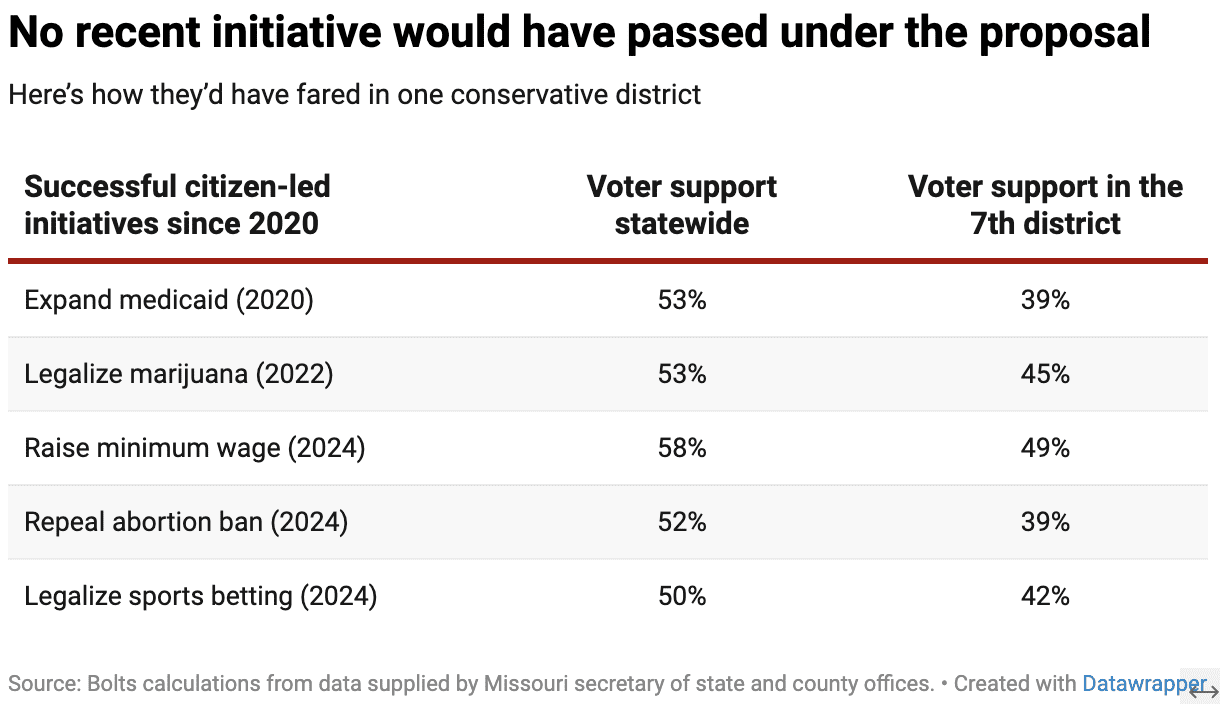
Under the proposed new rule for citizen-led ballot measures, all five popular initiatives that Missouri voters have approved since 2020 would have failed instead, a Bolts analysis found.
That even includes last year’s referendum on minimum wage and paid sick leave, which won by a resounding margin of 58 to 42 percent statewide. Still, it lost in Missouri’s seventh and eighth districts, staunchly conservative areas that gave President Trump more than 70 percent of the vote last year. The four other initiatives also lost in both of these congressional districts.
”For those who oppose change, they can concentrate all of their energy, all of their money, all of their messaging in a single district, and in that one district, they can cause the initiative to fail,” said Mallory Rusch, executive director of Empower Missouri, an advocacy group that worked to build support for the Medicaid and minimum wage initiatives. “I don’t see how that is a fair and just system for making important decisions as a state.”
Rusch says the new rules, which would be unique in the country, would spell the end of citizen petitions. “A lot of activists say that, if we want to do something via initiative, this might be our last year,” she said.
Faced with this ticking clock, some advocates are rushing to mount a last-ditch measure to protect direct democracy in the state.
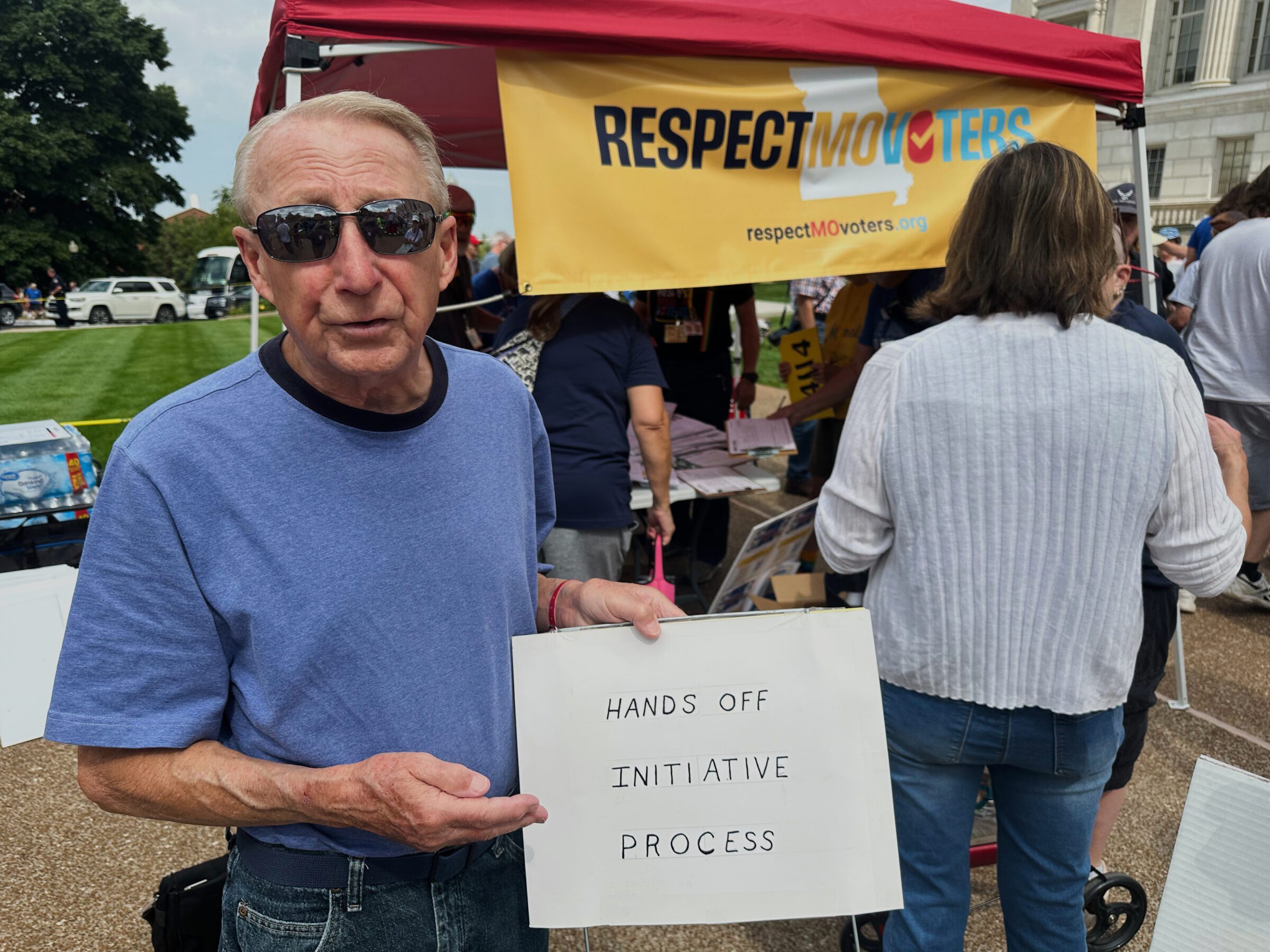
They’re organizing around an initiative, Respect Missouri Voters, to amend the state constitution with language that safeguards citizen initiatives and forestalls attempts to roll them back. If this coalition manages to gather the 170,000 signatures it needs by next May’s deadline for appearing on the 2026 general election ballot, their measure to protect citizen-led initiatives could appear alongside the GOP measure to effectively end them
Republicans advanced their proposal, called the Protect Missouri Voters Amendment, last week in a special session called by GOP Governor Mike Kehoe. The other priority for the session was a mid-decade redistricting plan, spurred by President Donald Trump, to help the Republican majority in Congress. Lawmakers last week also adopted a new congressional map that eliminated the Kansas City-based district held by Emanuel Cleaver, a Black Democrat, diluting the city’s voting power by splitting it into three districts dominated by Republican voters.
“It’s about suppressing our voices,” said Kansas City Mayor Quinton Lucas, who in recent years has faced other efforts by state politicians to override the will of his constituents.
This gerrymander followed Texas Republicans’ special session last month that drew a new map meant to flip five congressional seats toward the GOP. Republicans are also considering redistricting Florida and Indiana. In California, Democrats have asked voters to approve a gerrymander meant to counter Texas’ new map.
The GOP’s measure to curtail citizen initiatives adds to another nationwide conservative push aimed at shutting the door on direct democracy. This year alone, GOP-led states have piled on restrictions for citizen-initiated referendums in Arkansas, Florida, and Oklahoma. Those have focused on making it harder to qualify an item on the ballot and increasing the burden of collecting signatures, whereas Missouri’s proposal would make it harder for a measure to pass once it’s on the ballot.
No other state requires ballot measures to win a so-called concurrent majority, or majorities in multiple districts (let alone all of them) in addition to a statewide majority.
The measure passed the legislature on a largely party-line vote, with only eight GOP lawmakers joining Democrats in opposing it—including Speaker Jon Patterson and Republican Senator Lincoln Hough, who was subsequently removed as chair of the Senate Appropriations Committee.
Proponents say that requiring majority approval in all congressional districts ensures that referendums have “broad geographic support.” They’ve also been open that they think weaker support in rural areas should have been enough to kill the reforms that voters passed in recent years.
“Most of the recent Initiatives Petitions in the last 10 years have been controversial and partisan such as recreational marijuana, and abortion and Medicaid expansion,” the amendment’s sponsor, Republican Representative Ed Lewis, told Bolts in a written statement. “This ensures broad support and doesn’t provide a large hurdle for initiatives when enjoy broad support (sic).”
Lewis pointed out that voters in a liberal-leaning congressional district would be able to block a measure initiated by conservative citizens. “Only those non-partisan, issues with broad consensus would make it into the Constitution,” he said.
Republican politicians have dominated Missouri’s state government, controlling both legislative chambers since 2003 and enjoying a supermajority in each since 2012. They’re able to advance conservative priorities through regular legislation, and also by passing resolutions that place constitutional amendments on the statewide ballot.
Lewis said amendments that lawmakers put on the ballot shouldn’t be subjected to the higher threshold he wants for citizen-led initiatives because the legislative process already requires “rigorous vetting” in public hearings. Rusch denounced this as a “double standard.”
Lewis’ amendment, when it’s on the ballot in 2026, would also only require a simple majority to pass, rather than the concurrent majority it would require for future initiatives.
For Missouri advocates who have organized ballot initiatives in the past, Lewis’ proposal adds to a longstanding tactic of “brazenly reversing the will of the people” by rolling back citizen-led policies, says Benjamin Singer, co-founder of the Respect Missouri Voters campaign.
In 2018, Singer worked on a successful measure, overwhelmingly approved by voters, that established a bipartisan redistricting commission and banned lobbyists from making gifts to legislators over $5. But Missouri legislators put an item on the ballot two years later to repeal the redistricting reform. The repeal measure narrowly passed as part of a package of policies that Singer says was designed to be misleading by reaffirming a ban on lobbying gifts, and minimizing the details about eliminating the independent redistricting commission. “In the fine print, down below the ballot title, it said it would change redistricting,” Singer told Bolts.
Singer and other proponents of direct democracy are now worried that the GOP is using this exact same “ballot candy” tactic to persuade voters to adopt their crackdown on initiatives—focusing their messaging on small provisions to drown out their proposal’s most controversial aspect.
On the measure’s summary filed on the legislature’s website, the requirement of a new concurrent majority only comes up briefly in the fifth paragraph. It follows much longer explanations of other provisions, starting with a ban on campaigns receiving donations from “foreign adversaries” of the United States.
Kay Park, president of the League of Women Voters Missouri, points out that the constitutional amendment also contains provisions that are already law in Missouri. “They’re putting in a requirement that somebody has to be a registered voter in order to sign. Well, that is already the case!” she said. “These are tricks to get people to vote the way they want them to vote.”
Legislators this year have also worked to roll back two of the citizen measures approved last year—the ones on abortion and labor rights.
Republican lawmakers this spring were able to revoke the paid sick leave requirement with a simple majority vote because that initiative did not amend the constitution.
Caitlyn Adams, executive director of Missouri Jobs for Justice, a group that supported this 2024 initiative, accused lawmakers of ignoring Missourians’ “pro-worker” values, telling Bolts, “A lot of workers are no longer going to get paid sick days. They’re going to have to go to work sick, and they are going to have to lose out on money due to no fault of their own.”
In light of that rollback, Adams isn’t surprised by the latest attempt to crackdown on direct democracy, telling Bolts, “Politicians that are in charge right now actually want to be more disconnected from their voters. They want to be less accountable to the people that elect them.”
Since the abortion rights measure amended the constitution, lawmakers couldn’t simply repeal it on their own. So in May, they passed a resolution to put a repeal on the 2026 ballot. The ACLU of Missouri is now in an ongoing court battle over the language that will be shown to voters, which currently makes no mention of the abortion ban that would be enacted if it were to be approved; it focuses instead on other provisions such as a ban on gender-affirming care for minors.
Next year’s ballot is likely to be packed with even more high-stakes measures beyond the reinstatement of the abortion ban. Some groups have already launched an effort to block the redistricting plan that the GOP adopted last week by forcing a so-called veto referendum.
But for Park, the League of Women Voters president, the priority is to preserve the initiative process; as long as that’s available, she says, efforts on other issues will be possible in the future.
“If we can’t use the citizen-led initiative petition process, we’re done, we’re cooked,” she said. “We don’t even have the ability to do a petition to get the initiative petition process back.”
The proposal by the Respect Missouri Voters campaign that launched this month would allow citizens to challenge misleading ballot language in court and prohibit legislators from changing the rules to make it harder to gather signatures or ratify future proposals.
It would also make it a lot tougher for lawmakers to roll back citizen initiatives. Overturning a measure adopted by voters would require a supermajority of 80 percent of lawmakers, and even then any repeal measure would go on the ballot for voter approval.
“We can’t just sit back and keep playing defense, we have to go on offense,” said Singer. “We have to proactively lock in the people’s power to have a check on the government when it goes off the rails due to gerrymandering and money in politics.”
Sign up and stay up-to-date
Support us
Bolts is a non-profit newsroom that relies on donations, and it takes resources to produce this work. If you appreciate our value, become a monthly donor or make a contribution.
Related Posts