
Inside the Clunky Elections to Control Pennsylvania’s Supreme Court
The GOP is making an expensive push to end Democrats’ majority on a court at the center of election lawsuits, sparking a fledging campaign season with little precedent or template.
| October 7, 2025

With kids beaming on rides, adults losing money on carnival games, and the unmistakable smells of funnel cake and grilled meat swirling for blocks around, the annual street fair in the Lancaster County town of Ephrata, Pennsylvania, was hopping even on the muggy, overcast Thursday afternoon of Sept. 25.
The fair happened to fall on the same week ballots began trickling into Pennsylvania mailboxes. It’s an off-year, but hardly a non-event in this most crucial and populous of swing states: November’s election could end Democrats’ control of the state supreme court.
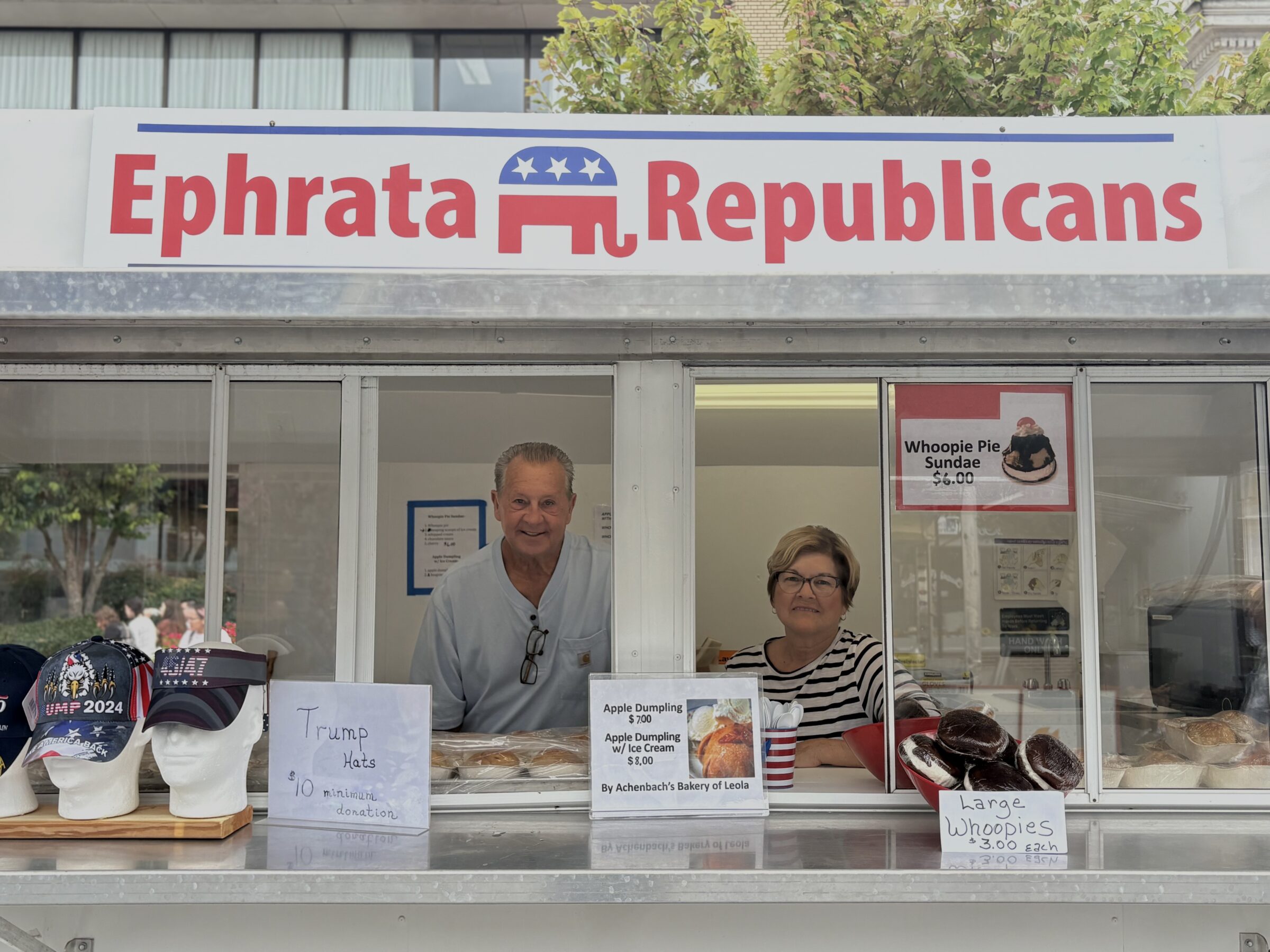
At the edge of all of the fair fun, on one of downtown Ephrata’s less busy blocks, the local Democratic and Republican parties were each on hand to greet voters. The Democrats gave away bumper stickers (“Protect Your Children Not Your Guns”; “Immigrants & Refugees Welcome”) and yard signs and campaign pamphlets. The Republicans sold Trump hats for ten dollars and apple dumplings for seven.
Staffing the GOP’s booth at the fair, Janice Brenaman, a committee member for her local party, said she cared very much about the supreme court elections. “We don’t want to have Democrats making choices we don’t agree with,” she said. “Their values are different from ours.”
But the Republican booth contained no signage or campaign materials mentioning this election. Brenaman herself said she didn’t know much about it beyond the topline. She said she’d like to talk more with voters about the court, but that the state party hadn’t done much to prime local volunteers to do so.
A hundred or so feet up the block, Brenaman’s counterpart in the Democratic tent, local party committee member Pam Way, pointed to a stack of flyers produced by the state party, urging voters to support Democratic judges: “We’ve been told to stress this, that this is important,” she said. She confessed she wasn’t sure how to speak to voters about it.
Voters seldom ask about court elections, said Way, who has worked this fair for years. That’s held true so far this cycle.
Still, the stakes next month are high: Three Democratic justices—Christine Donohue, Kevin Dougherty, and David Wecht—are up for retention, meaning voters will decide, in a simple yes-or-no vote, whether or not to keep them on the bench. Republicans are mounting an unusual effort to oust them and deprive Democrats of the court majority they’ve enjoyed for the last decade.
Whether that effort succeeds depends on the right’s ability to shake up a firm status quo—only one state judge has ever lost a retention election in Pennsylvania—by motivating people like those walking the fair in Ephrata. Bolts interviewed more than a dozen voters there, mostly Republicans. Only two of them were even vaguely aware of these supreme court elections, and neither knew the justices’ names or party affiliations. Several said they weren’t planning to vote at all in this off-year election.
“People have no idea,” Way said. “Even informed voters—they just don’t know.”
In a sense, the GOP’s mission is straightforward: If voters remove Donohue, Dougherty, and Wecht, the current 5-2 Democratic majority would fall to a 2-2 tie. Republicans would then have a shot at winning an outright majority in the 2027 cycle, in time for the 2028 presidential election.
But in practice, this is a tall order.
Because these three judges are up for retention, they have no opponents. Pennsylvania voters will see the justices’ names on the ballot and face a choice for each: retain or fire. The state lists no partisan markers on retention ballots, even though justices are initially elected in partisan races.
Presented with such a choice, voters tend to overwhelmingly favor retention, treating it as the default option, which puts a heavy burden on the opposition. It’s been 20 years since any Pennsylvania state judge has even come within 22 percentage points of defeat.
And even if the justices are ousted in November, Republicans wouldn’t just take over the seats. The 2-2 tie that would result could become a prolonged stalemate that keeps the seats vacant through the fall of 2027, the next cycle with judicial elections.
That’s because any replacements for ousted justices would need to be nominated by the state’s Democratic governor, Josh Shapiro, and then approved by a supermajority in the Republican-controlled state Senate. The last time a vacancy arose, when a justice died in September of 2022, the seat just remained empty until voters chose a replacement in the November 2023 election; several Pennsylvania politicos told Bolts they expect the same thing would happen now.
Still, any seats vacated this year would go up for a regular election in 2027, which could hand the GOP a new, clear path to flipping the court that year. Without some success this year, and barring unexpected departures from the court, Republicans have virtually no path to a majority until 2029 at the earliest.
Want updates on state courts?
Sign up for our newsletter.
Democrats have run this court ever since Donohue, Dougherty, and Wecht were all elected in a 2015 wave that flipped the court blue for the first time in a decade. The flip proved hugely consequential; the new majority struck down a GOP gerrymander, which helped Democrats gain in the 2018 midterms.
The majority also upheld Act 77, a state law allowing mail-in voting, and just last week it issued a decision that should ensure many ballots at risk of being tossed will in fact be counted. This court also rejected Trump’s repeated attempts to overturn his loss in the 2020 presidential election.
These election cases have angered Republicans, and they’re eager to take back the majority before the next presidential race, which is sure to generate more election lawsuits. The stakes are not lost on various powerful forces now throwing big money at this election. Conservative billionaire Jeff Yass, the richest man in Pennsylvania, is helping fund a series of eye-catching, misleading mailers calling on voters to reject the justices. The national Republican State Leadership Committee has poured in cash, and its counterpart, the Democratic Legislative Campaign Committee, has responded in kind.
The Philadelphia Inquirer has tallied more than $7 million total this cycle—with much more doubtless to come by Election Day. It’s already one of the most expensive retention elections in U.S. history, and some experts in judicial spending think it may end up breaking the national record.
But all this money must contend with longstanding precedent. Pennsylvania adopted its nonpartisan retention system in 1968 with an explicit goal to insulate judges from political pressure, though critics warned it could keep judges in power endlessly and reduce accountability. The one state judge who has lost retention in Pennsylvania since then—Justice Russell Nigro, in 2005—faced unusual crosspartisan anger and a controversy entirely unlike anything that’s happening this year.
With no 2005-esque air of scandal, and with these justices having little name ID around the state, many Pennsylvanians are grasping for how to approach a campaign that has no recent parallel.
The justices themselves are having to adapt to a challenge neither they nor their peers in this state have had to face for decades: how to run a political campaign while insisting that you’re not a politician and in the absence of any opposing candidate.
That was on display a few hours after Brenaman and Way wrapped their shifts at the Ephrata Fair, as Dougherty arrived at a campaign stop inside a church in Philadelphia’s upscale Chestnut Hill neighborhood. He’d just gotten word of a tweet by the Pennsylvania GOP: “President Trump Urges PA Voters to Vote NO on Retention,” it read, linking to a Republican National Committee website that argued voters should oppose retention in order to support Trump and his mission.
“Good for us,” Dougherty said to the crowd. “Now we have a boogeyman.”
Later, he told Bolts that he’s been unsure at times of how to market himself. “We’ve been fighting this invisible force that said, ‘vote no,’” Dougherty said—hence his gratitude for the RNC giving him a reason to invoke Trump.
But he also told Bolts that running what may look like a standard election campaign makes him feel dirty. “I find it embarrassing that sitting judges and justices need to resort to politics,” he said.
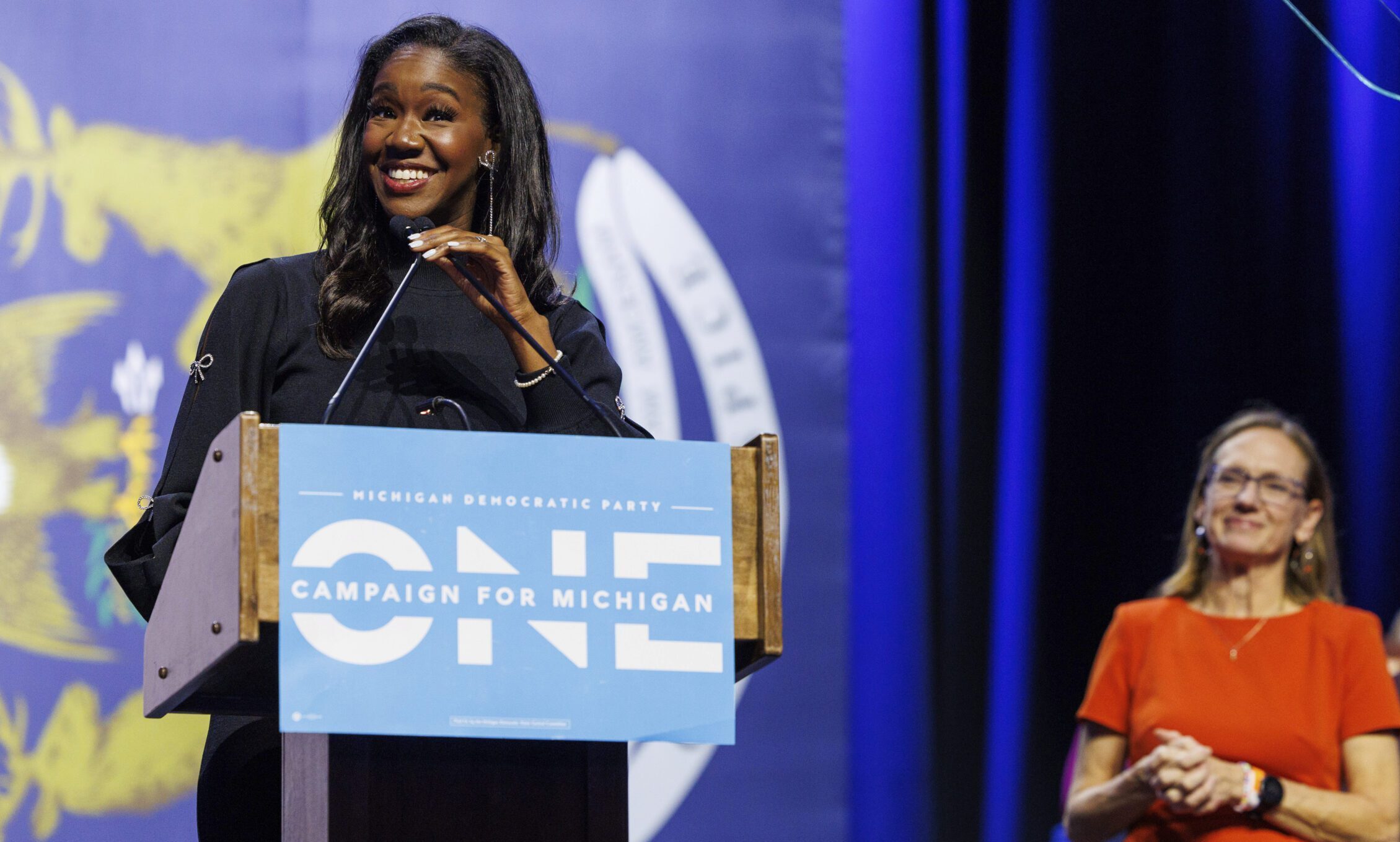
That’s not stopping him from appealing to partisan allegiances. “If Philadelphia doesn’t come out, we lose,” Dougherty told Democratic organizers at the Chestnut Hill stop, his fourth campaign event of that day. “All the MAGA, all the hate, all of them—and all the money—cannot beat the numbers of Philadelphia.”
The last time Pennsylvania justices stood for retention, in 2017, Democrat Debra Todd and Republican Thomas Saylor were both on the ballot and they both cruised, with 71 and 68 percent of the vote, respectively.
Todd hired staff and ran TV ads, and spent more than $600,000. Saylor spent four times less, running a much more limited campaign and no TV ads. When Election Day came and the justices won by similarly huge margins, “it told us that people had some faith in the judiciary,” Dan Fee, a political consultant who ran Todd’s campaign that year, told Bolts. “But it also told us that people just weren’t paying that much attention.”
The 19 states that use retention elections for their supreme courts have had experiences similar to Pennsylvania’s, with justices having been ousted only in extraordinarily rare circumstances involving scandals or uncommonly high-profile rulings. Three judges were ousted from the Iowa Supreme Court in 2010, for instance, following that court’s decision to overturn a ban on same-sex marriage.
In 2024, some progressives pointed to rulings against abortion rights in Arizona and Florida to campaign against retention in those states, though neither effort came close to succeeding. But Oklahoma conservatives, angered that their state supreme court had issued narrow protections for abortion, convinced voters to oust a Democratic-appointed justice. The loss made her the first justice in Oklahoma history to lose retention.
Pennsylvania retention opponents this year hope for a similar upset—but they don’t seem to have a coherent pitch.
The Republican State Legislative Committee, which has spent more than half a million dollars this year in Pennsylvania, put up a website, NoInNovember.com, which calls on people to vote against retention, but which offers no information about why the judges should not be retained. Instead, it largely focuses on instructing people on how to vote, and encourages them to request absentee ballots. (“There’s a real push on to get Republicans to vote by mail,” Donohue said at a recent campaign event in Pittsburgh, noting the irony given President Trump’s wrath against mail ballots. “Isn’t that funny?”)
Mason Di Palma, a spokesperson for the RSLC, declined to make anyone with the organization available for an interview. He sent Bolts a statement that read, in part, “These three liberal justices have spent years advancing the left’s agenda from the bench, and their defeat would spur a seismic momentum shift in Pennsylvania that would create an opening for more conservative policy victories in the state.”
A group largely funded by Yass, the Pennsylvania megadonor, has an anti-retention site of its own, CitizensForTermLimits.net; as of publication, it also states no case for why people should vote against retention. This group has sent out mailers with a variety of misleading messages; one of them suggests that this court bears responsibility for partisan gerrymandering, even though the justices standing for retention all voted against Pennsylvania’s previous gerrymander.
Other mailers urge voters to oppose retention in order to “defend our democracy” and to “protect women and children”—the latter argument referring to several cases, including the court’s ruling four years ago to free Bill Cosby. (That ruling, which cut across party lines, was complex, with the court ordering Cosby’s release on a 6-1 vote on the grounds that prosecutors had violated his due process rights.) The group behind these mailers, Commonwealth Partners, did not respond to an interview request from Bolts.
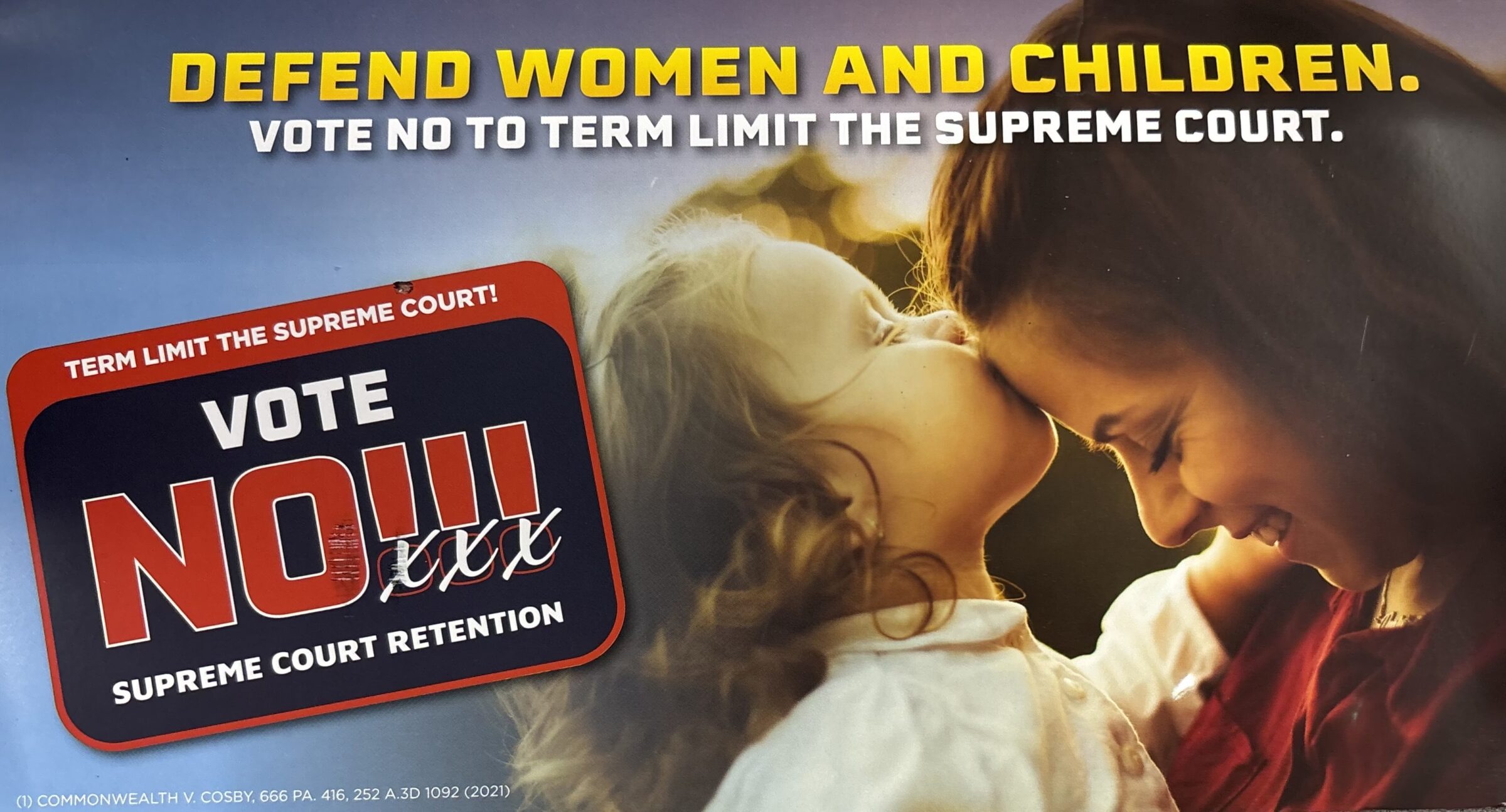
The Democratic Party has responded with mailers that stress the judges’ support for abortion rights, balanced electoral maps, and education funding.
On the campaign trail, the justices have emphasized, above any other policy matter, the likely upshot for voting rights should they lose in November. “My court is the backstop of democracy,” Dougherty boasted in Chestnut Hill.
The justices are touting their 2022 decision to uphold mail-in voting, and their 2018 ruling against a GOP gerrymander that had handed Republicans 13 out of 18 U.S. House seats in Pennsylvania. Donohue, Dougherty, and Wecht all supported a court-drawn map that resulted in a 9-9 split. “It was a flamboyantly and really outrageously gerrymandered map,” Wecht told Bolts.
Speculating on Republican motivations, Dougherty said at his Chestnut Hill event that he expects the court to continue playing a major role in election law: “The theory is that we have to deal with a congressional election in 2026, and there’s preparation regarding gerrymandering for the next presidential election—should there be one.”
Campaigning in Pittsburgh, Donohue warned that if the justices are not retained this year, challenges to election results and procedures would likely result in 2-2 splits on the supreme court for the next two years. In the event of any such tie, the most recent lower-court ruling would stand. This would hand enormous new power to the GOP-held Commonwealth Court—a body that just three years ago sought to strike down Pennsylvania’s mail-in voting law, before being overruled by the supreme Court.
“To not have a fully functional supreme court during the 2026 midterms elections is chaos. It is totally chaos,” she said.
On the ground in Lancaster County, Brenaman and Way said that little about this year’s supreme court elections is clicking with voters, despite all the money and the ads and the campaign events. “With judges, it’s really hard to learn,” Brenaman said. Neither she nor Way knew the names of the justices up for retention.
Both also said they always vote to retain judges unless they’ve been made aware of a major reason not to—and they almost never have been. Many other fairgoers told Bolts they side with retention because they aren’t familiar with individual judges and generally want to trust the judiciary.
“You just see a name on the ballot and you don’t know who the guy is,” said one Republican fairgoer, Les Fasnacht. In this or any other year, he said, judicial retention “is something you vote on and don’t think about—and then you don’t hear the names again.”

Said fairgoer Dave Hershey, a Democrat, “People should start caring about everything because our democracy is about to be destroyed. But I don’t think the public has a lot of understanding about what the courts do.”
Several voters at the Ephrata Fair said they leave retention elections blank on their ballots because they do not know anything about the judges up for election. This is common in Pennsylvania, where retention always inspires major undervoting: Consistently, hundreds of thousands of people who vote in years when retention is on the ballot leave the retention section blank.
Dougherty himself told Bolts that as a young man he used to have no idea how to vote when he’d get to the retention section of his ballot. “I’d ask my parents,” he said.
But Aliza Shatzman, a Pennsylvanian who founded the national Legal Accountability Project to root out corruption and misconduct in courts, believes this cycle heralds a new era of attention and money in retention races.
“I think we should expect to see this going forward,” she said. “I think every election, including retention elections, we’ll see a huge influx of spending and politicking. And we’re going to have to do this again in a couple years.”
The 2027 cycle is already sure to feature multiple important court contests, no matter what happens this fall. Donohue will turn 75 and face mandatory retirement by that year, and two other justices—Democrat Debra Todd and Republican Sallie Mundy—are set to stand for retention that year.
Should all three justices be retained this year, the GOP’s best-case scenario in 2027 would be to force a 3-3 tie, with a vacant seat that’d only be filled in the event of gubernatorial appointment and confirmation by a two-thirds supermajority of the state Senate. (Shapiro is up for re-election next year, and, should he lose, any such appointment would be made by his successor.) The GOP can change this math if it manages to oust Dougherty or Wecht this year, adding their seats to the mix; ousting Donohue alone would do less for the GOP, as she’s set to leave the court by 2027 in any event.
Looking ahead to future cycles, Wecht said he does see some benefit in retention elections having a raised profile.
“I’d welcome more public access, more public exposure to these races and all their features—anything that would enhance public understanding and comprehension and information about these races and the people who run in them,” he said.
Wecht continued, “I would like to think that the heightened spending would signal or hold out promise that people would learn more about their courts and the people who serve on those courts. I don’t know that this election or any one judicial retention election could bring these kinds of elections up to a level of appeal or sexiness.”
Dougherty hopes not. He told Bolts, “My attitude is that judicial elections should not be sexy.”
Sign up and stay up-to-date
Get timely updates about pressing stories and elections.
Support us
Bolts is a non-profit newsroom that relies on donations, and it takes resources to produce this work. If you appreciate our value, become a monthly donor or make a contribution.
Related Posts