
Your State-by-State Guide to the 2026 Supreme Court Elections
Abortion, redistricting, and ballot access remain heated issues as voters face dozens of supreme court races across 32 states this year.
| April 20, 2026
When the supreme court in Wyoming struck down an abortion ban in January, it cited a state constitutional amendment adopted in 2012 that affirmed a right for people to make their own health care choices. The measure was championed by conservatives to target the Affordable Care Act. But progressive lawyers, in an unlikely reversal, turned it into a weapon in their efforts to protect access to abortion.
The ruling was just the latest in a string of high-profile decisions in state courts that have either protected or undermined reproductive rights since the U.S. Supreme Court ended federal protections for abortion in 2022.
This year, many of the judges who have taken part in those decisions will be on the ballot. One of the justices who struck down Wyoming’s ban is up for reelection this year; so are justices who sided with proponents of abortion rights in Kansas, Missouri, and New Mexico.
Justices who upheld restrictions on abortion and reproductive rights are up in Alabama, Arizona, Florida, Georgia, North Dakota, Oklahoma, and Texas.
The results may affect future abortion cases. They’re also sure to shape a vast array of other issues that routinely come up in state supreme courts, from ballot access and redistricting to sentencing and labor rights. Just last year, Michigan’s Democratic majority further restricted life without parole sentences; Florida’s supreme court, whose members were nearly all chosen by GOP Governor Ron DeSantis, blessed the congressional gerrymander he championed.
All in all, 32 states are holding supreme court elections in 2026. These races will decide over 60 seats.
Two states already resolved their contests—conservatives won in Arkansas, and liberals in Wisconsin. But plenty of major showdowns remain, with Alabama, Georgia, Kansas, Michigan, Montana, North Carolina, Ohio, and Texas standing out at this juncture as having the clearest ideological or partisan stakes.
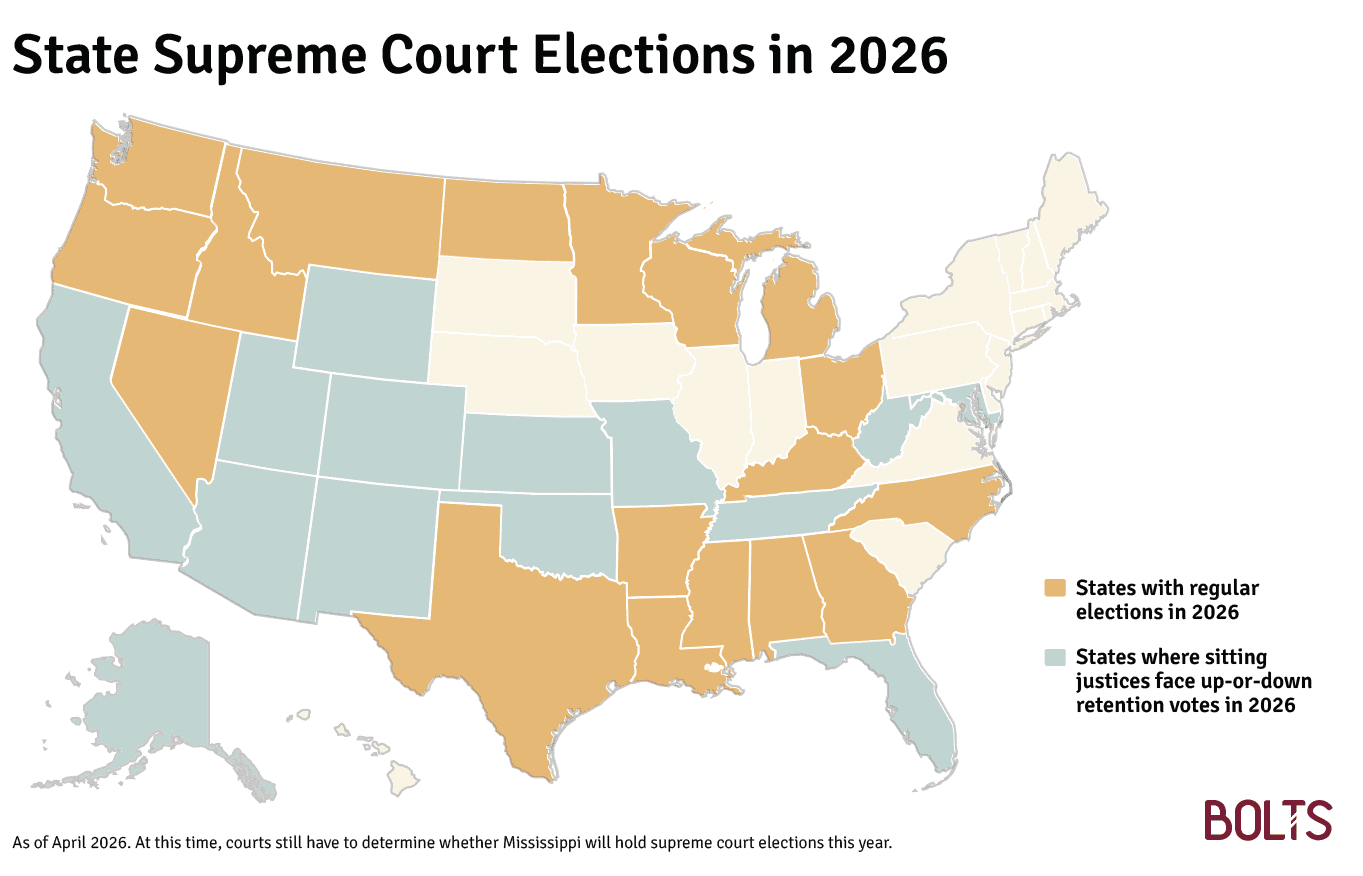
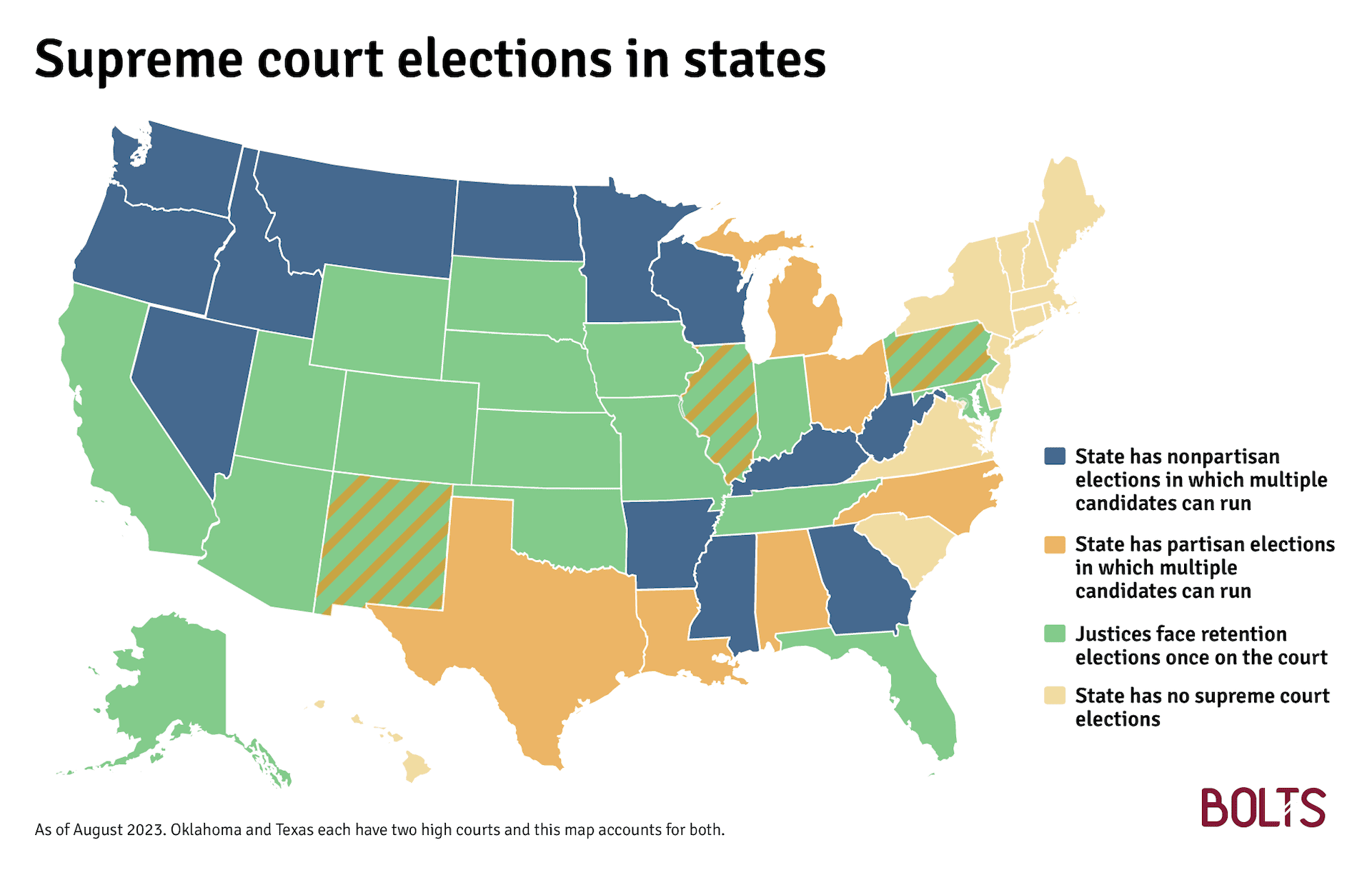
Nineteen states are holding regular elections for their supreme courts this year, meaning races where candidates can challenge incumbent judges or run for an open seat. How those work is straightforward; think of what you’re used to seeing for Congress or governor.
But 13 states are holding retention elections, which are simple up-or-down votes, with no challengers, where voters decide if a judge who is already on the court should stay in office. (Explore these rules in our state-by-state guide to each state’s high court.)
Plus, some states allow candidates to affiliate with a party. Others hold nonpartisan elections, though in many such states parties and advocacy organizations still get involved.
This year, liberals or Democrats are aiming to retain their large advantage in Michigan and gain a foothold in Georgia and Texas. A wave of retirements could affect the Washington court’s recent history as one of the more left-leaning in the country, though conservatives are unlikely to gain major ground.
Conservatives or Republicans, meanwhile, have an opportunity to erase the liberal lean of Montana’s supreme court, and extend their dominance in North Carolina and Ohio.
In the red states of Kansas, Missouri, and Wyoming, justices who have sided with more liberal outcomes in major recent cases are all up for retention. Conservatives managed to oust a Democratic-appointed justice in Oklahoma two years ago for the first time in the state’s history, though it appears unlikely that the state will see similar agitation this year.
Progressive efforts to oust justices who upheld abortion bans faltered in Arizona and Florida two years ago; this year, more justices who held that position are up for retention in those states. And in Minnesota, justices with experience as public defenders are up for reelection.
Only in Montana and Washington could there be an outright partisan or ideological flip this year; in Washington, that’s because a majority of the court is on the ballot all at once. But the results in other states will also shape cases and they’ll affect whether the political parties have a path to taking control of a court in future cycles. Below, explore the stakes in each of the 32 states with supreme court races this year.
Sign up for our newsletter
For more on state courts
Alabama
This state holds regular elections.
AshLeigh Dunham, an attorney at a law firm that helps people interested in assisted reproduction, is challenging Justice Greg Shaw.
Shaw, a Republican, joined a blockbuster state supreme court ruling in 2024 that held that frozen embryos are children, which endangered IVF treatments and led fertility clinics to shut down. Dunham says that she herself has conceived a child through IVF, and that her anger at the court’s 2024 ruling led her to want to challenge Shaw.
“The court has made some anti-family rulings that are wildly out of touch with the people of Alabama,” she told a local TV channel.
She is running as a Democrat and will face Shaw in November. Republicans are heavily favored in general elections in Alabama, though Democrats are hoping to make inroads this year with the gubernatorial candidacy of former U.S. Senator Doug Jones. Another Republican justice who sided with the majority in that 2024 ruling, Brad Mendheim, is running unopposed.
Alaska
This state holds retention elections, meaning incumbents face an up-or-down vote.
Justice Jude Pate, nominated by Republican Governor Mike Dunleavy in 2023, faces voters for the first time in a retention election. (No Alaska justice has lost retention since 1962.)
The court will soon issue several decisions related to abortion and that will put Pate on the record on contentious debates. In October, the court heard a case in which Planned Parenthood is hoping to allow a wider range of medical professionals to perform an abortion. In March, the court heard another case that may restrict conservative lawmakers’ ability to limit abortion access via budgetary maneuvers.
Arizona
This state holds retention elections, meaning incumbents face an up-or-down vote.
The headline in Arizona is that any judicial election is even happening. In 2024, Republicans proposed doing away with these elections and giving sitting justices lifetime tenure, but voters rejected the idea by a wide margin.
But on the same day, voters also retained two conservative justices who had just voted to uphold Arizona’s 19th-century abortion ban. While Arizona justices have historically easily won retention, progressives had hoped to draw attention to the justices’ abortion ruling but they were massively outspent.
This year, Justice John Lopez IV, a 2019 appointee of former Republican Governor Doug Ducey, is up for retention.
Lopez wrote the majority opinion in the 2024 case that outlawed nearly all abortions, writing, “Physicians are now on notice that all abortions, except those necessary to save a woman’s life, are illegal.” (Republican lawmakers later passed a law to loosen the ban.)
Arkansas
This state holds regular elections, but note that the 2026 races already took place in March.
Conservatives solidified their hold on this court in March, when Justices Nick Bronni and Cody Hiland won the state’s two elections.
Bronni and Hiland were both appointed in late 2024 by Governor Sarah Huckabee Sanders, a Republican who said she wished to “cement” a conservative majority. The Arkansas constitution bans appointed justices from running to keep their own seats, but Bronni and Hiland traded spots as a way to work around that prohibition, as Bolts reported earlier this year. And legislators passed a law to make it even easier for Bronni and Hiland to reap the benefits of incumbency.
Bronni beat John Adams, his challenger, 55 to 45 percent. Hiland did not draw any challenger.
California
This state holds retention elections, meaning incumbents face an up-or-down vote.
Justices Joshua Groban and Kelli Evans, who are appointees of Democratic Governors Jerry Brown and Gavin Newsom, respectively, are each up for retention.
Despite a now-distant history of Californians ousting justices, recent retention elections have rarely proved contentious. Over the last three midterm cycles, all justices have received at least two-thirds of the vote.
Still, it’s worth noting that the two justices split on a major criminal justice case in 2024. When the California Supreme Court upheld the practice of sentencing young adults to life without parole, unlike other states’ high courts, Evans dissented from that ruling.
Colorado
This state holds retention elections, meaning incumbents face an up-or-down vote.
William Hood, an appointee of Democratic Governor John Hickenlooper, has been on the court for over a decade. This year, he is facing voters for a second time; the last time he was on the ballot, in 2016, he was retained with more than 70 percent of the vote.
In 2023, Hood was part of the 4-3 majority that removed Donald Trump from the ballot. (The U.S. Supreme later reversed the decision.) The justices who issued that decision then suffered ongoing threats and harassment, but the ruling had little impact on how people voted in the next judicial elections: In 2024, three justices prevailed with similar shares of the vote whether or not they’d sided with the majority or dissenters in that case. There’s no organized opposition so far that would suggest 2026 may turn out any different.
Florida
This state holds retention elections, meaning incumbents face an up-or-down vote.
No judge has ever lost a retention election in Florida history. Even in 2024, when two justices faced voters after ruling to uphold the state’s abortion ban, they prevailed with more than 60 percent of the vote.
Voters this year will weigh in on Chief Justice Carlos Muñiz, who was appointed to the bench by Republican Governor Ron DeSantis in 2022. Since then, Muñiz has blessed many of DeSantis’ priorities. He voted to reverse precedents of this court by upholding Florida’s six-week abortion ban, and upholding a law that allowed nonunanimous juries to sentence someone to death. He also voted not to strike down the GOP’s congressional gerrymander despite a constitutional amendment approved by voters that imposed fairness criteria.
Georgia
This state holds regular elections. Note that they are on the ballot in May, rather than November.
Georgia’s elections have very rarely been contested this decade. One reason is that some challengers have been spooked from running by a bizarre loophole that lets state officials cancel elections even once candidates are already running.
But in February, progressive lawyers Jen Jordan and Miracle Rankin jointly launched last-minute bids against Justices Charlie Bethel and Sarah Warren, who are both appointees of former Republican Governor Nathan Deal.
The challengers don’t have much time to make their case: These elections are taking place in May rather than in November.
Jordan, a former Democratic state senator, is challenging Warren, who worked as the state’s solicitor general under a Republican attorney general. Rankin, a former president of the Georgia Association of Black Women Attorneys, is challenging Bethel, who is a former Republican state senator.
Jordan and Rankin say they’re worried about the erosion of civil and constitutional rights in Georgia, and the Georgia Recorder reports that their launch event featured state advocates who are working to promote voting rights and abortion access.
The incumbents, Bethel and Warren, were both part of the court’s 6-1 majority in 2023 that reversed a lower-court ruling and upheld the state’s six-week abortion ban. On democracy cases, Bethel and Warren were both part of last year’s unanimous ruling that mostly reversed the rules adopted by MAGA members of the state’s election board, a decision greeted with relief by voting rights advocates; but they were also both part of the 5-3 decision in November 2024, amid the presidential race, that refused relief for voters who’d received their mail ballots late.
A third justice is also on the ballot in May: Ben Land, who was appointed to the court last summer by Republican Governor Brian Kemp. Land did not draw a challenger and is sure to remain on the court.
Update: The two incumbent justices, Bethel and Warren, prevailed on May 19.
Idaho
This state holds regular elections.
Two justices are running to stay on the court, and no one filed to challenge either of them by the deadline. This extends a remarkable streak: All Idaho supreme court races have been uncontested since 2018.
That means Cynthia Meyer, who was appointed by Republican Governor Brad Little in 2023, and Gregory Moeller, who was appointed in 2019 by Republican Governor Butch Otter, are sure to stay on the court.
Moeller wrote the majority ruling in an important 2021 case that struck down a GOP law restricting direct democracy. But in another democracy case three years later, Moeller and Meyer both voted to uphold new restrictions on ballot access passed by the GOP-led legislature.
Kansas
This state holds retention elections, meaning incumbents face an up-or-down vote.
Kansas conservatives have long wanted to secure a more right-wing supreme court, especially since a momentous 2019 decision protecting abortion access. They also tried and failed to overturn that decision via referendum in 2022, and they made no inroads at persuading voters to oust the justices who took part in that decision, all of whom have easily won their retention races since then.
This year, conservatives’ strategy for transforming the court is a measure on the August ballot that would end the state’s current system, in which judges only face voters once they’ve been chosen by the governor in an up-or-down vote, and replace it with regular partisan elections. That would likely hand an advantage to GOP candidates in this red-leaning state.
But the results of that measure won’t affect this year’s elections, so two justices will face a retention vote in November.
The first justice up for retention, Larkin Walsh, was just appointed by Democratic Governor Laura Kelly last summer. She was a longtime private attorney and has yet to tip her hand on major decisions.
The second justice, Eric Rosen, has been on the court for much longer. An appointee of former Democratic Governor Kathleen Sebelius, he sided with the majority in 2019 to protect abortion access.
He has also sided with the more liberal outcome in several high-profile election law cases. He wrote the dissent when a narrow majority held that the Kansas constitution does not protect a fundamental right to vote; he also wrote the dissent in the 2022 case that upheld the GOP’s congressional gerrymander, calling it a “subversion of the democratic process.”
Conservatives tried to oust Rosen in 2014 over his vote to overturn two death sentences, and Rosen barely survived. But the last time Rosen was on the ballot, in 2020, he coasted with nearly 70 percent of the vote. It remains to be seen whether conservatives mount an organized effort against him this fall.
Update: The August ballot measure failed by a large margin, a blow to conservative ambitions. Rosen and Walsh are still up for retention in November.
Kentucky
This state holds regular elections.
No one filed to challenge Debra Hembree Lambert, a conservative justice who represents the state’s deeply-Republican third judicial district. She is sure to secure a new eight-year term.
Lambert’s seat is the only one on the ballot this year, so there will be no change on the court through the polls this year.
Still, the court is facing a lot of pressure right now. GOP lawmakers have initiated impeachment proceedings against Justice Pamela Goodwine, who won a seat in 2024 with Democratic support and became the first Black woman to serve on the court. Once Goodwine joined, the court then reversed itself in a high-profile case and struck down a law that Republicans had passed to target Louisville schools. The GOP says Goodwine should have recused herself because of campaign support she received from a teacher’s union, and now wants to punish her—a tactic they’ve used in other states to gain power on state supreme courts.
Louisiana
This state holds regular elections.
Louisiana’s first judicial district, which includes the staunchly conservative St. Tammany Parish and its surroundings, is sure to elect a new justice. William Crain was nominated to the federal bench by Donald Trump, and he left his seat on the state supreme court in December.
No Democrat filed for the seat, so Crain’s replacement will be decided in a May GOP primary featuring two lower-court judges, Blair Downing Edwards and William Burris. Both candidates call themselves conservative, though the Louisiana Illuminator flags that major conservative business groups rallied around Burris when he entered the race. Edwards is the sister-in-law of former Democratic Governor Jon Bel Edwards.
This is the first cycle with party primaries for a supreme court race. In the past, all candidates appeared on one single ballot that all voters could weigh in on; now, voters registered with a party will decide its nominees prior to a general election. The change was sparked by a 2024 GOP law, and it will keep the region’s Democratic residents from helping make the choice between Burris and Edwards.
Two other justices, Republicans Cade Cole and Jay McCallum, are running unopposed.
Maryland
This state holds retention elections, meaning incumbents face an up-or-down vote.
Peter Killough was nominated in 2024 by Democratic Governor Wes Moore, and that makes him one of just two sitting Maryland justices who wasn’t chosen by Republican Governor Larry Hogan. Now he must face voters for the first time in a retention election.
Judicial elections in Maryland are particularly uncompetitive. The supreme court’s six other members have all won their last retention race with at least 75 percent of the vote. There’s no sign that a different dynamic is at play this year. The state Senate confirmed Killough near unanimously, even though, as a local judge, he faced critics who said he was not punitive enough toward young defendants. The court has issued no blockbuster rulings since he was appointed.
Michigan
This state holds regular elections.
The GOP hoped to flip this swing state’s supreme court in both 2022 and 2024. Democrats built a mighty 6-1 majority instead. This means they cannot lose control this year even if the GOP wins and flips both of the seats on the ballot.
Two Democratic justices will be on the ballot: Megan Cavanagh, who has been on the court since 2019, and Noah Hood, who was appointed by Governor Gretchen Whitmer just last year. Cavanagh joined the party-line majority last year in a major ruling that struck down life without parole sentences for some young adults; she’s also repeatedly voted to safeguard popular initiatives from the encroachment of lawmakers and other state officials. (Hood has yet to take part in major rulings.)
At a party convention in late March, Republicans nominated two lower court judges, Michael Warren and Casandra Morse-Bills, to face Cavanagh and Hood. Party labels don’t appear on the general election ballot in Michigan, even though the candidates are selected by the parties.
Minnesota
This state holds regular elections.
Governor Tim Walz did something very unusual in 2024: He appointed two justices with extensive experience as public defenders. Progressives have long complained about the lack of public defenders on the bench, but Walz has helped Minnesota stand out as an exception.
One of those two Walz appointees, Sarah Hennesy, is facing voters this year, as is Justice Paul Thissen, a 2018 appointee of Democratic Governor Mark Dayton who is also a former public defender.
No one filed to challenge either Hennesy and Thissen by the June filing deadline; both are now virtually guaranteed to earn a new term.
The second of those two Walz appointees, Theodora Gaïtas, was also meant to face voters this year. But that changed in May, when Walz appointed Gaïtas to the vacant chief justice seat; Walz also appointed lower-court judge Reynaldo Aligada Jr. to replace Gaïtas as an associate justice. Minnesota law says an interim justice should serve at least one year before facing voters, so this game of musical chairs has effectively canceled the 2026 election for Gaïtas’ associate justice seat. To stay on the court, Gaïtas and Aligada Jr. will have to run in 2028.
This section on Minnesota was updated in June, after the filling deadline passed.
Mississippi
This state holds regular elections.
Will Mississippi even have supreme court elections this year? That likely hinges on Callais v. Louisiana, a pending U.S. Supreme Court case that could gut the federal Voting Rights Act.
As Bolts and The Marshall Project reported in February, a federal judge ruled last year that the districts that Mississippi uses to elect its supreme court justices are racially discriminatory and violate the VRA; the judge hinted she may end up ordering special elections in the fall of 2026 under a new map. But GOP lawmakers have dragged their feet on drawing new districts in hope that a conservative win in Callais brings them relief. The standoff is unresolved as of publication, and Bolts will update this item once it’s clear whether there will be contests and in what districts.
Update: The Supreme Court’s decision to gut the VRA in the spring of 2026 effectively erased the victory that Black plaintiffs had enjoyed in this state, and canceled the prospect of supreme court elections this year, as Bolts and the Marshall Project reported in June.
Missouri
This state holds retention elections, meaning incumbents face an up-or-down vote.
Justice Paul Wilson, a 2012 appointee of Democratic Governor Jay Nixon, is running for retention.
In a series of recent cases, Wilson has sided with the court’s more liberal faction. In March, he wrote the dissent when the court said Missouri Republicans acted legally when they drew new congressional districts mid-decade. Wilson argued this could only be done once a decade.
In 2024, he authored the majority opinion when the court decided, on a 4-3 vote, that a ballot measure protecting abortion rights should be placed on the ballot. He also wrote a 2024 ruling that struck down a state constitutional amendment that had required Kansas City to spend more money on police; state Republicans responded by passing a redo amendment. And in 2025, he dissented from a court ruling that denied a transgender student’s claims of discrimination.
Wilson easily secured retention the last time he was on the ballot, in 2014, with 63 percent of the vote. In the 12 years since, no justice has even dipped below 60 percent.
Montana
This state holds regular elections.
This supreme court kept its liberal lean in 2024 when a Democratic-backed candidate won one of the two seats at play. Conservatives have wanted to control the court but instead they’ve had to watch it strike down a string of GOP laws, including restrictions on abortion, trans rights, and voter registration. “It’s our last backstop,” Keaton Sunchild, director of civic engagement at Western Native Voice, an organization that pursues civil rights litigation, told Bolts in 2024.
Justice Beth Baker, part of the court’s more liberal wing, is retiring this year; in recent years, she voted to strike down limits on trans athletes and overturn many restrictions on ballot access, though she also disappointed liberal advocates in some instances.
The open race to replace Baker is one of the most pivotal in the country. Voters will decide in November between two lower-court judges, Amy Eddy and Dan Wilson.
While Montana’s judicial elections are nonpartisan and candidates tend to stress their political independence, parties and advocacy groups typically support opposing candidates and judicial races often morph into proxy battles between them.
This year, Wilson is the more conservative candidate. He already ran in 2024 with help from the state GOP but he lost that race. If he wins this fall, it would flip the court’s basic makeup to having a majority of justices who were elected with conservative support. Eddy is the more liberal candidate and was recently endorsed by the environmental organization Montana Conservation Voters; as an attorney last decade, she helped file a state lawsuit to demand that Montana adopt tighter regulations against pollution.
Nevada
This state holds regular elections.
Two conservative justices, Doug Herndon and Kris Pickering, will run for reelection unopposed, a missed opportunity for liberals to capitalize on what many expect to be a good year for Democrats. It’s common for incumbents in Nevada not to draw challengers, though Herndon faced a liberal challenger in his last reelection bid, in 2020, and prevailed by single digits.
New Mexico
This state holds retention elections when an incumbent wants to stay on the court, meaning sitting justices face an up-or-down vote.
Many major recent decisions from this all-Democratic court have been unanimous, including when it upheld Democrats’ congressional gerrymander in 2023 and when it struck down local ordinances that restricted abortion access last year. In a split ruling in 2023, the court voted 3-2 to uphold the Democratic governor’s use of emergency powers to impose new policies on guns and juvenile detention; her critics said she was unduly expanding executive authority.
The two justices up for retention this year, Shannon Bacon and David Thomson, both voted with the majority in that 2023 case, siding with the more expansive interpretation of executive authority. They also both took part in those court decisions on redistricting and abortion.
In New Mexico, a justice needs to receive at least 57 percent of the vote to be retained, a higher threshold than in most states. But that hasn’t made retention races any more uncertain. There is rarely any major opposition to retaining a justice (and no effort has emerged so far in 2026), and incumbents in recent cycles have received roughly 70 percent of the vote.
North Carolina
This state holds regular elections.
The GOP flipped this supreme court in 2022, a result that had tremendous implications for national politics. The Republican justices quickly reversed precedent and blessed GOP lawmakers’ efforts to gerrymander the state; that delivered three congressional seats to the party in the fall of 2024, nearly the margin by which they held the U.S. House.
And the court has swung right on many other issues—from rolling back voting rights restoration to narrowing relief from jury discrimination.
Democrats will have a shot at retaking the court and restoring their ability to force fairer political maps, but not before 2028. But for now, they can only aim to not fall into an even deeper hole than their current 5-2 deficit; there’s only one seat on the ballot this year, and it’s held by Democratic Justice Anita Earls, a former voting rights lawyer who joined the court in 2016 and is now is running for reelection.
In November, Earls will face Sarah Stevens, a GOP lawmaker who sponsored the state’s recent law that has restricted pretrial release and led jails to balloon.
North Dakota
This state holds regular elections.
Last November, North Dakota’s supreme court voted 3-2 to strike down the state’s abortion ban. But the abortion ban still survived: North Dakota has an unusual requirement by which it takes a supermajority of four justices to strike down a state law.
One of the two justices who voted to uphold the abortion ban, Jerod Tufte, is running for reelection this year.
He faces Ariston Johnson, an attorney who has refrained so far from direct criticism of Tufe and calls himself “generally apolitical.” The North Dakota Monitor says he has named Antonin Scalia, the late conservative U.S. Supreme Court justice, as a legal mind he admires.
Justice Douglas Bahr, a 2023 appointee of Republican Governor Doug Burgum, is also running for reelection, and he too is running unopposed. (Bahr recused himself in the abortion case.)
Ohio
This state holds regular elections.
It’s been nothing but downhill for Ohio Democrats this decade: As of 2022, they held three of the court’s seven seats and occasionally joined forces with the moderate Republican Maureen O’Connor for important wins. But then O’Connor retired, and the GOP changed state law so voters would see candidates’ party on the ballot. Republicans have won all six elections since. The streak included ousting two Democrats in 2024, giving the GOP a 6-1 majority.
Can the one remaining Democratic justice survive this year? Jennifer Brunner, a former secretary of state, is seeking a second term and will face Colleen O’Donnell, a former local judge in Franklin County.
In Ohio’s second supreme court race, Republican Dan Hawkins is running to stay in office after easily winning a shortened two-year term in a special election in 2024. He will face Democratic challenger Marilyn Zayas, a lower-court judge. The state’s recent election history paints a tough picture for Democratic candidates, but expectations of a favorable political environment nationwide and in Ohio has the party more optimistic than they have been in recent cycles.
This item was updated after the May primaries to reflect the nominees.
Oklahoma
This state holds retention elections, meaning incumbents face an up-or-down vote.
Conservatives in 2024 targeted three supreme court justices, all first appointed to the bench by a Democratic governor, who they thought were standing in the way of GOP priorities. They managed to defeat one, Yvonne Kauger, in a major win that marked the first time a sitting justice had ever lost a retention race in Oklahoma history.
Four justices are up for retention this year, and the dynamic is entirely different since all four have been placed on the bench by a Republican governor. There’s Richard Darby, an appointee of former Governor Mary Fallin, and John Kane, Dana Kuehn, and Travis Jett, all appointed by Kevin Stitt, the current governor.
While Jett is a recent arrival, the other three justices on the ballot dissented from the 2023 ruling that angered Oklahoma conservatives; they all opposed the 5-4 decision affirming a narrow right for a woman to access abortion when necessary to save her life. The justices who were heavily attacked in 2024 had all sided with the majority in that decision.
As of publication, there is no sign of an organized effort opposed to retention this year.
Meanwhile, two judges on Oklahoma’s Court of Criminal Appeals, which is the high court for criminal cases, are also up for retention. They are Gary Lumpkin, on the court since 1989, and Robert Hudson. Both were appointed by a Republican governor.
Oregon
This state holds regular elections.
Chris Garrett, one of six current justices appointed by former Democratic Governor Kate Brown, is running unopposed and is guaranteed to secure a second term. (He also ran unopposed in 2020.)
Garrett has taken part in high-profile decisions since his last election. In 2022, he voted to hold that nonunanimous jury convictions should be overturned, in a ruling that granted hundreds of people a new trial. Earlier this year, he voted to hold that the state must dismiss criminal cases if it cannot provide defendants with timely legal counsel. (Both decisions were unanimous.)
Tennessee
This state holds retention elections, meaning incumbents face an up-or-down vote.
Note that this election is on the ballot in August, rather than November.
The most recent addition to Tennessee’s supreme court, Mary Wagner, is a conservative jurist who has worked for the Tennessee Republican Party; she joined a court that is now well on the right due to appointments by Governor Bill Lee. Wagner is now facing an up-or-down retention election, which in this state like in many others tends to be a formality. (The other two justices that Lee has appointed won retention with more than 70 percent in 2022 and 2024.)
Texas
This state holds regular elections.
Republicans have won every single statewide election held in Texas since 1994, including all seats on the supreme court and the court of criminal appeals, the state’s two high courts.
And within the GOP, the party’s far-right faction solidified control in 2024 when three incumbent Republicans on the court of criminal appeals lost in a primary, victim to Attorney General Ken Paxton’s desire to have more leeway to pursue voter fraud prosecutions.
This streak has fueled many wins for conservatives in Texas, including decisions to uphold the state’s abortion ban and restrictions on trans rights, and other legal victories for Paxton—as well as many losses for prisoners on death row. (The court of criminal appeals did, however, pause a high-profile execution last fall in the face of evidence of a man’s innocence.)
This year, four GOP justices are seeking reelection to the state’s supreme court; each will face a Democratic challenger.
Also on the ballot are three seats on the court of criminal appeals; one incumbent is running for reelection while two races are open. Democrats are hoping for a long-awaited breakthrough at the top of the ticket with James Talarico’s Senate candidacy; that could buoy their judicial candidates as well. Still, they need an exceptionally favorable year to break these courts’ archconservative status quo.
Utah
This state holds retention elections, meaning incumbents face an up-or-down vote.
Utah Republicans are angry at their supreme court: First, the justices issued a unanimous, landmark ruling in 2024 that safeguarded direct democracy and rebuffed the GOP for ignoring a voter-approved redistricting reform; then, in 2025, after a local judge struck down the GOP’s congressional gerrymander, the supreme court let the decision stand.
In a bid to build a more favorable court system, the GOP responded this year by expanding the size of the state supreme court from five to seven. (New justices have not yet been selected by Republican Governor Spencer Cox.)
Two of the justices who took part in the 2024 decision and set the stage for the GOP’s gerrymander to unravel, Diana Hagen and Jill Pohlman, were up for retention elections this year. But after Republican officials launched a probe into Hagen this spring to explore allegations that she exchanged “inappropriate” messages with an attorney involved in the redistricting case, Hagen announced she would resign from the bench so as to avoid putting her loved ones through an investigation. This means that Cox will get to appoint her successor.
Pohlman is still running for retention, and Republicans have made it clear they intend to push voters to oust her from the court.
This section on Utah has been updated in June, to reflect Hagen’s resignation.
Washington
This state holds regular elections.
Washington’s high court over the last decade has been one of the nation’s most progressive, but a very recent wave of retirements and appointments has made it difficult to discern its exact politics at this moment.
And voters could force a lot more change through their ballots this fall. Five of the nine seats on Washington’s supreme court are up for grabs at once.
Those five races include three sitting justices running to stay on the bench, plus two seats that are open because the sitting justice isn’t running for reelection.
The race for Position 1 features Justice Colleen Melody, who was appointed to the court last year by Democratic Governor Bob Ferguson. Melody faces two challengers, both of whom lean to the right: Scott Edwards, an attorney who is currently helping conservatives sue against an income tax proposal; and Lauren Christensen Colberg, who is backed by the Republican Party.
The race for Position 5 features Justice Theo Angelis, who was also recently named to the court by Ferguson. Angelis faces three challengers, including the Republican-backed Dave Larson, who already ran—and narrowly lost—in 2024 on a platform of “taking back” the court from its progressive lean. The other candidates are Greg Miller, an appellate attorney who didn’t reply to Bolts’ questions, and Sharonda Amamilo, a lower-court judge who told Bolts in an email she was running to bring an “awareness of how rulings function in the real world” and declined to comment on what ideological direction the court should take.
Position 7 features the third Washington state justice up for reelection, Debra Stephens. She was appointed back in 2008 by Democratic Governor Christine Gregoire, and now faces challenges from three attorneys, the GOP-backed Todd Bloom, Karim Merchant, and David Shelvey; none of three replied to Bolts’ request for comment on what they think of the court’s current direction.
The other two seats on the ballot are those of Justices Charles Johnson and Racquel Montoya-Lewis, one of the court’s more left-leaning members. They are both retiring and letting voters choose their successors.
For Position 3, Montoya-Lewis’ seat, the three candidates are J. Michael Diaz, a lower-court judge unsuccessfully nominated to the federal bench by President Barack Obama a decade ago; Jaime Michelle Hawk, a former ACLU advocate who now serves as a lower-court judge; and David Stevens, a conservative attorney who is recommended by the state GOP.
For Position 4, Johnson’s seat, there are only two candidates, Ian Birk and Sean O’Donnell. Birk is currently on the Court of Appeals, appointed by Democratic Governor Jay Inslee; he has the backing of Inslee and most of the sitting justices. He told Bolts that the federal justice he most admires is Ketanji Brown Jackson, the liberal jurist. Among Washington state justices, he says he most admires former Justice Bob Utter because he championed the notion that the state constitution can go beyond the rights protected by the federal constitution. O’Donnell, a local judge who is also endorsed by some Democratic officials, did not reply to Bolts’ questions.
This section on Washington was updated in June, after the filling deadline passed.
West Virginia
This state holds regular elections.
Note that these two elections are on the ballot in May 12, not November.
Two of the court’s five seats are on the ballot; both are held by justices who were very recently appointed to the court by Republican Governor Pat Morrisey. They are now seeking a full term with the backing of conservative groups.
The elections are ostensibly nonpartisan but most candidates on the ballot have ties to GOP politics.
Justice Tom Ewing faces a two-way race against Bill Flanigan, a Republican lawmaker.
Over the last year, Flanigan has criticized his fellow GOP legislators for targeting LGBTQ rights rather than dealing with the pressing issues of mental health and substance use. “It seemed like if [a bill] didn’t deal with someone’s genitalia, we didn’t talk about it for at least a month,” he said at a local event last year about the 2025 legislative session. He tried to water down a bill that restricted gender-affirming care, warning it could lead to more youth suicides.
Also on the ballot is Justice Gerald Titus, who worked as a private lawyer until he was appointed by Morrisey last year. He faces four challengers. H.L. Kirkpatrick is a longtime local judge who is stressing his experience running a drug court for minors with substance use issues. Laura Faircloth is a lower-court judge and former trial lawyer who does not have a website for this race as of publication. Martin Sheehan, a frequent candidate, is using the campaign to sue the state over its restrictions on what judge candidates are allowed to say. Finally, Todd Kirby is a former GOP lawmaker who co-sponsored the state’s 2023 ban on gender-affirming care; he became a local judge in 2024 and now calls himself a “staunch conservative” as he runs for justice.
Wisconsin
This state holds regular elections, but note that this race already happened in April.
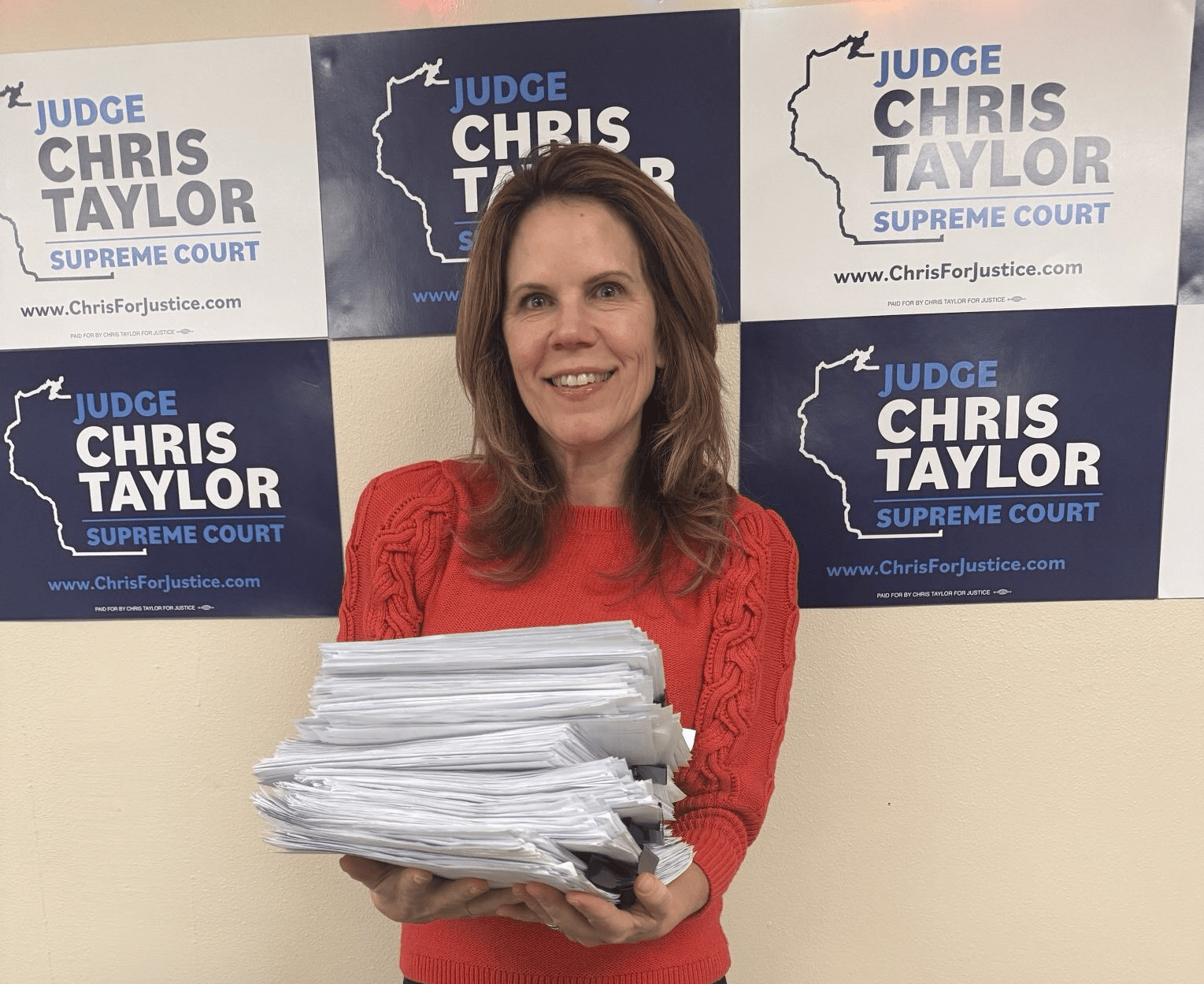
Liberals triumphed in this state on April 7, when Chris Taylor won an open seat by roughly 20 percentage points. Just three years after the liberal faction flipped the court in a hard-fought race, her win extended its majority to a 5-2 edge.
Taylor, an appeals court judge, will replace the archconservative Rebecca Bradley, who chose to retire rather than seek reelection; this locks in liberals’ majority through 2030. As Bolts reported earlier this year, the result may have major ramifications for voting rights given GOP efforts to change how elections are administered.
Wyoming
This state holds retention elections, meaning incumbents face an up-or-down vote.
In a momentous decision earlier this year, Wyoming’s supreme court struck down the state’s abortion ban, ruling that it violated a 2012 ballot measure that affirmed residents’ right to make their own health-care decisions. Ironically, that language was drafted by conservatives who meant it as an attack on the Affordable Care Act, as Bolts has reported.
A justice who joined the majority in that abortion case, Robert Jarosh, is up for retention this fall. He was a longtime lawyer, and former president of the Wyoming State Bar, until he was appointed to the court by Republican Governor Mark Gordon in early 2024.
Another justice, Bridget Hill, is up for retention but did not participate in the decision. She was appointed to the court by Gordon in the spring of 2025; before her appointment, she was Wyoming’s attorney general and defended the abortion ban in court.
What about the 18 other states?
Twelve states never hold elections for their supreme courts: Connecticut, Delaware, Hawaii, Massachusetts, Maine, New Jersey, New Hampshire, New York, Rhode Island, South Carolina, Virginia, and Vermont.
The six other states that do organize judicial contests are simply not holding any this year. Pennsylvania holds its elections in odd-numbered years—and there were plenty of fireworks there last year. In Iowa, Illinois, Indiana, Nebraska, and South Dakota, no seats are up until 2028.
This article has been updated to reflect candidate withdrawals or primary results that took place after publication in Ohio, Utah, and Washington. The article has also been corrected to reflect that one of the two justices in North Dakota has a general election opponent.
Sign up and stay up-to-date
Get timely updates about pressing stories and elections.
Support us
Bolts is a non-profit newsroom that relies on donations, and it takes resources to produce this work. If you appreciate our value, become a monthly donor or make a contribution.